
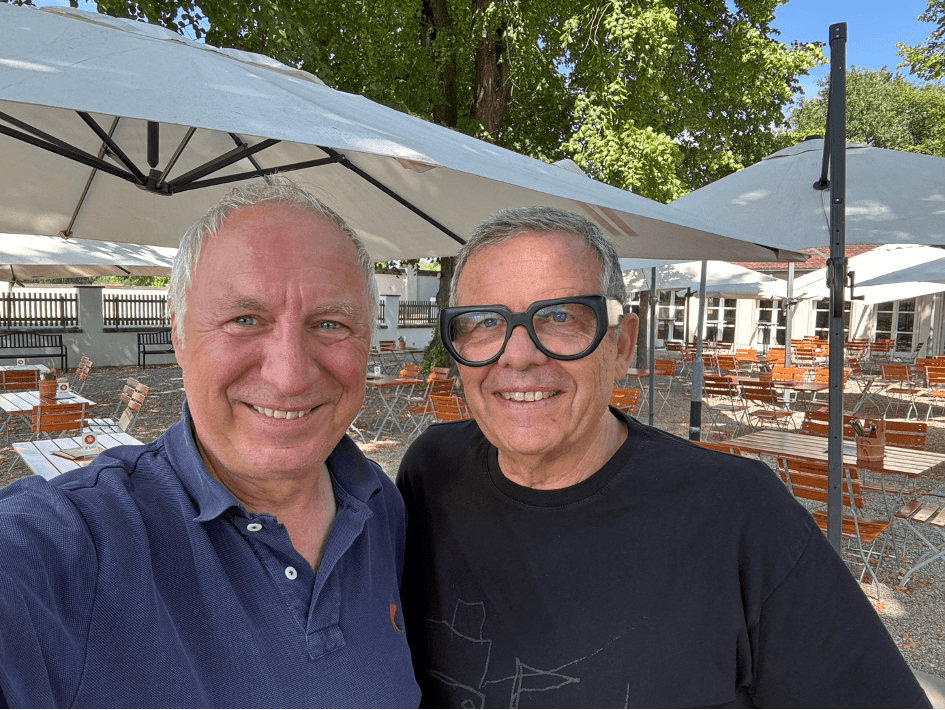
By Wolfgang Huhn
Peter Schreyer’s life’s work has so many highlights that readers of this newsletter have inevitably encountered some of them during their professional careers. He’s the world-renowned former head of design for Audi, Volkswagen, Kia, Hyundai and Genesis. He’s even got a Wikipedia page. Our time at Audi overlapped when Peter and his team created, among other models, the iconic Audi TT and A2. He then moved to Kia. Ferdinand Piech later admitted that letting Schreyer go was a serious mistake.
Hyundai’s chairman, Mong-Koo Chung, acquired Kia when the company were on the verge of bankruptcy. He handed the struggling brand over to his son, Euisun Chung, to turn it around. Euisun’s strategy was to hire renowned designer Peter Schreyer and use cutting-edge design to revitalise the brand. History shows that he more than succeeded. Peter was appointed Chief Design Officer (CDO) at Hyundai and Kia relatively soon after joining the company, taking overall responsibility for design. He was later appointed President, becoming the first – and so far, the only foreigner to hold this position. Every child in Korea knows of him. During that time, he flew back and forth between Frankfurt and Seoul over 250 times (in first class, of course). Massimo Frascella, the current head of design at Audi, used to work under Peter at Hyundai. In a way, this brings things full circle.
He clearly frowns upon today’s headlight and taillight design. There’s too much gimmickry; in some cases, the actual lighting functions – especially the turn signals – are even hidden. Many dynamic turn signals could also be designed to be clearer. Schreyer describes the continuous coast-to-coast taillight and front position light strips as a fashion trend. There’s no discernible improvement in functionality, and they often don’t suit the vehicle. He also has an aesthetic issue with most versions of the illuminated logo. He likes the new turn signal and reverse light projections because they provide additional information in traffic situations.
Early in his time in Korea, Korean OEMs still looked to Germany for inspiration. Back then, premium vehicles almost always had two-piece taillights, so two-piece lights were the Hyundai group standard. It was quite difficult to push through a one-piece light in a model—which he wanted for design reasons—even though the concept was significantly more cost-effective. A designer wants to save costs, which is somewhat unusual, but it would be easy to do today.
After leaving Hyundai and Kia, Peter now runs his own business, providing design consultancy services. He is also a judge in several international design competitions. We hope to win him over for a future DVN Design Competition, too.