
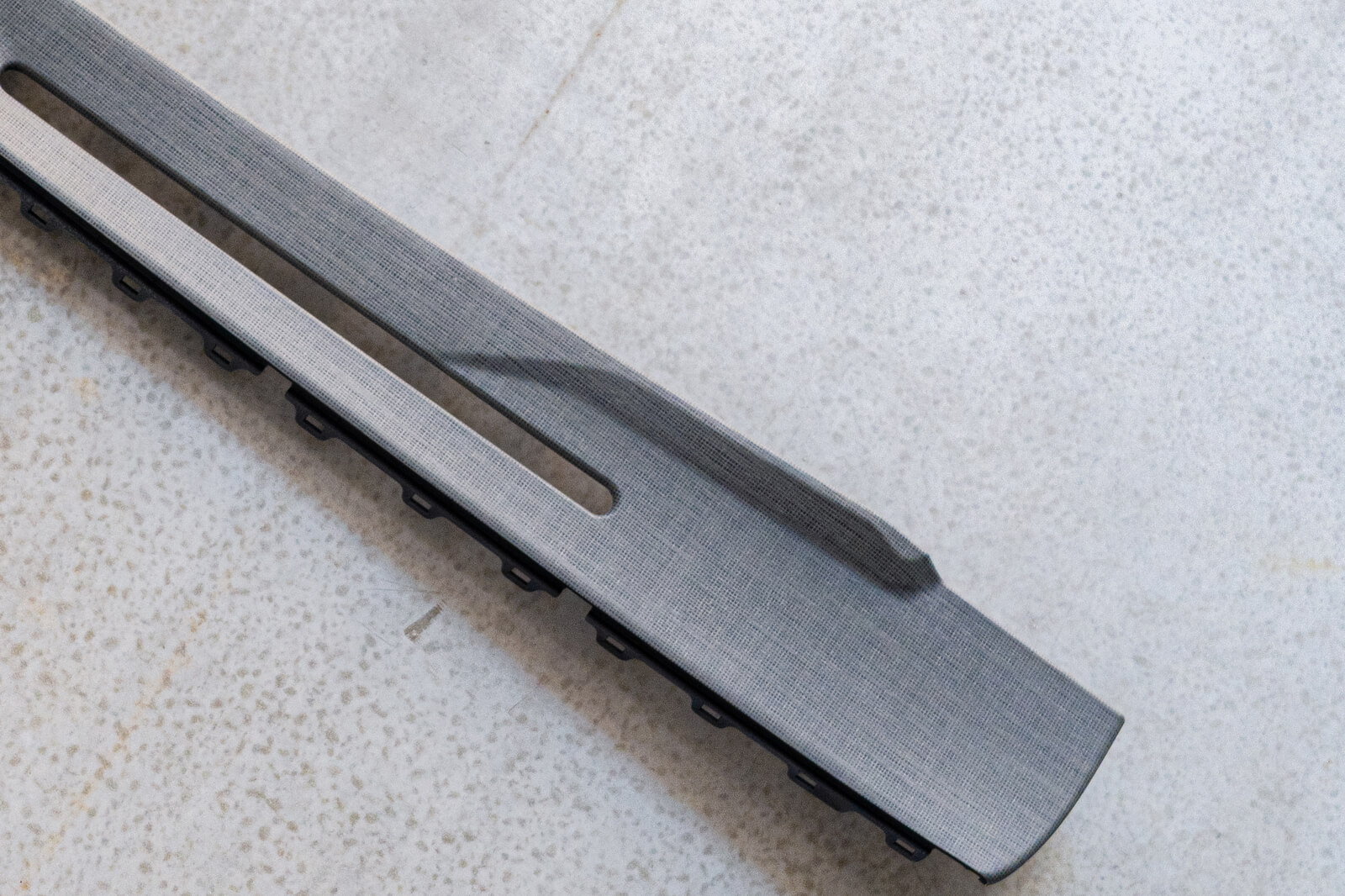
As the automotive industry intensifies its focus on decarbonization, material innovation is increasingly being evaluated for performance, manufacturability, and design value. Natural-fiber composites have long been discussed as an alternative to conventional materials, but questions of durability, consistency, surface quality, and production-readiness have limited their adoption beyond concept vehicles and niche applications.
Through years of development, validation, and industrialization, Bcomp is demonstrating that natural-fiber composites can meet the requirements of modern automotive programs while offering new opportunities for lightweighting, carbon reduction, vibration management, and material expression. In this interview, Bcomp talked with us about technological milestones, engineering realities, and design possibilities driving the ascent of natural-fiber composites for interior and exterior automotive applications.
DVN: Natural-fiber composites have long been perceived as experimental or niche. How has Bcomp worked to change that?
Bcomp: The biggest step was proving consistent performance across the full range of automotive requirements, not just mechanical properties, but repeatability, surface quality, ageing, and manufacturability.
Early on, many OEMs saw natural fibers as interesting prototypes or sustainability showcases. What changed is that we industrialized the material and validated it in real automotive environments. Rather than just creating a fabric, we built a complete solution, including the process knowledge, resin system characterization and surface engineering, and proved it against OEM specifications. Today the conversation has shifted from “can it work?” to “where does it bring the most value?”
DVN: How important was motorsport as a validation platform to boost OEM confidence?
Bcomp: Motorsport played a huge role in accelerating trust and credibility. Racing environments are incredibly demanding. Materials are placed under extreme vibration, impact and temperature, putting them to the ultimate test, and rapid development cycles mean that we could iterate fast.
Once teams and OEMs saw our materials – ampliTex™ technical fabrics and powerRibs reinforcement grid – performing reliably under those conditions, it repositioned natural fibre composites from an experimental solution to a credible engineering material.
Getting new materials into motorsports also means gaining exposure to OEMs, because almost every carmaker also has a motorsports arm. This created alignment internally within OEMs between the engineering, sustainability, and design teams by providing a shared, proven reference point they could all rally around.

DVN: Are there still common misconceptions about natural-fiber composites?
Bcomp: The first is that natural fiber means lower performance or inconsistent quality – we have the data and the production cars to counter that. The second is that the goal is to replace carbon fiber in every application, but this is not the case.
The real value is identifying where natural fiber composites deliver the right balance of stiffness, weight, damping, sustainability, and aesthetics. In some applications, especially visible or vibration-sensitive parts, they bring advantages carbon fiber doesn’t. And the comparison isn’t always against carbon. In thermoplastic applications, we’re replacing injected plastics, decorative films and wood veneer, while remaining fully compatible with existing manufacturing processes.
DVN: How do Bcomp materials compare to carbon fiber?
Bcomp: Carbon fiber still leads when the priority is maximum stiffness at minimum weight, but our materials offer a more balanced package, especially in terms of vibration damping, sustainability and visual appeal.
They also tend to be less brittle than carbon fiber, which is an advantage for crash performance and re-pair ability. In a crash, debris from carbon fiber parts can puncture tires with disastrous consequences. Natural fiber composites won’t, the broken edges are blunt and pose a much lower risk.
And as mentioned, these materials are not just replacements for carbon fiber. In thermoplastic applications, our materials are a direct alternative to conventional interior solutions like injected plastics, films and veneers.
DVN: Are there specific applications where natural-fiber composites outperform traditional ones?
Bcomp: For interior parts, especially decorative thermoplastic parts such as dashboard trims, door panels, center console elements or back seat panels, our materials are already designed for high-volume production and compatible with existing processes, including back injection molding.
For exterior applications, adoption naturally started with premium and performance vehicles as that’s where OEMs tend to move faster on innovative materials. But recent thermoset validations, notably with BMW, show a clear path toward broader industrialization as well.
DVN: What about durability over automotive lifecycles? UV stability, moisture, ageing, surface consistency…?
Bcomp: For interior thermoplastic applications, we already meet the specifications of multiple OEMs across all those parameters. For exterior applications, the thermoset validations with BMW were the critical milestone. Exterior parts face the harshest long-term conditions, and meeting BMW’s standards there is a meaningful proof point for anyone who still has questions about durability.

DVN: Automakers prize sustainable concepts but lag and struggle with series-production integration. How do Bcomp materials comport with existing production systems?
Bcomp: Compatibility was a key focus from the beginning. Bcomp materials integrate into established manufacturing routes for both thermoplastic and thermoset applications. For example, our materials are compatible with the back injection molding processes, which are used for most decorative automotive parts today.
In some cases, the process can even be simplified compared to traditional materials, for example by providing a high-quality visual finish that doesn’t require additional coating steps, which is a direct cost saving.
The idea is not to force OEMs to reinvent production, but to offer more sustainable solutions that fit into existing industrial standards and workflows.

DVN: Are Bcomp materials compatible with high-volume manufacturing? Or are they best suited to premium and performance vehicles?
Bcomp: Both. Premium and performance vehicles often adopt new materials first, but our natural fiber composites have already moved beyond motorsport and are being developed for serial production vehicles. Compatibility with existing automotive manufacturing processes is a key part of that approach, especially for high-volume applications.
DVN: How do you ensure consistent appearance and performance with natural raw materials?
Bcomp: A key reason we work with flax over other natural fibers materials such as hemp is its consistency. However, consistency doesn’t just come from the material itself, but from the full process behind it. We manage and control the process internally, including roving manufacturing, yarn quality, process parameters, resin system characterization. That is what allows us to guarantee batch-to-batch consistency.
DVN: How customizable are aspects like weave pattern, color, translucence, gloss…?
Bcomp: Our materials are highly customizable. We can adapt the weave pattern, color, translucency, texture, gloss level and hybrid finish to support each brand’s identity. This gives design teams the opportunity to create a distinctive visual language and bring a natural identity to visible parts, especially in interior applications. We also support this process with visualization software to help teams explore and refine the final look.

DVN: Are there regional differences in design acceptance?
Bcomp: Yes, definitely. Europe was the first to use these materials for their sustainability and design appeal, and early pioneers like BMW, Volvo and Polestar are still leading the way.
In the US, the growth of electric cars has raised greater awareness of sustainability. A clean car isn’t just about switching from a combustion engine to an electric motor; it extends to the car as a whole, including the interior materials. We have found Asian markets to be extremely demanding in terms of quality. Surface quality expectations are extremely high, and design is very important, so our ability to customize materials has been valuable.
Overall, acceptance is growing across the globe and there is a growing desire to incorporate them, not simply to demonstrate that sustainable materials are being used, but for the benefits they offer, their authenticity and their character, thereby creating a new emotional language.
DVN: How does Bcomp quantify environmental benefit?
Bcomp: OEMs want measurable data over sustainability claims. Rather than component-based assessments, we use full lifecycle analysis to give a complete and honest picture of environmental impact across production, use and end-of-life. Depending on the application, our materials can reduce the cradle-to-gate CO2 footprint of a component by up to 85 per cent.
Lightweighting has a direct environmental benefit too, since less mass means lower energy consumption over a vehicle’s lifetime.
End-of-life is also an important consideration. Unlike carbon fiber composites, which are typically land-filled or incinerated without energy recovery, Bcomp (mono)materials can be recycled or incinerated for energy recovery, recovering value from the carbon stored in the material.
DVN: BMW mentions a CO2E reuction for roof applications of around 40 per cent. Can you walk us through that?
Bcomp: BMW performed a component-level comparison of two parts with similar functional characteristics, using an ISO based life‑cycle assessment (LCA) framework to assess and quantify the differences in CO2 equivalent emissions across cradle to gate lifecycle stages.
The cradle‑to‑gate comparison focuses on emissions from raw material extraction, material processing, and component manufacturing up to the factory gate, applying consistent system boundaries, suppliers’ data, and emission factors to both alternatives to ensure a like‑for‑like comparison.
DVN: Are there still mindset shifts needed amongst OEMs?
Bcomp: Overall, there is a need to broaden the scope of what is possible, moving beyond what has been the norm for many years. For exterior applications, the key shift is moving away from evaluating natural fiber composites as purely as a carbon fiber alternative. They offer a different combination of unique advantages that deserve to be assessed on their own terms.
For interior applications, the path is more straightforward. Our materials are essentially plug-and-play within existing thermoplastic processes. The main technical consideration is UV performance, but that can be overcome.
The bigger shift is simply openness to treating natural materials as a viable, high-performance industrial solution.
DVN: Thank you for shedding light on this intriguing family of materials!


