
By Gerd Bahnmuller, DVN senior advisor
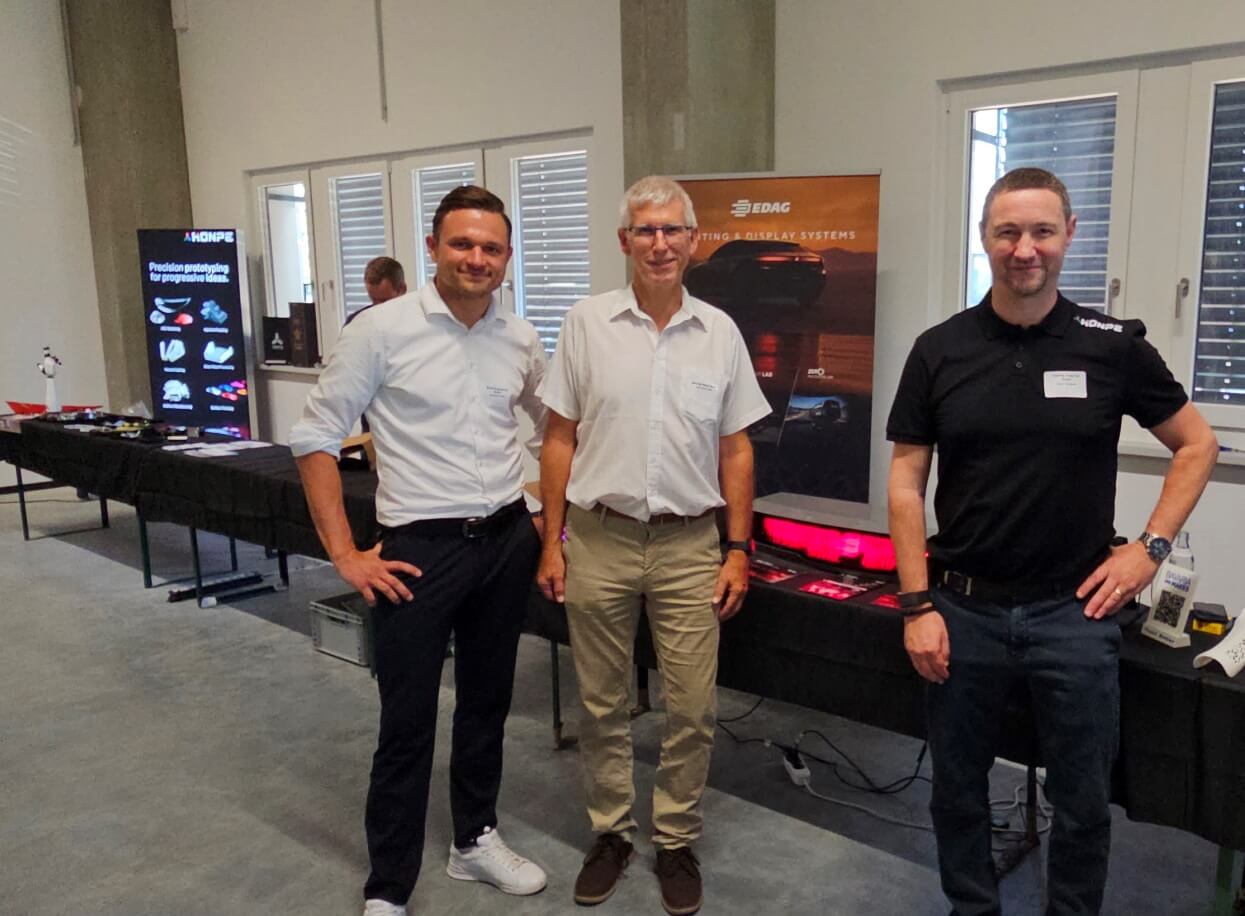
On 26 June 2026, Farsoon Technologies and Honpe hosted HIVE HUB 2026 at Farsoon’s Application Centre in Sindelfingen, Germany. The afternoon event was moderated by Sonja Rasch of Farsoon, and Honpe’s Marco Tscherner, and brought together companies from the automotive, hypercar, motorsport, additive manufacturing, and product development fields.
The objective was to strengthen collaboration amongst companies involved in advanced manufacturing technologies and to promote additive manufacturing (AM) as a key enabler for future vehicle development and low-volume production.
Both organizers are from China. Farsoon Technologies, headquartered in Changsha, are one of the world’s leading manufacturers of industrial laser sintering and metal laser melting systems for polymer and metal additive manufacturing. Honpe, headquartered in Shenzhen, have grown from a prototype manufacturer into an engineering and production partner serving the automotive, aerospace and consumer industries. Their affiliated manufacturing facility, San-E Prototype, located in Fujian Province, currently occupies around 55,000 square metres, with expansion plans aiming for about 150,000 m2. Besides prototype manufacturing, the company increasingly focuses on low-volume production using additive manufacturing technologies.
Around fifteen exhibitors showcased their products and expertise during the networking exhibition. Besides the hosts, companies such as Brose, EDAG, Reichle and several specialist suppliers from tooling, motorsport and bicycle industries presented their latest developments.
The docket had ten concise talks of 10 to 15 minutes each. Brose opened the conference with an overview of the complete innovation process from initial concept to industrial product, including the effective use of public funding programs to accelerate development.
Another noteworthy presentation focused on the practical implementation of agentic AI in small and medium-sized enterprises. Rather than simply purchasing AI software licenses, the speaker emphasized the importance of integrating AI agents into engineering and business processes to achieve measurable productivity gains.
Several presentations highlighted how additive manufacturing has evolved from a prototyping technology into a viable production method for functional components, tooling and customized low-volume applications.
Of particular interest for the vehicle lighting community was EDAG’s presentation of an illuminated vehicle rear-end concept, which was also exhibited during the event. Inspired by flowing lava, the design creates a continuous luminous surface across the entire rear fascia. Developed in cooperation with Magdeburg-Stendal University of Applied Sciences and Nichia, the demonstrator uses arrays of blue LEDs coupled into multiple transparent plastic light guides coated with a red phosphor conversion layer. The concept produces a remarkably homogeneous illuminated appearance. Due to their intentionally diffuse light distribution, however, the prototype currently fulfils the photometric requirements of only the rear position light function, not (yet?) the higher-intensity functions such as stop lamps.

A welcome change of pace came from 19-year-old racing driver Maxim Felix Dacher, who shared insights into his motorsport career. Having progressed from karting into endurance racing, he reported on the importance of engineering, teamwork and continuous technological development in modern motorsport.
The event concluded with guided tours through Farsoon’s demonstration centre, where visitors were introduced to the company’s polymer and metal additive manufacturing systems. Besides serving as a customer demonstration facility, the machines installed in Sindelfingen are also used for benchmarking activities and the production of functional prototypes for industrial customers.
HIVE HUB demonstrated how closely additive manufacturing, digital engineering and automotive innovation are becoming intertwined. The combination of technical presentations, industrial networking and live demonstrations provided valuable insights into technologies that are increasingly shaping future vehicle development and production.


