
Part of DVN’s ongoing RetroReflections series, by DVN Chief Editor Daniel Stern
Lit logos and full-width light bands are trendy; they’ve gained major traction over the last ten years or so. Regulators around the world have grappled with these novel kinds of car lights, and they’ve brought in a variety of requirements, allowances, and prohibitions.
But actually, none of this is new – not the lit logos, not the full-width lights, and not the regulatory patchwork. White front full-width light bars had their day in the sun – er, night in the moon – 40 years ago in North America. Ford’s 1986 Mercury Sable lit the match; between its aerodynamic replaceable-bulb headlamps (still a novelty after Ford’s reintroduction of non-sealed-beam headlamps to the US market for the first time since 1939) was a big plastic bar containing four reflector bowls, each with its own tiny, blacktopped, 8-watt, 132-lumen № 2040 halogen bulb, and a textured plastic lens covering all four:

When the front position lights or headlamps were switched on, the central bar filled up what had traditionally been the radiator grille space with light of brighter-than-position-lamp intensity, and made the Mercury logo visible as a silhouette. This was purely a decorative item; the compliance parking lights were provided by a dim filament in the amber turn signals outboard of the headlamps.


Ford kept the lightbar when the Sable was facelifted for 1991, with much-reduced front light height (enabled by the 9007 bulb, which had axial filaments that allowed for more efficient rectangular headlamps than the previous transverse-filament 9004):


Mercury was a step up from Ford and a step below Lincoln in the FoMoCo brand hierarchy, and the lightbar proliferated across Mercury models as a brandmark. The small Topaz had it:

And so did the Villager, a badge-engineered Nissan Quest minivan (though with the centre section left unlit):
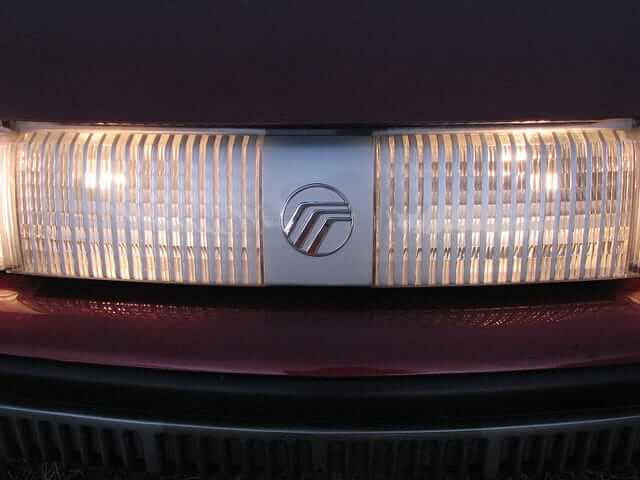
Oddly enough, the top-of-the-line large Mercury Grand Marquis never got a lightbar, and neither did the Cougar personal luxury coupe.
Ford weren’t the only US maker to have a go at conjoining the headlamps with light. General Motors put a front lightbar on their Pontiac Grand Prix for 1990. Depending on the body style and trim package, it was either five W3W bulbs in a row, or the outer left and right chambers and lens areas had № 881 bulbs and fog lamp optics. On the sporty trims, European-type parking lamps (a W3W bulb grommeted into the headlamp reflector) made the lighting truly full-width.

The Pontiac logo maybe didn’t lend itself quite so well as the Mercury logo to a silhouette presentation:


By 1996, all of these front lightbars had been scrubbed off the newest models, and it would be several decades before they would return.
US automakers had a fling with rear full-width light bands in the 1960s. The 1966 Buick Electra 225 had one:

…and so did the ’67 Electra 225…

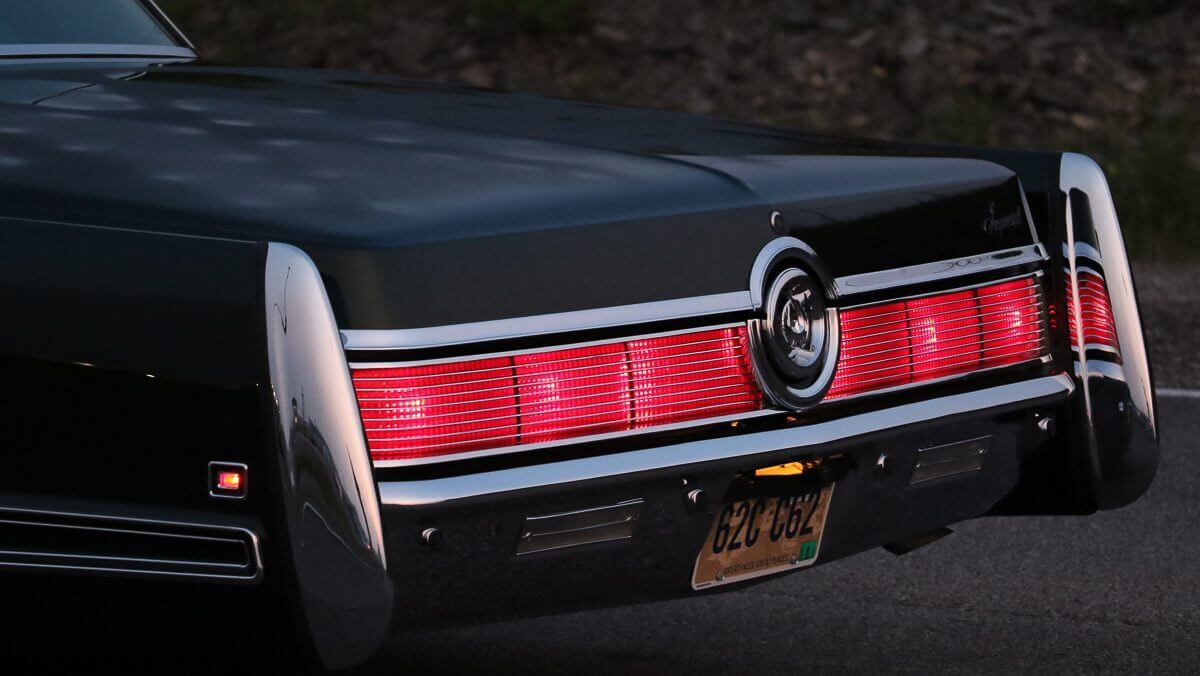
…and Chrysler’s top-of-the-line Imperial for ’67 and ’68 had a big, bold one (note first-year side marker light on this ’68, a requirement imposed because car designs at the time made the taillights invisible from lateral angles):

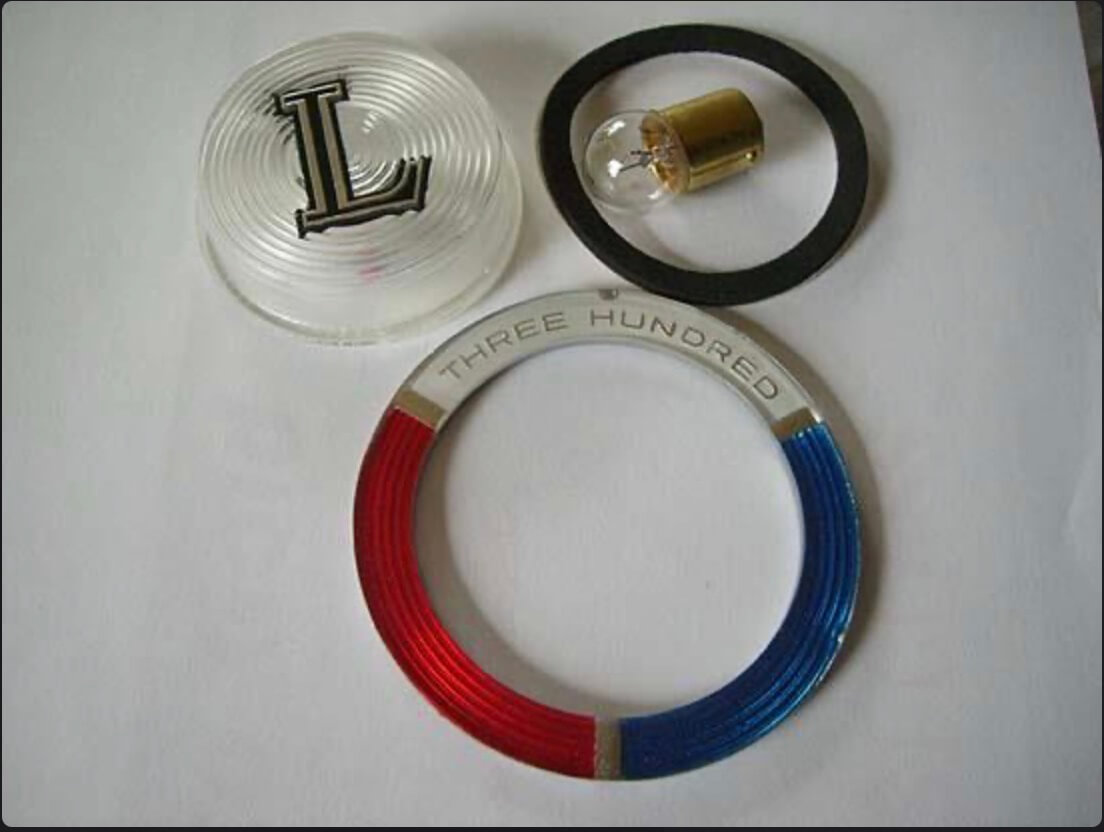
But what that prominent round chrome emblem in the middle of the Imperial rear lightband? It’s not illuminated. For an illuminated logo we have to go back even a few more years, to 1965. That year, Chrysler put an illuminated logo in the middle of the grille on their top-sport 300L model. It consisted of a clear lens with diffusion rings moulded in, a bulb similar to an R5W, and a wire leading to the ignition switch. This logo lit up whenever the ignition was switched on, much like modern lit logos. Here’s the assembly – quite low parts count compared to today’s complex multilayer optics and solid-state light sources:
In situ, it looked something like this – though the owner of this 1965 300L has installed an LED bulb, both brighter and bluer than the original (note quad sealed-beam headlamps behind glass cover lenses; once FMVSS 108 came in for 1968, such cover lenses were banned):

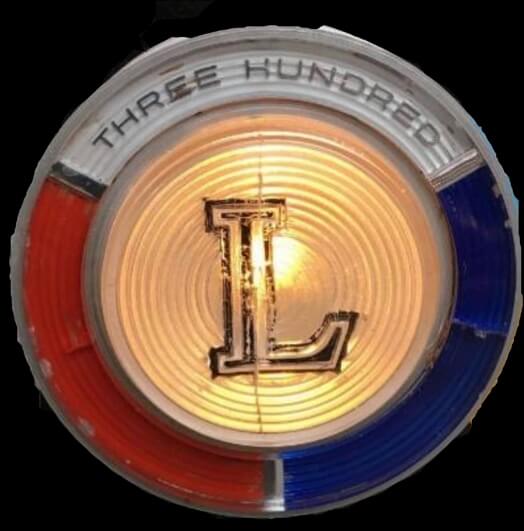
Originally, it would have looked like this, but even the low-watt incandescent bulb, burning nonstop whenever the engine was running, tended to heat-crack the lens:
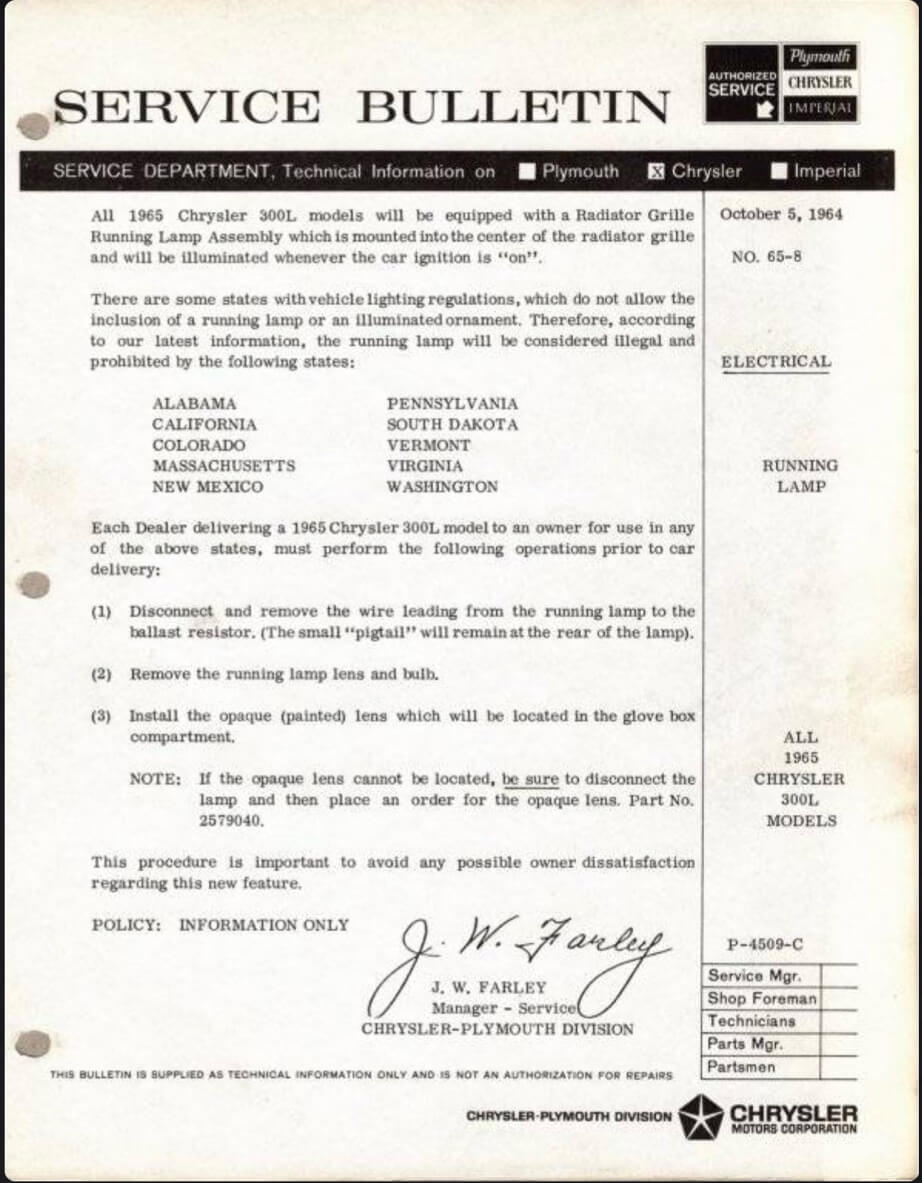
And just like now, regulators didn’t all agree on whether and how lit logos should be allowed. This technical service bulletin advises Chrysler dealers to disable the lit logo and install an opaque lens the maker supplied in the glovebox of the new cars, in case they were sent to a state with regulations which didn’t permit “lit ornaments” or “running lights”:
And so, in all practical senses, what we’re seeing today is not new. The particulars differ – back then it was individual US states objecting to lit logos; now it’s the European Commission raising concerns over the safety of full-width light bands versus discrete left and right position lights with unlit distance between them. What might be the next ‘new’ trend that’s really a throwback and do-over? Time will tell!


