
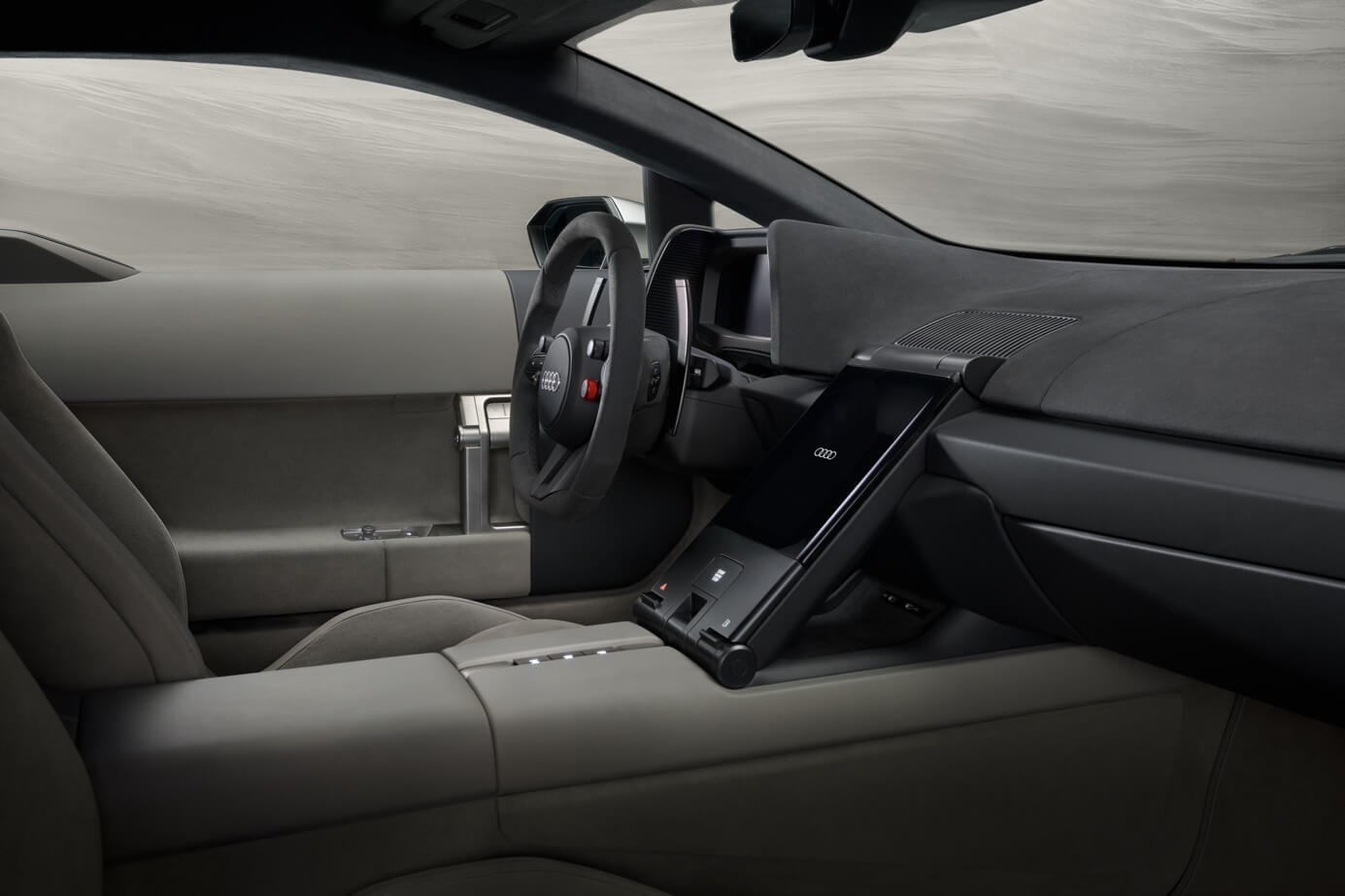
After twenty-five years of design reviews, I have learned that a performance cockpit cannot be judged only while stationary, under the flattering lights of a motor show. It must be judged at speed, when the road demands every available degree of attention and any unnecessary gesture is a distraction.
In high-performance driving, attention is a scarce resource. The driver should never have to negotiate with the interface; there should be no need to wonder where a function is located, whether a display is active, which submenu contains an essential command, or whether a control has really and properly been actuated.
Through this lens, it is interesting and informative to compare the Ferrari Luce, the Audi Nuvolari, and Bentley’s evolving approach, from the Continental GT to the EXP 15. These cars take their own approaches to tackling the question of how to preserve driver concentration when interface-induced hesitation, distraction, or delay cannot be afforded or tolerated.
Ferrari places the gesture at the center of the experience. In the Luce, mechanical resistance and clicks are not frivolous nostalgic references. They allow a function to be identified and executed by feel and muscle-memory, without having to search for it visually. OLED displays create a clear hierarchy; information appears when it is useful, but it does not constantly compete for the driver’s eye.

In the Continental GT, the Bentley Rotating Display allows the driver to choose a 12.3-inch central screen, three analog dials, or an uninterrupted veneer surface. In the EXP 15, the full-width digital dashboard can switch off to reveal wood beneath the glass. Technology remains available, but it no longer demands to be permanently visible.
The Audi Nuvolari centers attentional discipline. With a claimed top speed above 350 km/h, treating the cabin as an entertainment space would be utter folly, and so Audi does not. The dark front section, the information concentrated directly ahead of the driver, the reduced volumes and the controls maintained within the field of vision express a simple conviction: at high speed, the cockpit must support driving, never compete with it.
So Ferrari prioritizes gestures, Bentley controls the presence of the display, and Audi channels attention.
These decisions matter far beyond the supercar segment. As cabins become richer, more connected and increasingly configurable, our responsibility may be less about adding possibilities and more about protecting human attention.
This week, we scrutinize the Audi Nuvolari. Next week, we’ll take a detailed look at the Luce. In the meantime, as always, we’re listening; please feel free to contact Emilie Bonnet or Laurent Sérézat.
Take care,



