
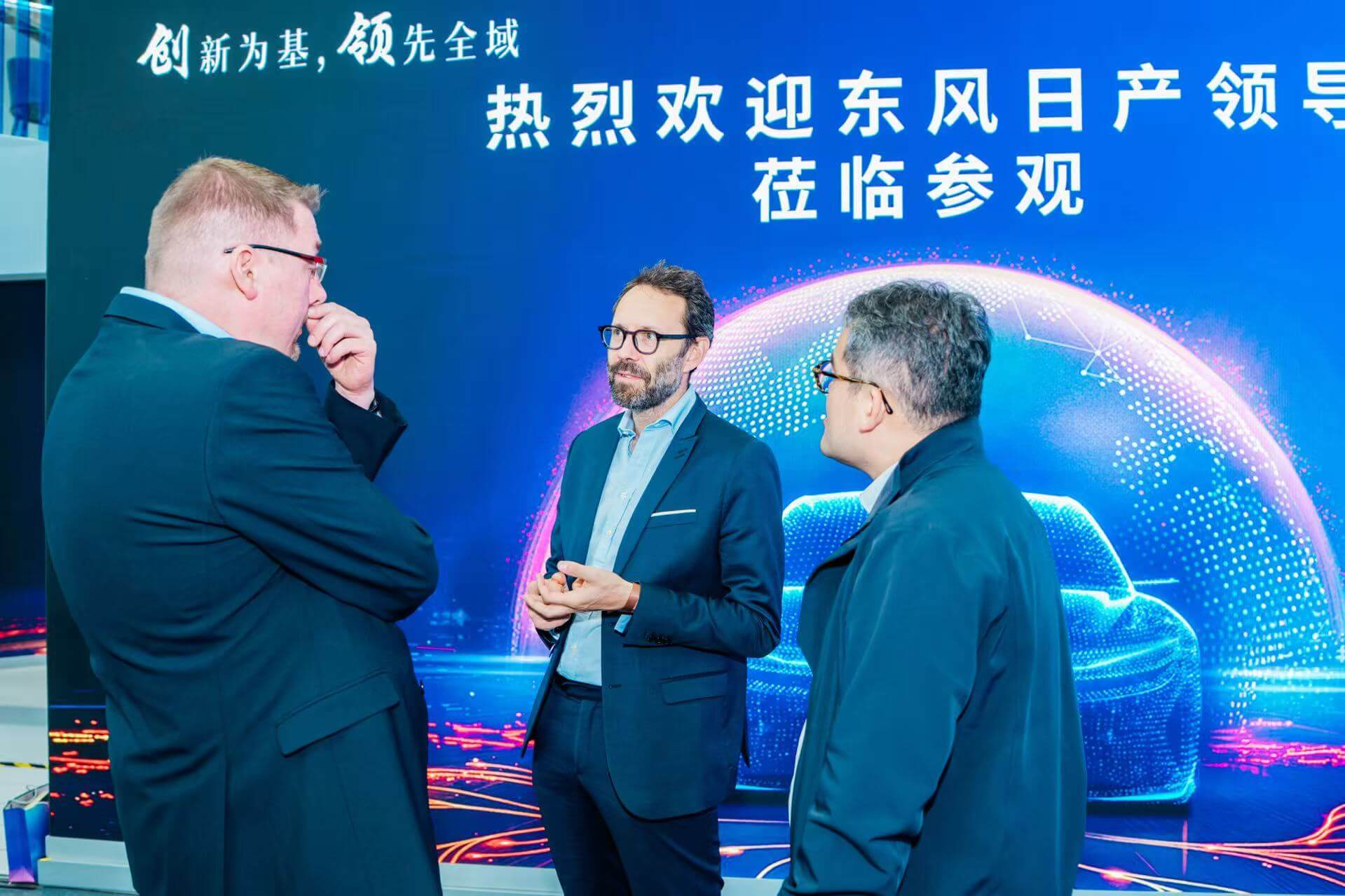
During Auto China, I talked with Marelli Lighting’s Stephan Braun (Head of Innovation) and Peter Cao (CTO and acting CEO). After Xingyu, Valeo, and Forvia Hella, I am happy to publish Marelli’s views about the Chinese market. Over the coming weeks, we’ll bring you more interviews as well as our full report about the Beijing auto show.
Paul-Henri Matha: First off, congratulations on your new role! What do you think of the show this year?
Peter Cao: My deepest impression from this year’s Beijing auto show is that competition in the Chinese automotive market has entered a new stage. The battleground is no longer just about price, but about design expression, technological experience, product definition capabilities, and the ability to quickly translate innovation into mass-production results.
I also observed a very clear trend: an increasing number of innovations are no longer remaining at the conceptual level but are being transformed into product features that consumers can genuinely perceive in a shorter timeframe. This is particularly evident in lighting, cockpit interaction, and intelligent experiences.
For global suppliers like us, the Beijing Auto Show reaffirms that China is not just a vital market but also a crucial frontier driving product innovation and the evolution of development models.
PHM: What trends do you see in exterior and interior design and technology?
PC: Looking separately, a very distinct trend I see in exterior design is the deeper integration of lighting units into the overall vehicle styling itself. Whether it’s ultra-slim profiles, integration, full-width designs, or stronger brand identity, lighting is no longer just a functional component. It has become a crucial element in shaping the vehicle’s overall visual language. Today, more and more OEMs aim to establish a more distinctive brand character through lighting. This, in turn, means that lighting systems need to balance design freedom, engineering feasibility, and mass-production reliability.

A similar transformation is happening in interior design with lighting. It’s no longer just about ambient mood creation; it’s increasingly participating in the cockpit experience, interaction logic, and brand expression. Future interior lighting won’t merely be about illuminating the cabin or adding a sense of luxury. It will be more deeply integrated with displays, sound, surface materials, and software scenarios, becoming part of the entire smart cockpit experience. In other words, lighting is gradually evolving from an add-on element to a component of the HMI and cockpit experience.
From a technological perspective, I believe the biggest change is that lighting is increasingly influenced by software-defined architectures. In the past, we often developed a lamp around a single function. Now, customers are more focused on whether the system is programmable, scalable, and capable of integrating more efficiently with the vehicle’s E/E architecture. For lighting suppliers, this means the focus of competition is shifting. It’s not just about who can produce brighter or more complex hardware, but about who can better integrate design, electronics, software, control, and system integration.
So, to summarize, I would say the industry is moving from innovation of individual components to system-level experience innovation. In this process, true competitiveness comes not just from possessing a single technology, but from the ability to combine design expression, interactive value, and mass-production capability.
PHM: Interior lighting is becoming more and more important. Cupra just launched interior DLP projection on their Raval’s door trim. What do you see in interior projection?
PC: I believe interior projection is a very promising development direction. It moves lighting from static effects towards dynamic content expression, and gives cockpit lighting greater potential for interaction and personalization.
However, from an industrialization perspective, we need to break it down. The value and maturity path differ depending on whether it’s used for decoration, information cues, or immersive interaction.
DLP projection’s advantages lie in content flexibility and rich visual expression. But its wider adoption depends on cost, packaging space, thermal management, brightness performance, and – crucially – whether it creates genuine user value when integrated with the vehicle’s HMI system. Therefore, I’m inclined to believe that interior projection won’t simply replace traditional ambient lighting in the short term. Instead, it will complement existing solutions in certain high-value scenarios. The most critical question isn’t “can it project?” but “is the projected content truly meaningful?”.
PHM: What other trends do you see for interior lighting in China?
PC: In China, I think the most noticeable change in interior lighting is its gradual shift from a decorative function towards functional and interactive experience enhancement.
In the past, it was understood more as ambient lighting. Today, it’s increasingly linked to functions like driving modes, ADAS status, welcome scenarios, charging status, and in-cabin theme switching. Its role has expanded from looking good to being perceptible, interactive, and expressive.
Another trend is the increasing systematization of interior lighting layout. It’s no longer confined to a single light strip. It’s progressively forming a more complete cabin lighting experience, extending from the instrument panel and door panels to footwells, seats, and the headliner.
I believe Chinese OEMs are driving this particularly fast because the Chinese market has a high acceptance of perceptible innovation. As long as a technology can create a clear experiential difference, customers are willing to try and implement it more quickly.
PHM: What about E/E architecture for interior lighting? Is LIN still the standard, or do you see new protocols coming? Should there be a single standard protocol? If so, how is that best pushed for?
PC: I believe that currently, LIN remains a very realistic and viable mainstream solution, especially in many cost-sensitive applications with relatively clear functional boundaries. It still holds strong competitiveness.
However, as interior lighting becomes more dynamic, programmable, and deeply coupled with domain controllers and the vehicle’s E/E architecture, we are indeed seeing new solutions with higher bandwidth and stronger synchronization capabilities emerging.
Personally, I don’t believe the future will necessarily be dominated by a single protocol unifying the landscape. A more likely scenario is that applications of different levels and complexity will adopt different communication architectures. Mature and cost-effective solutions will continue for basic functions, while new architectures will gradually develop for more complex applications emphasizing dynamic content and system-level interaction.
From an industry perspective, I do think a degree of standardization is needed. However, what’s perhaps more important than enforcing a single protocol is improving compatibility at the level of interfaces, functional definitions, and system integration. For OEMs, the ultimate priority isn’t the protocol name itself, but whether it can support scalability, development efficiency, cost control, and platform reuse.
PHM: For exterior lighting, RGB DLP was on main stage at ALE. Is it really going to compete with microLED?

PC: I don’t think this question can be simply understood as a contest between RGB DLP and microLED to see who wins, as they don’t entirely solve the same problems, and may not necessarily compete on the same mass-production path.
Looking at technical characteristics, RGB DLP’s advantages typically lie in its flexibility for content expression, dynamic capabilities, and external communication attributes. It’s more suited for applications emphasizing high-freedom projection, graphic expression, or a sense of interaction. In contrast, microLED shows highly notable strengths in resolution, integration potential, efficiency, and its potential for mass-production scalability in future high-performance lighting and some premium applications.
Therefore, I’m more inclined to believe that the industry won’t see a single technology emerge victorious in the coming years. Instead, different technologies will develop in parallel for different application targets. For scenarios emphasizing interaction, dynamic display, and experiential expression, RGB DLP may demonstrate its unique value. For directions prioritizing system integration, efficiency, reliability, and long-term, scaled implementation, microLED also holds clear appeal.
In the automotive industry, whether a technology becomes mainstream is never determined solely by how eye-catching it is in demonstrations. The decisive factors are cost, regulations, reliability, manufacturability, and whether it can deliver scalable value to OEMs. Many technologies are impressive at shows, but whether they can truly enter platform development and sustained mass production is a different test altogether.
So, I believe rather than asking which technology will become the sole mainstream, we should ask: under what product goals, regulatory conditions, and cost structures is which technology more suitable for adoption? For us, what’s more important isn’t championing one specific technology, but providing viable, implementable solutions based on different customers and different application scenarios.
PHM: What about exterior display with mini- or microLED? We see fewer and fewer cars with this feature. Too expensive…?

PC: Cost is certainly a significant factor, especially in the current fiercely competitive market environment, where OEMs are more cautious in evaluating the return on investment for every new feature.
However, I don’t think it’s the only reason. For exterior display functions, the industry also needs to consider regulatory compliance, reliability, durability, visibility in complex environments, and whether it creates sufficiently clear value for users and the brand.
What we’re seeing now isn’t necessarily a rejection of this technological path, but rather the market going through a filtering process: identifying which functions are truly meaningful and can be retained long-term, versus which are more demonstrative experiments.
I believe this direction will continue to exist in the future, but it will evolve towards a more rational cost structure, clearer application scenarios, and forms that are easier to mass-produce and gain regulatory acceptance. For suppliers, the goal isn’t to put the most complex display on the vehicle, but to find solutions that are truly platformable, replicable, and acceptable to the market.
PHM: You develop for European and Chinese OEMs. The pace of development in China is blisteringly fast; What are the other differences?
PC: I believe Marelli’s ability to achieve relatively fast product development in China isn’t just because the team works faster. More importantly, we’ve established a systemic capability that supports rapid development. For me, real speed isn’t about one project sprinting quickly for a short time. It’s about maintaining pace, quality, and delivery certainty even when managing multiple parallel projects and constantly changing customer requirements.
Several key points are crucial here. First, we can engage earlier in the customer’s front-end definition phase. A characteristic of today’s Chinese market is that many product opportunities and requirement changes occur very rapidly. If a supplier only gets involved after specifications are frozen, they often miss the most critical stage. We prefer to engage earlier, discussing design targets, system architecture, cost targets, and mass-production paths with the customer. This builds speed in the right direction from the start, avoiding rework later.
The second point is closer collaboration between the local engineering team and the local supply chain. The fast development pace in China isn’t just due to demanding customer timelines; it’s also because a very complete industry chain exists here. For a system product like lighting, speed cannot come solely from the R&D department itself. It must come from high-frequency, highly efficient collaboration between optics, mechanical, electronics, software, project management, manufacturing support, and the supply chain. What we are continuously building in China is precisely this end-to-end collaborative capability.
The third point is our continuous effort to enhance platformization and module reuse. Many people equate fast with allocating more resources or accelerating the pace. But in the long run, truly sustainable speed must be built on a foundation of reusability, scalability, and rapid adaptability. In other words, we don’t start from zero for every project. We continuously build a repository of modules, methodologies, and system capabilities, enabling the team to respond more efficiently to different customer needs.
Comparing Chinese and European OEMs, I’d say they aren’t about which is better, but about different development cultures. Chinese OEMs typically operate at a faster pace, are more sensitive to user-perceivable innovation, and are more willing to iterate quickly during the product definition phase. They pay close attention to whether a technology can quickly create differentiation and be directly perceived by users, while also heavily valuing development efficiency and time-to-market. European OEMs usually have higher demands in terms of process maturity, system rigour, and long-term stability. They often have very clear systemic requirements for front-end definition, verification logic, and platform consistency.
For a global tier-1, truly valuable capability isn’t adapting to just one type of customer rhythm, but combining the speed of China with global engineering robustness. I believe this is also the significance of our continuous team capability building in China. China is not only an important market but also a very important competency base. What we are accumulating here isn’t just local delivery experience, we are building a comprehensive capability that supports rapid innovation, global collaboration, and long-term mass-production stability.
PHM: How big is your team in China?
PC: In China, we have a substantial team, currently with over 1,700 employees. This team covers key competencies including R&D, engineering, optics, mechanical, electronics, software, project management, manufacturing support, and supply chain collaboration.
I want to emphasize that this isn’t just a team supporting local business; it has essentially developed comprehensive end-to-end capabilities. Precisely because of this, we are not only better equipped to serve Chinese customers but can also consistently export a portion of the China team’s capabilities to our global operations.


