
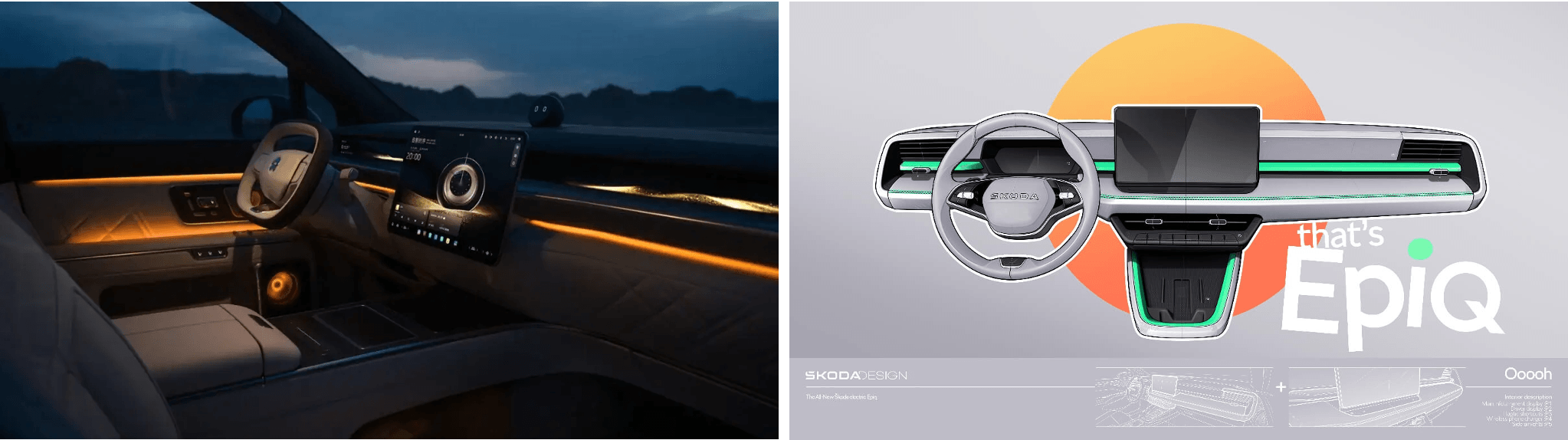
I wonder whether we have underestimated light for the last twenty years.
For a long time, in the automotive interior we talked about soft-touch plastics, leather, textiles, satin chrome, wood décor, tactile quality, and piano-black sometimes too much. Light often came later. A line here, an ambient element there, a signature to make things feel modern. Then Milan reminded us of something obvious: light is no longer an accessory; it is becoming a material.
During the discussions at Milan Design Week, this idea of light as the ‘fourth material’ really stayed with me. Not because it is poetic (although it is), but because well-designed light changes the perception of volume, reveals or hides a grain, gives value to a simple surface, calms down an overloaded interface, and facilitates warning without alarming. It connects CMF, HMI, safety, emotion, and brand.
The China/Europe divergence is fascinating: Chinese OEMs, perhaps Nio most of all, consider the EV cabin as nor just a driving position but a stage, a living space, a ‘connected refuge’. The Nio ES9 pushes this logic hard with its Sky Island, sound environment, displays, adjustable privacy, and almost theatrical rear comfort. This is coherent, confident, China-speed fast…and not really in accord with European priorities and customs.
Europe has a more subtle culture of balance. Consider the Škoda Epiq, configured almost opposite to the ES9: less effect, more readability; less demonstration, more usage. Restraint like this is a strength, in context of screen-fatigue. Of course, simplicity must not be conflated or confused with slowness.
What Milan whispers to European OEMs is that their creativity is not dead or irrelevant. It still flows between architecture, furniture, automotive, lighting, craftsmanship and interface. What China shouts is that a good idea no longer waits three program cycles before meeting a customer.
And that is exactly the gap we look at this week.
Questions, comments? Contact Emilie Bonnet or Laurent Sérézat.
Take care,



