By Hannah Pauline Droste, Volvo Cars
The transition from a linear to a circular economy is an essential yet slow process, with increasing urgency driven by global commitments such as the 2015 Paris Agreement. As defined by the Ellen MacArthur Foundation, the circular economy seeks to eliminate waste and regenerate natural systems by prioritizing practices such as recycling, reuse, and refurbishment. In line with these principles, Volvo have committed to achieving net-zero emissions by 2040 and incorporating 30 per cent recycled content in their vehicles by 2030. This thesis explores how circular economy principles can be integrated into the exterior lighting, focusing on identifying the barriers and opportunities within these products.
The background outlines four areas relevant to Volvo Cars exterior lighting and circular economy integration: functions, literature, damage data, and legislation. Exterior lighting serves both safety and design purposes, but current design trends challenge sustainability. Literature shows that design-phase decisions strongly influence a product’s footprint, yet plastics and electronics remain difficult to recycle, partly because OEMs are detached from end-of-life treatment. Finally, upcoming EU regulations, especially the new end-of-life vehicle (ELV) regulation, will introduce stricter requirements such as recycled material quotas including recirculating plastic from ELV and product passports, directly impacting automotive lighting design and production.

The methodology for this study focuses on evaluating the circularity of current exterior lighting products through circularity analysis and expert interviews. The CE Designer platform was used to assess the sustainability of existing lighting products. Several strategies, particularly those related to extending product lifecycles and enabling remanufacturing, revealed significant room for improvement. A key issue identified is that the outer lens of lighting units is permanently attached to the housing, making repairs impossible and forcing the entire lamp to be discarded and shredded, resulting in inefficient recycling.
Interviews with experts revealed a strong desire to improve sustainability, although there was uncertainty about where to start. Some experts pointed to design flaws, while others identified cybersecurity software limitations as a barrier to reuse. The lack of effective tools for assessing sustainability impacts at the product design stage was identified as a major challenge.
The analysis identifies three main barriers to sustainable exterior lighting: inadequate design for disassembly, cybersecurity software that prevents reuse, and high power consumption caused by current design choices. Although legal requirements and those of Volvo Cars define performance targets, they may allow for more sustainable approaches. However, existing standards and practices often overlook these. While new sustainability requirements are necessary, excessive regulation could hinder progress and prevent the adoption of circular economy principles. A simple study showed that design features like inner filters and curved lenses significantly increase energy use, while glued or welded outer lenses prevent repair or recycling. Potential solutions include removing ECUs to bypass VIN-locking, reducing energy demands through optimized optics, and exploring alternative attachment methods.
The follow-up actions stress that achieving a circular economy in vehicle lighting requires collaboration across the value chain, regulatory support, and design changes. The proposed path forward involves short-term goals like making products recyclable, medium-term steps such as adapting supply chains and recycling methods for plastics and electronics, and long-term ambitions like removable outer lenses and leading to full circularity. While the transition is complex and often unclear, regulations like the ELV regulation proposal and product passports provide momentum, and gradual, practical steps can drive progress toward sustainable lighting solutions.
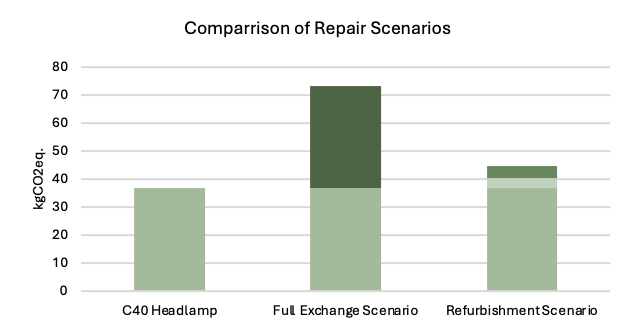
An interesting takeaway from the study is the comparison of the repair scenarios between a new and a remanufactured lamp in kgCO2eq below (exercise done on C40 Headlamp with a 9,000-km logistic scenario for a lens replacement):