
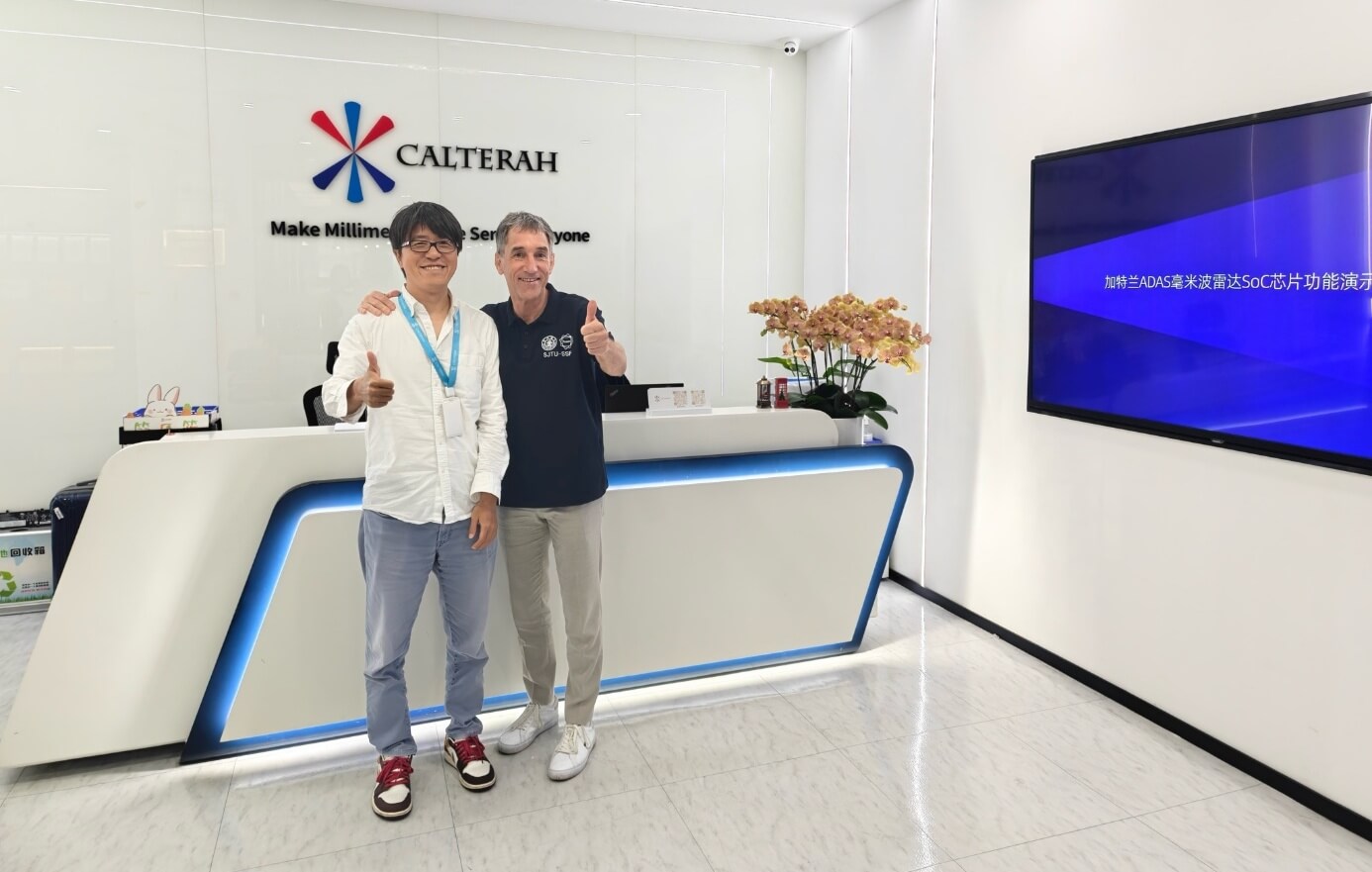
The latest of our interviews with key companies and personalities in ADAS/AV and dual-use sensors, in the runup to our DVN Sensing & Applications Conference on 17 – 18 November in Stuttgart.
Calterah is vigorously active in the Chinese semiconductor/MMIC industry. They have successfully made the jump from a startup to a successful supplier, and founder and CEO Dr. Jiashu Chen talked with us about his company’s activities, results, and plans.
DVN: Hello, Dr. Chen! Let’s jump right in: how has Calterah’s product portfolio evolved, and how do you plan to position Calterah in the ADAS radar market?
Dr. Jiashu Chen: Compared with two years ago, Calterah now has a much more comprehensive radar chip portfolio. We cover both 77- and 60-GHz frequency bands. The 77-GHz portfolio is mainly targeted at exterior sensing, including entry-level corner radar, high-performance corner radar, front-corner radar, front radar and entry-level imaging front radar. The 60-GHz portfolio is mainly targeted at in-cabin sensing applications.
On the 77-GHz side, we support different platforms and channel configurations. We have 40- and 22-nm platforms, and the portfolio ranges from 2T4R devices for entry-level corner radar to the widely adopted 4T4R devices for corner and standard front radar applications. We are also announcing 5T4R and 6T6R devices, which are designed more for front radar in L2 applications, especially to meet the latest L2 ADAS GB requirements in China and the more stringent global NCAP requirements.
For in-cabin applications, we already have 4T4R and 6T6R 60-GHz devices in volume production, mainly for CPD. The 6T6R device, which we announced two years ago, has already secured more than ten OEM brands for in-cabin CPD applications. Overall, I would say Calterah has one of the most comprehensive millimeter-wave radar portfolios in the market, covering the main requirements in China and globally.
DVN: So the current focus is mainly L2 and L2+?
Dr. J.C.: Today, our chips are mainly used from entry-level L2 up to advanced L2+ applications. That is the mainstream and the high-volume market. We also offer what we call entry-level imaging radar solutions, for example by cascading two 4T4R SoCs to form an 8T8R imaging radar. With two 6T6R devices, the concept can evolve toward a 12T12R configuration.
So, we do have an offering for entry-level imaging radar. However, the market demand for imaging radar today is still relatively small. The major demand remains in L1, L2, and L2+ applications.
DVN: Do you expect a meaningful increase soon in L3 or L4 functionality in privately-owned cars?
Dr. J.C.: Some OEMs are certainly experimenting with L3. Mercedes-Benz is a clear leader in this area, and there are also several Chinese OEMs testing L3 vehicles. For L3, we expect the vehicle to need more sensors, including more radar sensors, probably five to six radar sensors in total, and each sensor will need to become more capable.
A minimum configuration would likely start at 4T4R, but we expect an evolution toward 6T6R. For the front radar, the requirement would probably be at least 12T12R or above. That said, in the next five years we still expect the number of true L3 passenger vehicles to remain quite limited.
DVN: Today, L4 is confined to robotaxi fleets. Private-car applications would need high-resolution imaging radar, beyond 24T24R – right?
Dr. J.C.: Yes, for that kind of L4 application, a real imaging radar would typically need to go beyond 24 by 24 channels.
DVN: Are the high-end imaging radar segments a business opportunity for Calterah, or do you see it as a niche market best left to others?
Dr. J.C.: At least for now, Calterah is focused primarily on the mainstream ADAS market. That is where we see solid demand, high penetration, and very large volumes. In China, the penetration rate is moving toward 60 to 70 per cent in many segments, so the market opportunity is substantial. This is also the area where we believe our devices are very competitive compared with alternative solutions.
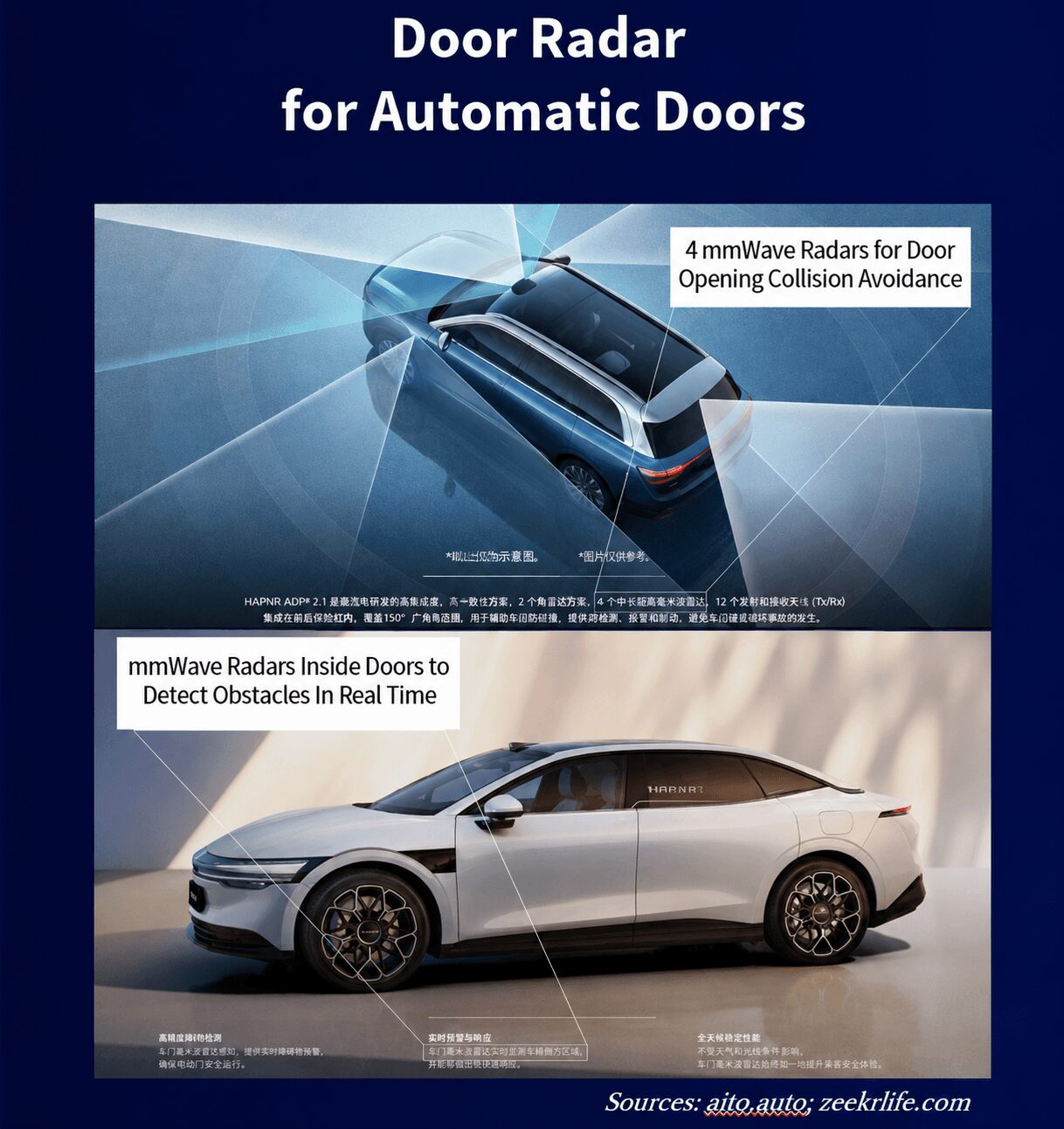
Another important focus is the emerging short-range radar market. In addition to the applications I mentioned earlier, we also offer 77-GHz ultrashort-range devices for door radar. We see increasing demand for door radar in China, especially in premium EVs with automatic doors. Each door can be equipped with an antenna-in-package 77-GHz radar sensor. This is a unique product area for us, and we do not see many competitors offering the same type of device today.
For high-end imaging radar above 24 by 24 channels, we are still studying the market and assessing the technology. We already have entry-level imaging radar offerings such as 8T8R and 12T12R, but we do not currently have a product plan for 24T24R and above.
Today, the performance-to-cost ratio of massive MIMO radar is still not attractive enough for most OEMs, especially as lidar costs in China are also decreasing rapidly. For massive MIMO radar to reach high-volume adoption, further technology breakthroughs are still required.
DVN: Lidar creates additional vehicle-level cost and complexity: cleaning, packaging, styling constraints, integration location, and other measures needed to guarantee sensor function, especially at higher automation levels. So even if lidar unit prices keep falling, the average vehicle-level cost may remain much higher than the sensor price alone suggests. Radar doesn’t need the same infrastructure, which could mean more opportunity for L3 and L4 applications, if radar performance improves. Historically, especially in China, radar often lost out to lidar because the radar performance wasn’t competitive. But with higher channel counts and much stronger silicon and signal processing, even lower Tx/Rx configurations could become much more competitive. Do you agree?
Dr. J.C.: Exactly. That is the direction in which radar has to improve, if it wants to unlock more value in higher-level ADAS and automated driving systems.
DVN: How do you see radar – lidar competition developing over the next few years?
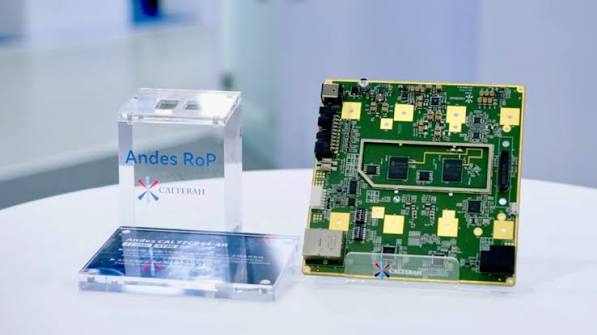
Dr. J.C.: In the devices we are announcing, such as the 5T4R Kunlun-Pro and the 6T6R Andes-Pro, the increase in channel count is only one part of the improvement. A major part comes from signal processing. Even with the same number of channels, our new signal-processing hardware can significantly improve detection capability.
We believe there is still a lot of potential in radar that has not yet been fully utilized. Even with a 4T4R device, we see clear capability improvements through better pre-processing and post-processing. When more channels are added on top of that, detection capability improves further. At the same time, single-chip integration and increasing volumes are driving radar sensor costs down to a very attractive level. Among the three major sensor types, radar is probably already the lowest-cost option.
This gives radar a very strong performance-to-cost ratio. As you said, traditional radar also requires very little additional infrastructure in the vehicle. There are fewer packaging, cleaning and integration constraints than with optical sensors. lidar and camera are both optical sensors. One passively receives light and the other emits light and receives reflected light, but their fundamental disadvantages are similar. Under difficult weather, lighting or occlusion conditions, including non-line-of-sight cases, radar remains necessary. That is why radar is still required for AEB, NCAP, and GB requirements, regardless of lidar adoption.
DVN: Does this change when we talk specifically about true imaging radar beyond 24T24R?
Dr. J.C.: For imaging radar, there is more direct competition with lidar. Today, a high-end imaging radar can cost up to ten times as much as a mainstream single-chip ADAS radar. At that cost level, OEMs naturally ask whether the sensor really delivers a ten-times improvement, or whether it can replace a lidar sensor.
The key point is that OEMs need radar anyway. It is very difficult to imagine a vehicle using lidar but no radar at all. However, it is possible to imagine a vehicle using radar without lidar. Therefore, the real question for OEMs is this: if the imaging radar is powerful enough, can the lidar be removed?
DVN: In interviews with Pony and other software-stack builders, they said some side-looking radars could be removed because side-looking lidar could solve the respective perception tasks. They didn’t provide details on the safety case, but this was a concrete example of lidar replacing radar. For L2 and L2+ outside China, the business case seems clear: vision and radar are sufficient, and there is usually no technical need for lidar.
The question is bigger at higher automation levels. In my previous role, the main debate was often with legal and safety-case teams rather than technical teams. They wanted a third sensing modality, with camera and radar as the base and lidar as the third sensor. Lidar had the stronger point cloud then, but with real imaging radar and higher Tx/Rx counts, radar point-cloud density and use-case coverage can become strong enough to support object fitting and trajectory estimation. If radar data is centrally processed and different sensor inputs can be treated with statistically independent algorithms to support an ASIL-D safety argument, maybe lidar is no longer needed.
But robotaxi companies may define the reference sensor setup for higher automation. If regulators accept a robotaxi sensor architecture as a blueprint for a global safety case, suppliers included in that setup are well positioned, and others coming from L2++ toward L3 or L4 may be forced to follow that blueprint. What do you think?
Dr. J.C.: I think the use cases and target applications for robotaxis and passenger cars are still quite different. A robotaxi is designed to replace the driver and operate by itself, but it can also be limited to specific operating domains. If the conditions are not suitable, it can stop operating. A privately owned passenger car is different. When customers buy such a car, they will not accept too many limitations on when driver assistance or automation can be used.
I agree that lidar provides a rich point cloud and can make some autonomous-driving functions easier to achieve. However, lidar remains an optical sensor, and optical sensors have inherent disadvantages under certain conditions, such as bad lighting, bad weather and fog. These limitations cannot be fully removed by software.
For passenger vehicles, the main objective is often not simply to mimic a human driver. The objective is to make the vehicle safer, reduce collisions, and reduce traffic accidents. For that, you need a sensing modality that is different from human eyes. That is why I do not think the L4 robotaxi path will necessarily define the sensor architecture for passenger vehicles. The two roadmaps may not fully converge, because they solve different problems and deliver different value to different customers.
If the goal is only to mimic an experienced driver, then an optical-sensor-based approach may be sufficient in some scenarios. Tesla relies mainly on image sensors, and some Chinese OEMs also choose not to install lidar. But to make the vehicle safer and to pass stringent regulation, NCAP and GB test conditions across weather, lighting and complex road scenarios, radar remains an important part of the sensor set.
DVN: And in that context, how do you see the specific role of radar?
Dr. J.C.: radar plays a critical role because it is fundamentally different from the human eye and from optical sensors. It adds another dimension of safety to the system. With radar, you get range, velocity and in some cases non-line-of-sight information under all-weather conditions, and you can obtain that information at a very competitive cost.
For that reason, it is difficult to make a strong technical case for removing radar. Imaging radar certainly has potential, but in my view it is not fully there yet as a broad lidar replacement. Either the cost is still too high, or the sensor is too bulky for high-volume passenger-car applications. Eventually, imaging radar may become much stronger, but more technology breakthroughs are needed.
DVN: The number of deployed vehicles is the relevant market potential for radar suppliers. Robotaxi fleets are growing, but when do you expect a significant jump in real robotaxi fleet volumes, not just in the general robotaxi business narrative?
Dr. J.C.: That is a very difficult question. Our business focus is clearly on passenger vehicles and the mainstream high-volume market. We pay relatively less attention to robotaxis, because today the volume is still quite small. My expectation is that robotaxi deployment will continue to increase gradually, but I do not expect a dramatic jump in adoption in a single year, or before 2035.
DVN: To be clear: you do not expect rapid large-scale growth of robotaxi fleets before around 2035?
Dr. J.C.: Most likely, yes. The pace is closely linked to real market demand for robotaxi services. Looking at China, and I admit this is anecdotal rather than a formal data set, conversations with ride-hailing drivers suggest that demand is not obviously exceeding supply. Some drivers say it is becoming more difficult to secure orders than it was five years ago.
DVN: How come?
Dr. J.C.: One reason may be that the pool of ride-hailing drivers has increased. When I talk to DiDi drivers, they do not usually say that demand is rising strongly or that their revenues are increasing. On the contrary, many say that it has become more challenging to find enough orders.
This is not a technology argument, but the demand-and-supply equation matters. If there is not a strong shortage of mobility supply, that also affects how quickly the robotaxi business can scale.
DVN: Calterah’s growth curve is impressive, both within and outside China. What’s driving it?
Dr. J.C.: First of all, we are a very innovative company. Calterah was among the first companies to introduce standard CMOS 77-GHz radar chips, and we have demonstrated several world-first technologies in this space.

This includes CMOS radar chips, antenna-in-package radar chips in volume production for door radar and in-cabin sensing, the first 4T4R SoC, and later the first 6T6R SoC.
We were also among the first to introduce a comprehensive radar signal processor that does not require an external DSP. Many competitors still need a DSP to perform part of the pre-processing. In our architecture, the pre-processing can be handled by dedicated processors and hardware accelerators. We also introduced a full signal-chain hardware accelerator for radar.
In short, we are an innovator in millimeter-wave radar. This helps us reduce total sensor cost, lower the development barrier for customers, and shorten time-to-market. That is one of the key reasons why we have been able to grow quickly.
DVN: What enables Calterah’s cost-competitivity?
Dr. J.C.: There are two main reasons. The first is the move from SiGe to standard CMOS. Ten years ago, automotive radar still relied heavily on silicon-germanium (SiGe) multi-chip solutions. Today, CMOS has become the mainstream technology for radar sensor chips, and Calterah was one of the earliest companies worldwide to push this direction.
The second reason is our dedicated radar signal-processing hardware. Because we use application-specific processing instead of general-purpose computing units such as DSPs, the silicon area needed to perform the same functions can be smaller. A smaller silicon area in standard CMOS helps reduce the BOM cost.
A further advantage is that we are a system-level capable company. We understand how the chip should be designed, and we also understand how the radar sensor should be built. We work deeply on radar signal-processing algorithms and system-level design. This allows us to create application-specific hardware accelerators and to provide customers with a hardware-software combination that helps them accelerate sensor development.
DVN: How much of your competitivity is linked to Chinese market conditions – low labor costs, for example, or the China-speed mentality?
Dr. J.C.: The idea that China is mainly a low-labor-cost location has been outdated for a long time. As Tim Cook has said in the past, China is no longer simply a cheap labor base. The reason global companies rely on China is the maturity and completeness of the supply chain, the depth of engineering talent, and the sophistication of the manufacturing ecosystem.
For Calterah, labor cost is not the foundation of our competitiveness. We are a technology company, and we need top talent. We are willing to pay for the best engineers. What really helps us is being located in the center of many automotive innovations. Over the last decade, many key developments in electrification and intelligent vehicles have happened in China. That proximity helps us understand the market and innovate faster.
Calterah has some international roots, including people educated and trained outside China, but our main activities are here in China. Our product and marketing teams are very close to the Chinese market, so we can assess market dynamics and technology trends very quickly.
That helps us understand where automotive innovation is moving and what customers need at the frontier of the market. Being a Chinese technology company also helps us iterate at a fast pace. If you look at the speed at which we roll out and improve products, the iteration cycle is very fast. Being close to the center of automotive electrification and intelligence is definitely a critical advantage.
DVN: China has an innovative chip ecosystem and capable radar system suppliers. Is it an advantage for Calterah to work with local radar tier-1s such as Sinpro, versus large global suppliers like Bosch or Aumovio?
Dr. J.C.: Yes, it is an advantage. Over the past ten years, we mainly cooperated with local radar tier-1s, and many of those companies grew together with us. Ten or fifteen years ago, there were not yet many volume radar system companies in China. Many local radar tier-1s started around the same time as Calterah.
We enabled them to build competitive sensors faster by providing chips and software. Their willingness to work with us and their close cooperation with OEMs gave us very fast feedback on how to improve our products. The local radar supply chain has grown significantly, and in corner radar especially, the Chinese market is now largely dominated by local radar suppliers. On the silicon side, Calterah is one of the key suppliers in that ecosystem.
During the past five years we have also started to work with global tier-1s, especially leading European tier-1s. That has helped us understand more rigorous requirements, including functional safety, cybersecurity, software development processes and ASPICE. It has also pushed us to make our radar signal processors more flexible, because many European tier-1s want to implement their own signal-processing algorithms rather than use only our software. Working with them also opens opportunities with European OEMs and, more recently, U.S. OEMs.
DVN: When expanding outside China, parts availability and crisis resilience become crucial. Calterah is a fabless company. Other semiconductor suppliers emphasize their regional manufacturing and backup paths. What is Calterah’s answer?
Dr. J.C.: We will continue to be a fabless company. One important reason for implementing 77-GHz radar in standard CMOS, beyond BOM cost reduction, is that standard CMOS gives us access to multiple foundry options. It is one of the most widely available semiconductor process families globally, so it gives us more flexibility in supply-chain design.
Supply resilience is now a must-have capability for automotive chip suppliers. To meet customer requirements, we have already established a dual supply-chain structure. We can support an in-China supply chain, and we have also built a complete supply chain outside mainland China for customers and regions that require it.
DVN: When you say you’ll serve U.S. customers through an outside-China supply chain, do you mean foundries in the United States?
Dr. J.C.: Not completely in the United States, but outside mainland China. For U.S. business we can ship products through a complete outside-mainland-China supply chain.
At the same time, customers that have no specific regional preference can benefit from the resilience of both supply paths. Because our products are based on standard CMOS, we can work with multiple foundries. For example, we also work with local Chinese foundry suppliers. Last year we announced a 6T6R short-range device using SMIC as foundry, and that device has already secured more than ten OEM project awards for in-cabin applications.
DVN: Let’s talk about streaming radar. The robotaxi industry has accelerated the discussion around end-to-end AI and central AI computers. Some companies say radar no longer needs to provide object-level outputs, or even point clouds. Instead, just stream lower-level data to the central computer. That would move intelligence away from the radar sensor and chip, into the central AI platform. What do you think?
Dr. J.C.: This has been a very hot topic over the past year. Some OEMs are experimenting with centralized architectures, where more computation is performed in the central domain controller. BYD is probably the most prominent example, and some vehicles may already be close to or in SOP with this concept. But there is no solid conclusion yet on whether this trend will continue at scale.
Centralized radar processing has pros and cons. The advantage is clear: the central unit has more computing resources, so in theory it may enable higher signal-processing gains. That is the initial idea. However, whether this is proven in real engineering is still an open question. Good radar signal processing is not simple. Calterah has spent a lot of effort optimizing silicon hardware specifically for radar processing, while many central compute chips do not have radar-application-optimized hardware.
The disadvantages are also clear. If ADC data is transmitted, the data volume can be around 100 times higher than in a traditional architecture. The system moves from 100 Mbps Ethernet toward multi-gigabit point-to-point links. That increases the cost of data transmission, cables, connectors and module interfaces. When we analyze the total radar system, centralized architecture is not cheaper than edge processing. In fact, the overall system cost is higher.
DVN: What’s the major cost driver in centralized architecture?
Dr. J.C.: Mainly the interface: the high-speed link, the cable, the connector, and the related module cost. In addition, the central computing unit cannot be treated as free. If someone assumes the central computing resource is free because it is already in the vehicle, the conclusion may look different. But if we allocate the cost of the computation fairly, centralized processing is more expensive.
We compare the same computation task across different technology nodes and implementations. For example, we look at the cost and silicon area of doing the task at the edge in 22 nm compared with using resources on a central 7-nm processor. From that fundamental cost comparison, edge processing remains attractive.
Another point is that the apparent spare computing capacity in a central AI computer is often an illusion. Vision models and AI stacks always grow and occupy the available resources. So even if the central chip looks powerful, those resources are usually consumed by the vision and AI workload.
DVN: The demand for computing resources keeps increasing with the available hardware?
Dr. J.C.: Exactly. The so-called redundancy in central hardware is often an illusion, because the vision-processing stack will use up the available resources. So, from a cost perspective, centralized radar processing does not create a clear advantage.
There are also significant engineering disadvantages. With edge processing, radar sensor development is relatively decoupled from the central vision and compute platform. That makes engineering more efficient, easier to debug and more transferable. With centralized processing, the radar software has to be adapted and optimized for several central platforms, such as Nvidia, Horizon Robotics or OEM-specific chips. That creates additional development cost and complexity.
There are also cybersecurity and real-time-control challenges. If the sensor head is only a transceiver or MMIC, it may not have the same mature cybersecurity capabilities as an SoC with MACsec and HSM. In addition, modern radar needs sophisticated interference detection, mitigation and recovery. That requires adaptive waveform control and fast real-time interaction between radio control and signal processing. Separating the processing from the radar transceiver makes this harder. For these reasons, I expect some OEMs to adopt centralized radar architectures in selected vehicles, but the mainstream market will likely remain with edge processing for the foreseeable future.
DVN: So your core business is unlikely to be significantly affected by this trend in the coming years?
Dr. J.C.: The impact on our core business should be limited, but we are monitoring the development carefully; never say never. We also have transceiver-type products for customers who want to explore this architecture. At the same time, we see fundamental challenges and limitations in centralized radar processing, especially around system cost, engineering complexity, cybersecurity and real-time radar control. That is our current view.
We see some OEMs and radar tier-1s in China actively exploring centralized radar architectures, for example BYD. But the future direction is not yet written. Traditional edge-processing architecture still has strong merits: it is mature, proven, cost-effective and independent of the specific central SoC used in the vehicle.
The satellite radar concept has been discussed for a long time in different regions, but it has not yet become the dominant architecture. The question is how the global OEMs, especially in Europe, will evaluate the trade-off between potential signal-processing gains and the additional system complexity.
DVN: That is a strong closing statement. Thank you, Dr. Chen, for this intensive and eye-opening interview and for sharing insights into Calterah’s impressive development and future plans. I hope we will be able to welcome your colleagues to our 9th DVN Sensing Conference on 17 – 18 November in Stuttgart and continue the discussion there.


