
City driving brings the next step in driver assistance into focus. Mercedes-Benz and NVIDIA are developing route-based urban assistance for Germany, with early access planned in Stuttgart and Munich. The product challenge is to make assistance useful through junctions, traffic lights and mixed traffic while keeping the driver involved.
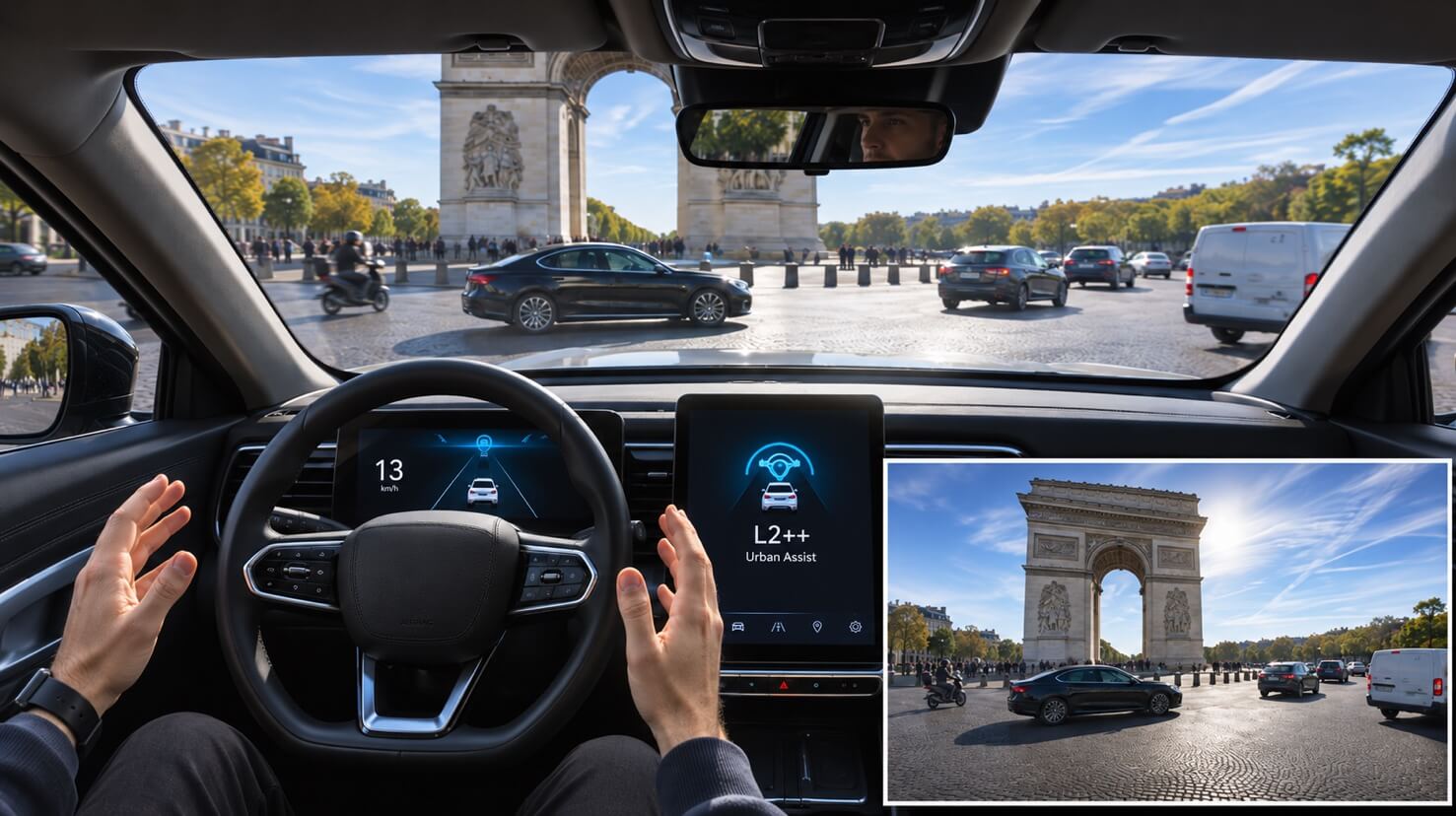
JAECOO and Momenta chose a particularly recognisable test in October. Their JAECOO 7 development vehicle, equipped with the Momenta R7 World Model, tackled the roundabout around the Arc de Triomphe at Place Charles de Gaulle in Paris. Twelve avenues converge there, with no clear lane markings and vehicles entering from the right taking priority. Anyone who has driven around the monument will understand the difficulty. The partners reported no driver intervention on the demonstration route. A safety driver supervised throughout, and the vehicle remains in testing and validation.
Such demonstrations make the ambition behind “L2++” tangible. The term describes increasingly capable driver assistance, not a separate automation level. At Level 2, the driver must continuously supervise steering and speed support. As driving functions expand, it must remain clear who is driving. Better performance in difficult traffic makes that distinction more important.
Volkswagen adds another European question. The group is reportedly considering its China Electronic Architecture, co-developed with XPENG, for European models. That could bring more China-developed vehicle technology into European programs. It would not automatically bring the same driving software. Reusing an electronic architecture and transferring a driving system are separate decisions, and a European rollout remains unconfirmed.
Other developments concern how the complete product comes together. Toyota plans to assemble a Waymo-equipped bZ4X and integrate its autonomous-driving hardware at Takaoka, with Japanese testing and validation planned for 2027. Infineon and Qualcomm are working on the connection between high-performance computing and safety-critical control. Manufacturing integration and predictable control deserve attention alongside driving models.
Oro Mobility brings a further part of the picture into view. Its fleet-management approach connects vehicle ownership with charging, cleaning, maintenance and the work needed to return a car to service. A robotaxi still needs someone to deal with an iced-up windscreen on a winter morning. These ordinary tasks are easy to overlook in discussions dominated by software and sensors. They matter directly to passengers waiting for a clean, available vehicle.
Tensor and Munich Taxi Zentrum (MTZ) suggest how established taxi operators could participate. Their letter of intent covers up to 500 autonomous taxis in German cities, with MTZ retaining its own brand and customer relationships while Tensor supplies vehicles and driving technology. Binding agreements and regulatory approval are still needed. The proposal gives local operators a role in shaping the service around the technology.
This issue follows both the expansion of assistance and the work behind dependable driverless services. A difficult roundabout is a meaningful test. A vehicle that arrives ready for its next passenger is another. Progress needs to be judged against the task, the operating conditions and the responsibility that remains with people.

Dr. Markus Hahn
Senior Advisor, DVN


