
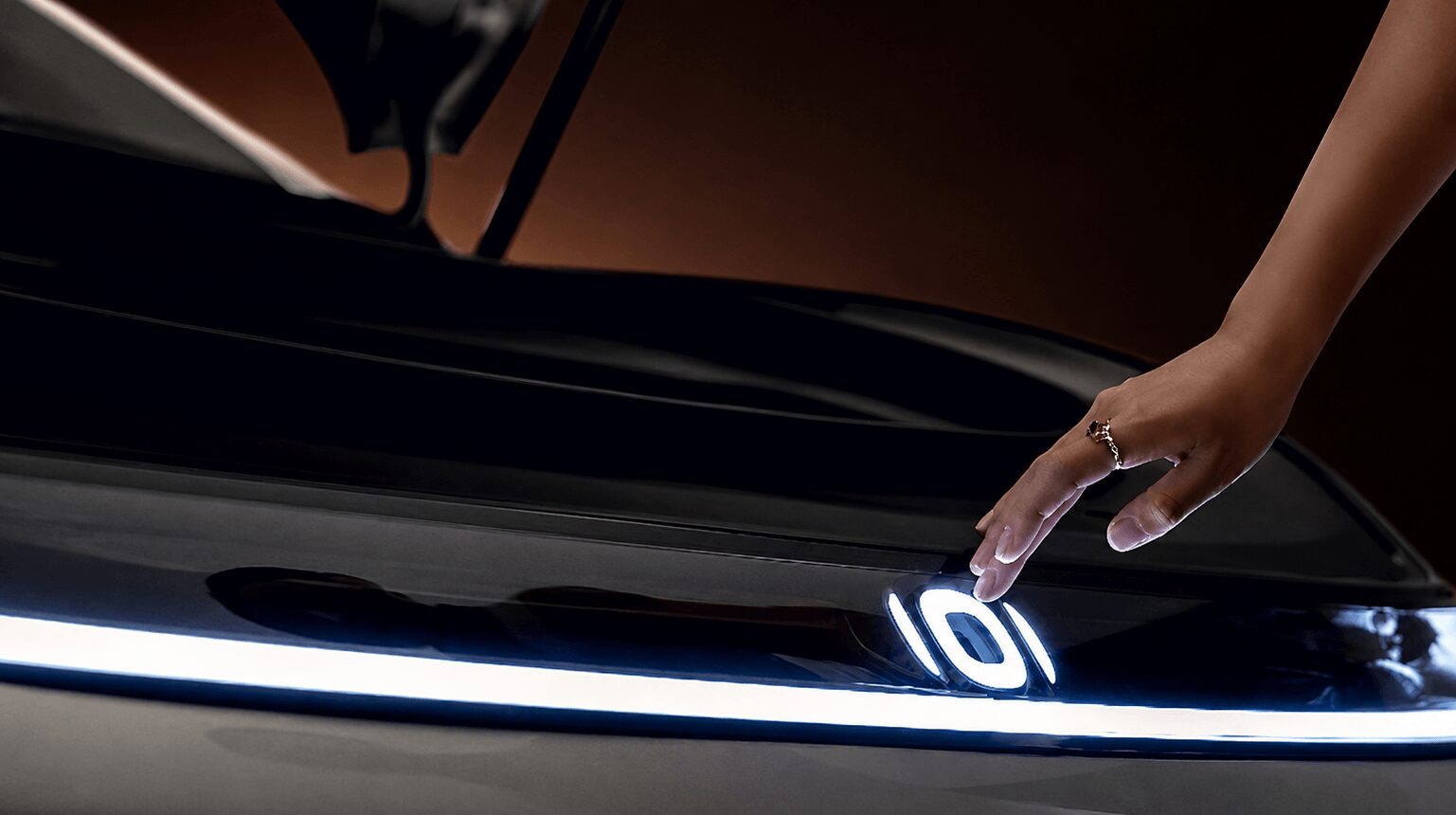
We see more and more applications where surfaces are becoming the control without any physical buttons. There are the flush door handles we have seen on cars during the last three years, and even the hood opening method on the Mercedes GLC (sensor as part of the logo) – or the Changan A06 with hood opening sensor built into the lamp, as shown by the image below from Marelli.
DVN’s Paul-Henri Matha talked with RNC Technologies CEO Christiaan Scholtes to learn more about these technologies.

The sensing is solid-state: no mechanical travel at the control, no moving element in the sensing path. A deliberate press deflects the surface by a few microns, and a sensor behind the part reads that strain and turns it into a command. Because it reads deformation rather than an electric field, it works through solid metal – including the likes of 3mm stainless steel, where capacitive sensing won’t work. The engineering sits in the integration: the mechanical design and activation threshold, adjustable in real time from 0.25 N on up, are tuned to the material, the geometry, and the intended feel of each part. Real-time calibration, adaptive filtering, and machine-learning-assisted pattern recognition together separate an intended press from vibration, thermal drift, wash pressure, electrical interference, and incidental contact. On the outside of a car, the challenge is not so much detecting contact as detecting the right press, on the right surface, in the right conditions – and it has to work correctly for the life of the vehicle.
A reliable exterior control is genuinely difficult. A mechanical switch or microswitch usually needs an aperture, local travel, or a moving element, and every added gasket, potting step, or drainage path becomes another component, another cost, and another engineering variable. Capacitive sensing removes the moving part, but brings its own difficulties outside – rain, ice, salt, dirt, gloves, and conductive surfaces.
Sensing through an unbroken surface circumvents much of that problem. The input can sit behind metal, glass, plastic, trim, or lens structures; at the input point there is no opening to seal and no moving part to wear. That is what makes exterior-grade ratings practical: IP69K sealing, IK10 impact resistance, operating temperature range of -40 to +85 °C, and lifetimes beyond 50 million actuations. The unbroken surface closes the ingress path, filtering rejects wash pressure and vibration, and standing snow or ice is ignored as a static load. A high-pressure wash reads as no input. The piezo element generates its activation signal mechanically, standby consumption is 5 to 10 µA with sensing active, and the module integrates over CAN or LIN like any other body node.
Every sensing point can report its own health in real time, so a degraded point is known before it is felt. The surface recognises knock and tap patterns, a tailgate that releases to a knock or an elbow: one part, several gestures, no added input hardware. And independent points sit at 10 mm pitch with controlled crosstalk, so a compact multi-key zone fits where mechanical switches need travel space per button and capacitive layouts need guard spacing.
A release that lets a person exit or access a powerless vehicle in an emergency must remain mechanical and independent where regulation or safety requires it; a sensing surface is not a substitute. And where a latch, flap, or tailgate must open, that actuation still has to be engineered and may still draw power. What changes is the user input, which no longer need be a visible button, a hole in the surface, or a moving exterior control.
All of this is relevant to the lighting community: lit signature zones that already express state and identity are natural candidates to accept input. An illuminated logo which is also a control is one assembly with two functions – optics on one side, sensing on the other.
For OEMs, this protects design freedom; the surface stays whole. For the tier-1 supplier, it turns an exterior part into a higher-value functional module. One configurable platform, tuned per part, can cover several functions, reducing variants and tooling across a vehicle line. At the system level, removing button caps, apertures, switch housings, input seals, and their assembly and sealing operations can cut part count and complexity. The integration can reduce costs and expand design possibilities.
Examples are already in production. Marelli’s touch-enabled, full-width headlamp on the Changan Qiyuan A06, for instance, combines front lighting functions with an illuminated brand logo. A lit, translucent logo is a natural place to start, because the active area can show itself. The wider technical question expands beyond the lit panel: solid metal, painted trim, polymer panels, glass, and lens structures that must stay visually unchanged in all real vehicle conditions. There, the sensing method becomes the whole question.
RNC Technologies, for example, works in this direction: solid-state, deformation-based sensing built into existing exterior parts, with the surface, the sensing stack, and the electronics treated as one system. Their automotive work runs from emblems and handles to charge doors, rear light units, and tailgate surfaces, and the exterior technology has completed a leading European OEM qualification program.
All in all, brand surfaces and control surfaces are converging!


