
By Andrew Leuchtmann
Hyundai & DVN images
We experts who meet weekly on this DVN communication platform to discuss interior‑related topics, certainly agree that we do not consider ‘interior’ in the narrow sense of an enclosed passenger space within a vehicle, but rather as a place for all types of human mobility interfaces. Since we are consistently curious and tend to direct our interest toward the future, it is of course only natural that we also gladly seize the opportunity to explore the answers that mainly the international circle of young design students is developing to the question of future mobility and its broader implications.
Such an opportunity is currently presenting itself in the form of the World Design Capital expo, held at Frankfurt Rhein Main. As one of 2,000 individual events throughout the year, the widely noted five‑part exhibition Dreams, Ideas, & Prototypes of the WDC Campus project at the Museum für Angewandte Kunst (it means “Museum for Applied Arts”) offers us a particularly fascinating field in its Movement & Mobility section. Here, students, universities, companies, and institutions from around the world engage with the central challenge of how we will move in the future so that more people can participate – mobility as social infrastructure, in a phrase.
Within the scope of a newsletter article we cannot present all the exciting contributions. As a representative selection, two Hyundai projects stand out. Hyundai’s European headquarters is located just outside the city, and close compatibility of the company philosophy (‘Progress for Humanity’) with the WDC guiding principle (‘Design for Democracy’) motivated Hyundai’s Design Innovation & Strategy Team to take part, led by Nico Munkler. Munkler says, “Design innovations should ultimately support everyone, bridge social gaps, and make future mobility accessible, inclusive and fair”.
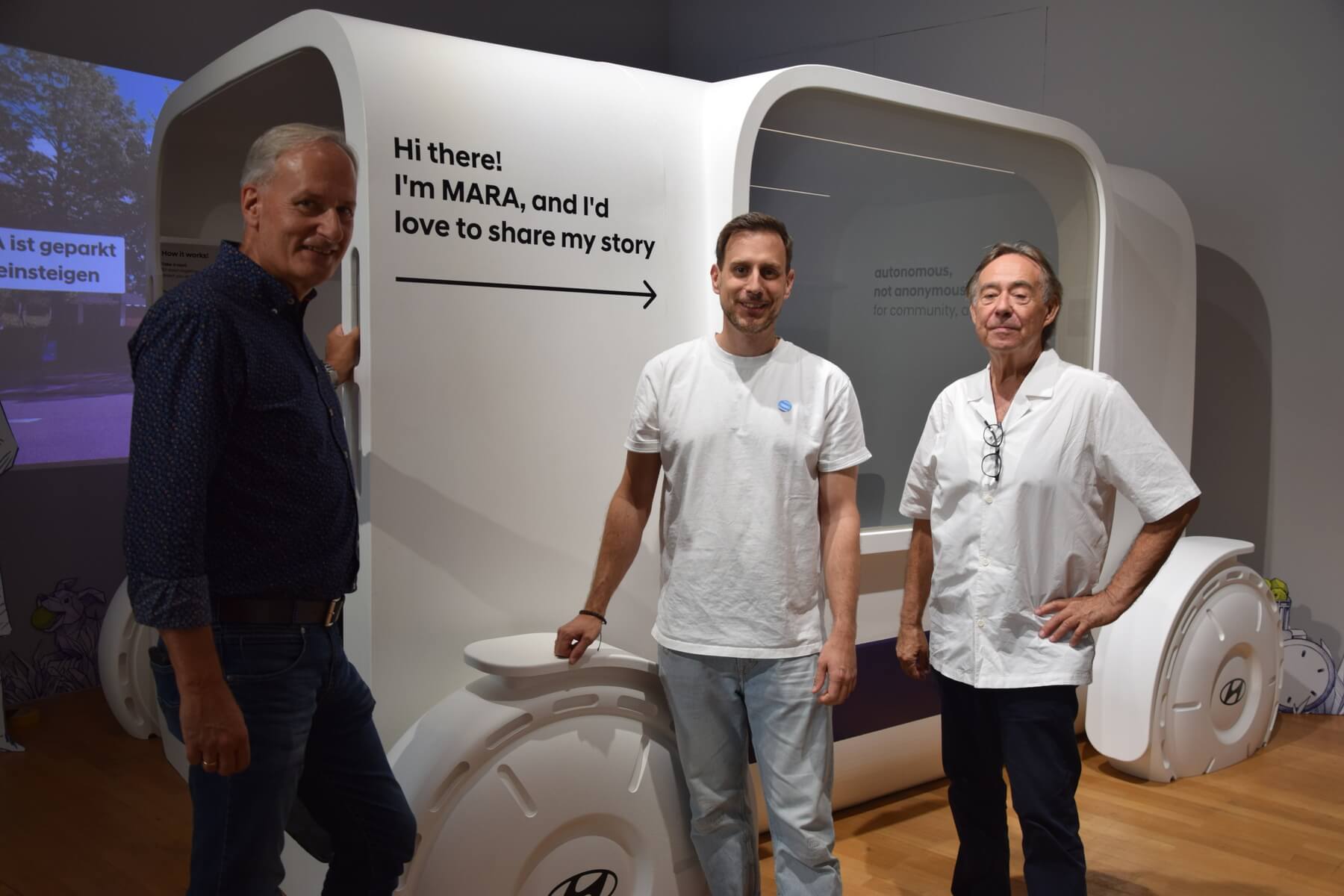
In this spirit, Hyundai Motor analyzed questions relating to both rural and urban mobility, which led to two completely different answers. One of them, which Nico personally supported as both a member and a sponsor of the project team, was created in collaboration with the nearby HfG – University of Art and Design Offenbach. It’s a concept called MARA – Mobility Alliance for Rural Areas. It’s an app-controlled autonomous-shuttle system to connect underserved villages to the nearest train stations, shopping centers, doctors, and other essential everyday destinations based on individual demand. In addition to transporting passengers, small independent platforms equipped with standardized boxes also enable the delivery of goods directly on site.

MARA underscores with its guiding idea of “autonomous – but not anonymous” that mobility is more than transportation — it is, ideally, a form of social infrastructure capable of fostering new encounters and overcoming isolation. Building on the scientifically confirmed insight that limiting capacity to a maximum of four seats removes a key condition for anonymity, the shuttle becomes a meeting place that connects generations. In particular, elderly people, children, and those without access to a private car benefit from greater independence and freedom.

MARA also incorporates an intriguing technical approach that encourages democratic interaction among passengers and, in doing so, suggests playful new possibilities for the interiors of future autonomous passenger cars. Each seat has a touch‑sensitive blue puck the passenger touches and holds to signal readiness for departure.

If any passenger wishes to adjust light brightness, window tint, airflow, or temperature during the ride, the change only takes effect if all occupants will confirm the request by activating their own pucks.
The second project, which investigates how human‑centered public mobility could be shaped in future smart cities, was carried out jointly by the Hyundai Genesis Future Design Team and Kookmin University in Seoul. To do so, the team deliberately analysed two highly contrasting districts – Gangbuk and Gangnam – to understand their current mobility structures and local challenges.

Gangbuk, in North Seoul, calls for tourist last‑mile mobility. Field research around Gwanghwamun Square, visited by over 9 million people per month, revealed two major issues: insufficient last‑mile options for tourists carrying luggage, and abandoned personal mobility devices cluttering public space. The proposed system combines tailored PM vehicles with supportive infrastructure such as storage facilities and PM lanes to provide convenient, comfortable mobility for diverse tourist needs.
Gangnam, in South Seoul, on the other hand, calls for commuter mobility for office workers. Gangnam’s high density of office buildings leads to significant congestion during peak hours. Here, dedicated PM lanes were also designed to protect both riders and pedestrians, while unused areas near subway exits could be repurposed as PM stations. Since walking remains the preferred last‑mile mode, the concept focuses on reducing psychological barriers to PM use. The envisioned user experience enables seamless access to and return of devices at any location, with vehicles autonomously returning to PM stations – eliminating complex rental and return procedures.

As a key takeaway, it can be concluded that, alongside the specifically adapted PM vehicles, the dedicated PM lanes and stations in both scenarios would lead to a significant improvement in the overall urban mobility experience.
From the perspective of the DVN community, the specifically-designed PM vehicles are of particular interest. While the differing needs of tourists compared with business‑orientated users result in distinctly different technical concepts, there are also shared challenges that can be found even on large autonomous vehicles. In addition to numerous ergonomic details, this particularly concerns the use of light signals – for their primary purpose of illumination and indication, and to enable differentiated communication with active users and passive road participants.

So: let’s keep our fingers crossed for the residents of rural areas and big cities that the mobility concepts developed by Hyundai and its partner universities can be implemented as fully and as soon as possible.


