
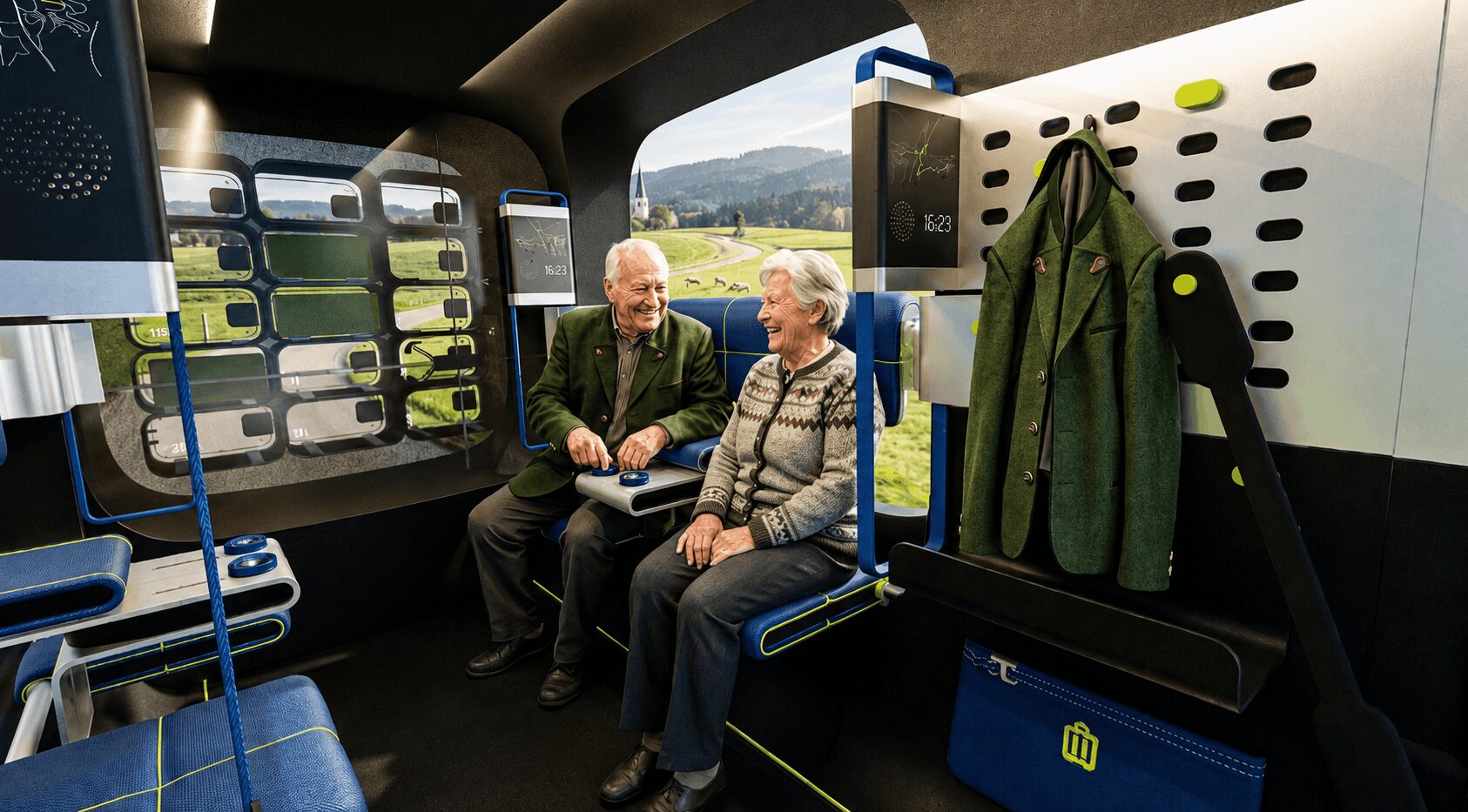
Welcome back from Summer holidays! Let’s jump right in: we bring you an article in today’s newsletter about Hyundai’s exhibits at World Design Capital this year – proposals which invite us to move beyond the traditional definition of the automotive interior. The cabin as just an enclosed space to sit out a journey is giving way to a social interface connecting passengers, territories, and essential services.
You’ll read all about the autonomous-but-not-anonymous philosophy, and the interior design and implementation concepts that flow from it to the MARA concept for rural-area mobility. The principle is that autonomy should not lead to isolation, but rather should help rebuild social connections.
Each seat has a touch-sensitive interface for passengers to confirm departure or collectively approve changes to lighting, window tint, airflow, an temperature. Comfort becomes a shared decision rather than a purely individual setting.
The work conducted in Seoul by the Hyundai Genesis Future Design Team and Kookmin University extends this approach to urban mobility: vehicles, stations, dedicated lanes, and light signals are designed as elements of one coherent journey. It all suggests future interiors will be measured by their ability to make mobility more accessible, intuitive, and human.
All the best,



