
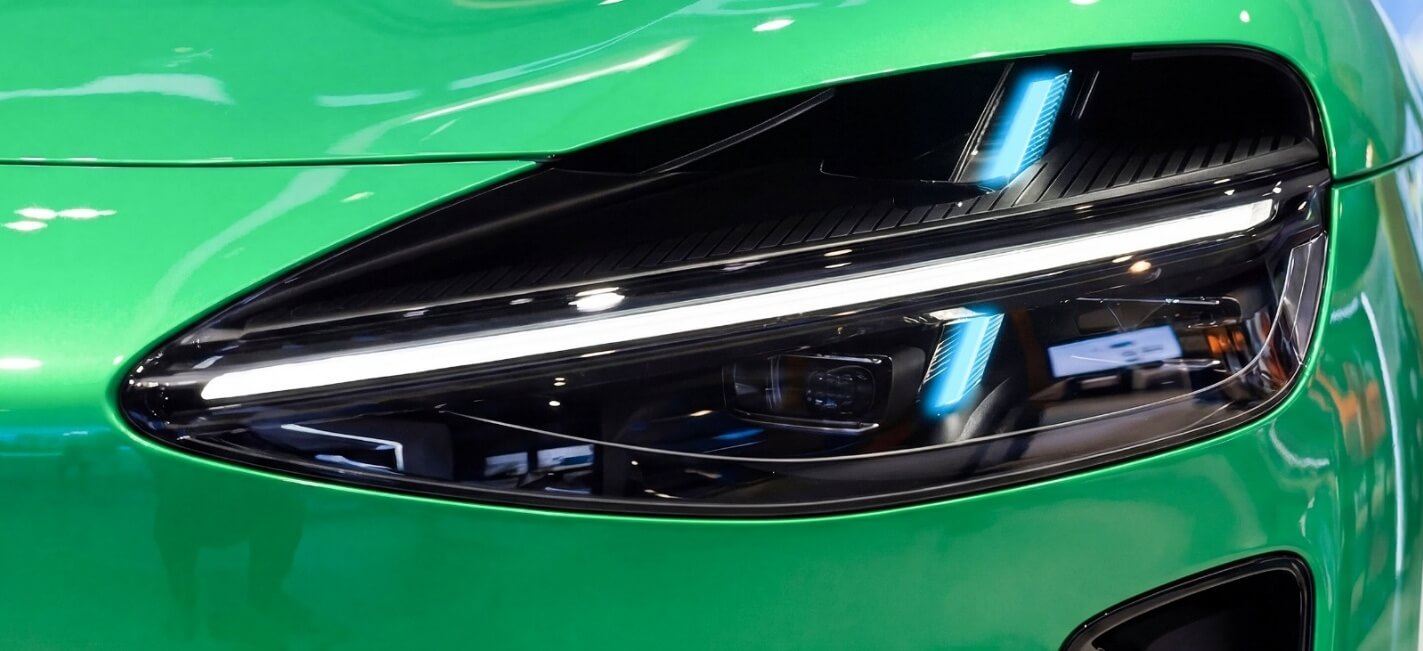
In September 2025, we reported that 755,000 vehicles in China had, to that date, been equipped with blue-green AD-S (autonomous driving status indicator) lights.
This feature has expanded fast and widely. BYD, XPeng, Li Auto, Huawei/HIMA (Aito), Xiaomi, Geely, Great Wall, Dongfeng, and other Chinese brands have introduced these lamps on many new models with L2 or L2+ ADAS, as we saw last April at the Beijing auto show.
The L2 and L2+ market is expected to reach five million vehicles in China in 2026, and we estimate (by reference to interviews with OEMs and suppliers) that half of those vehicles will be equipped with AD status lights – that will mean 2.5 million vehicles with the blue-green lights in China this year.
Is it just a fad? Or an enduring trend? This will depend on how the regulation evolves. Perhaps these lights will be banned in China for L2 vehicles, but mandated for L3 vehicles, with six AD lamps per vehicle — front, side, and rear, left and right. In Europe, AD lights may be permitted on L3 vehicles; the matter is still under discussion. The L3 market, is estimated by Yole and S&P to reach up to 10 million vehicles in 10 years, and they’d all be ripe candidates to be equipped with AD-S lamps.
In 2030, depending on how the regulations take shape, Chinese OEMs are expecting half of Chinese vehicles to be equipped with ADS (even 80% for New Energy Vehicles), that means 15 million vehicles.
From a design perspective, Chinese OEMs are clearly integrating AD lights not as an add-on, but as a design element and a key differentiator. The colour is loosely defined in the proposed regulation, so makers can decide exactly what they want between Cyan and Turquoise; a bit bluish or a bit greenish.

To cater for whatever colour within the allowable range is chosen by a styling department, a variety of solutions are available on the market, including both direct (chip monochromatic) cyan and phosphor-converted (PC) LEDs.
With monochromatic LEDs, the colour will be closer to the border of the blue-green box, while with PC LEDs the colour will be more centered. The colour shift at dimming current and high temperature will have to be considered for both types LEDs – especially in case of current dimming for monochromatic LEDs.
If the optical solution requires high power LEDs (≥3W), as for a light guide application, phosphor converted LEDs will be the applicable solution.
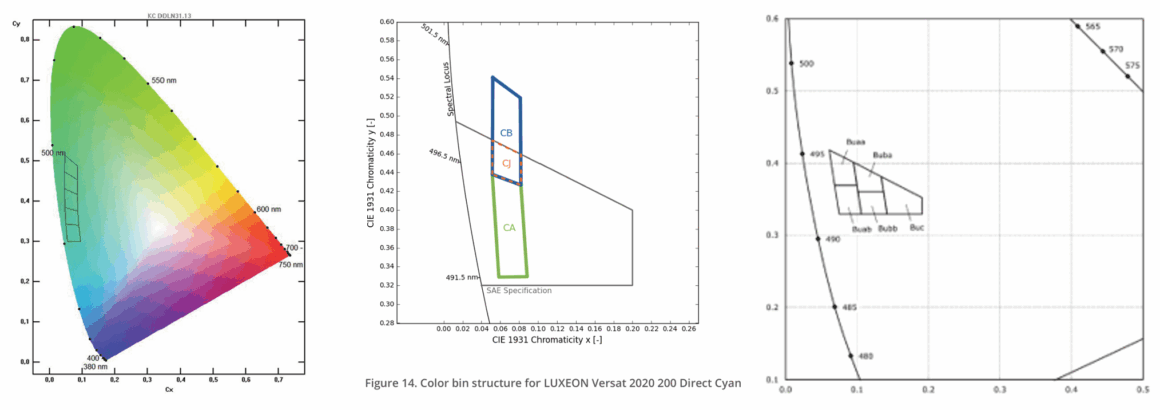
The regulation has not yet been released, but current draft suggests it will be well harmonized among Europe, China, and USA, so a single solution will be possible, depending on the lamp design and integration.
In USA, an optional item such as the AD light may not impair the effectiveness of any mandatory function, so the front position lamp will always be lit (DRLs are not mandatory in the US, though they are in Canada).
In China, the AD light may replace DRL by day, but the position lamp must still be lit and legal while the AD light is lit (but the reciprocally-incorporated part can be unlit).
In Europe and the many countries around the world where the UN Regulations are recognized, the AD light may not replace DRLs or position lamps, and so both must be lit when they are required.
So, a thorough regulatory analysis will be needed for OEMs and tier-1s at the vehicle level, even if colour and photometric requirements are common.
To have a better understanding about AD lamp design, we are glad to publish our DVN Technical Report on the subject, written by DVN senior experts Jean Paul Ravier, Eric Blusseau, Franco Marcori, and Mark Verplank. Find it here. This report includes:
- Discussions and interviews with light sources makers, tier-1s, and OEMs
- A deep analysis of Chinese market with OEM strategies for AD lights seen at Beijing auto show in April
- A benchmark of current AD lamps with our partner A2MAC1
- An analysis of current draft regulations in Europe, China, and USA
We are also glad to publish our interview with Mercedes-Benz Autonomous Driving and Parking Technology representative Alexandros Mitropoulos on the subject.
And now we start our 3-week summer break. We will be back with you on August 18. In the meantime, stay cool!
Sincerely yours,