
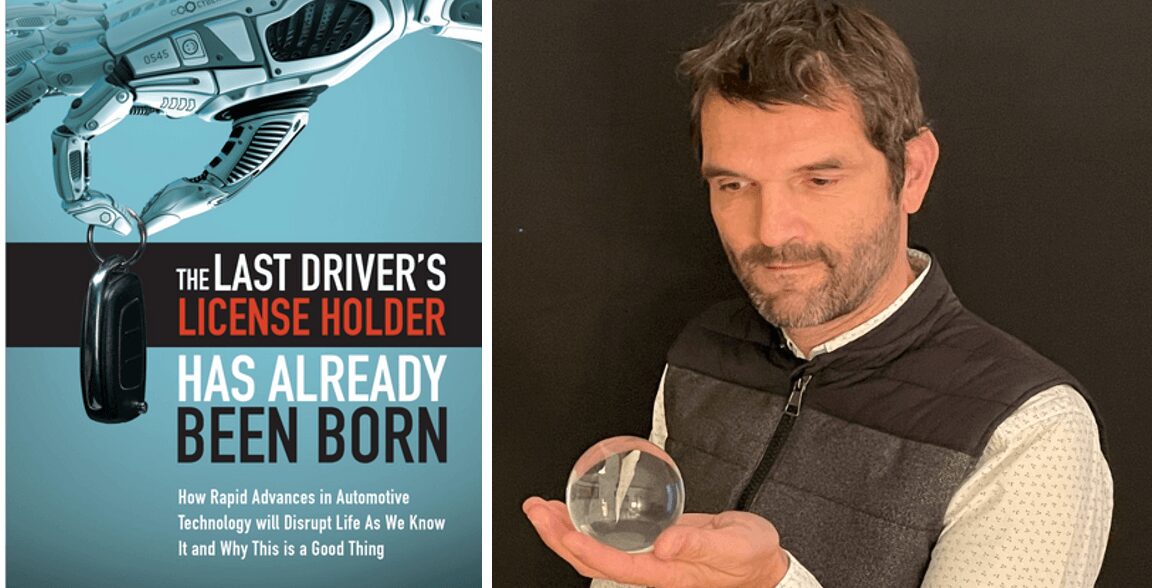
Interview by Dr Jürgen Dickmann, Senior Advisor, DVN
Dr. Mario Herger is a well-known author and consultant who explains and contextualizes current trends in technological innovation, such as the Silicon Valley mindset, AI, autonomous driving and humanoid robotics, in an accessible yet insightful way through his books and posts
Note: On 17–18 November, our DVN conference will take place in Stuttgart and for the first time, host special sessions on Dual-Use and on “The Road to Type Approval: Mastering End-to-End AI Systems”.
In the runup to the DVN conference, we are presenting Key ADAS/AV players , and sharing their results, perspectives in this field. The first in this series was our report on a preview drive with Wayve’s latest vehicle.
Dickmann-DVN: Who is Mario Herger and what does he do professionally?
Mario Herger: I come from the technology side of SAP, where I engaged early on with new technologies, start-ups and digital platforms. Since 2013, I have been an independent technology trend researcher, focusing on topics such as autonomous driving, electric mobility, AI, humanoid robots and technology transfer between Silicon Valley and the German-speaking world. I see my role as interpreting technological developments on the ground and making visible the often very different perceptions in Germany and Silicon Valley.
Quote: “I see myself as a bridge between the German bubble and the Silicon Valley (bubble) perspective.”
Dickmann-DVN: Is your website a hobby or a job?
Mario Herger: My business model is not based on the website alone, but on the expertise and visibility it generates. For me, books are above all calling cards: they position me as an expert and lead to speaking engagements, workshops and consulting projects.
An unexpected additional business came through requests for organizing deep dives into the Silicon Valley with learning trips for executives, managers and everyone who want to experience technological developments on the ground for themselves.
Dickmann-DVN: What topics do you cover besides ADAS/AV?
Mario Herger: I use several websites and newsletters as platforms for my topics. In mobility, the focus early on, was on electric mobility, after all, I live just 10 minutes from the Tesla Factory in Fremont, but nowadays the focus is on autonomous driving. I use other sites to cover topics such as AI, humanoid robotics, and the differences in the innovation mindset in Silicon Valley and Europe. My websites are therefore both a publishing channel, an archive and a positioning tool.
Quote: “My sites are platforms for making technological developments visible and putting them into context, I want to break the negative bias towards technology in Europe.”
Dickmann-DVN: Do you do all of this on your own, or do you have staff?
Mario Herger: I work mostly on my own, but occasionally I pull in other freelancers into my workshops or Silicon Valley tours. At the same time, comments, reactions and discussions from my community constantly give me indications of which topics are becoming relevant, which arguments are circulating and where disagreement is emerging. I then use this feedback for new articles, talks and books.
Dickmann-DVN: Now to the specialist questions: around 2017, you predicted on your portal that the era of the last car driver and driving license holder would soon be over. We are now almost 10 years later. How close are we today to that prediction, and why?
Mario Herger: First, I find the classic level debate only of limited use, because the real technological leap lies between L3 and L4. L3 remains heavily constrained and, in my view, is not a mass-market model for the future; it confuses the driver.
Secondly, not that the autonomous driving technology works, with 500,000 driverless paid rides that Waymo delivers every single week as a proof, the question is more how quickly the technology scales and how rapidly autonomous systems take over a relevant share of driven miles. I would now expect that by 2035 we will see the majority of miles driven to be done by autonomous vehicles, at least in Europe, China and North America.
Quote: “L3 is the slightly better candle; L4 is the light bulb. We are no longer discussing only feasibility, but scaling. In 2035, the majority of driven miles could, come from autonomous systems.”
Dickmann-DVN: Okay. L4 is no longer at the research stage. What hurdles remain?
Mario Herger: Today, the main hurdles come from regulations and laws that have been too slow and hesitant to allow autonomous vehicles to be tested and deployed. One can get the feeling that not developing self-driving car technology is the rocket technology, but to make the laws allowing that.
Quote: “Today, the hurdles lie mainly in scaling, operations and regulation. As soon as the floodgates open, more providers will follow.”
Dickmann-DVN: Let us zoom in a little on the L4 market. It is divided into the private sector and fleet operations. Alongside the traditional tech giants such as Waymo, more and more partnerships between OEMs and software stack providers are entering the race, with Mercedes and Nvidia as one example. Do you see this as the start of a brutal displacement battle, or simply as cross-investment by OEMs seeking to secure their future?
Mario Herger: Waymo is currently the most visible and most advanced reference case for robotaxis, but there are also many other providers and approaches worldwide, such as Zoox, Baidu/Apollo. WeRide, Tensor, Pony.AI or Tesla. Many OEMs have realized that their strength lies in vehicle manufacturing, not in building a complete self-driving stack, and are therefore seeking partnerships with software and technology providers. For me, collaborations such as Mercedes and Nvidia are above all an expression of this strategic catch-up effort; in the end, what matters is who actually belongs to the top tier in the operational software stack.
Quotes: “Waymo is the reference point today because you can use the system in the real world. OEMs are realizing that they are not software companies and need to buy in technology.”
Dickmann-DVN: By 2035/40, where do you see the larger market for L4 systems: private L4 or L4 fleets? Why?
Mario Herger: By 2035/40, I see greater scaling potential in robotaxi fleets than in privately owned robocars. The reason is that autonomous fleets can be significantly cheaper, more flexible and better utilized than privately owned vehicles, while users can give up many points of friction such as parking, insurance, refueling or maintenance.
There will be private robocar offerings, but in the mass market there are strong reasons to believe that autonomous ride, robotaxi and sharing models will gain traction more quickly. Nvidia is clearly an A-player in chips and computing platforms – but the greater value in the self-driving market only emerges through the interaction of hardware, software, data and operations, in other words the entire ecosystem.
Quotes: “When autonomous mobility costs only a fraction of what a car costs today, the system tips. By 2035/40, robotaxi, ride and car-sharing models have greater scaling potential. Nvidia is an A-player in chips – but not automatically in the complete self-driving stack.”
Dickmann-DVN: Who will make money from L4, then? (OEMs, software stack developers, SoC/CPU manufacturers, fleet operators?)
Mario Herger: In the robotaxi market, money will not be made from hardware alone. Chip providers such as Nvidia will participate through computing platforms, but the greater value creation lies where data, simulation environments, operational know-how, user experience and the actual driving service are brought together.
That is the strength of companies such as Waymo: they do not merely deliver components, but a complete solution like the Waymo Driver, including real-world operations, simulations and MaaS.
OEMs will come under pressure. Margins are shrinking. For OEMs, the existential question over the next three to five years will be how they can secure parts of the digital value chain – or customer-facing USPs.
OEMs will also have to look at how to reduce the costly per-vehicle infrastructure. In future, the sensor set-up will certainly come under scrutiny as well. Lidars are good, but they create high costs in ensuring quality of service in the vehicle. New radar approaches could be the cheaper alternative here.
Quotes: “Nvidia’s goal, at the end of the day, is to sell chips. Waymo does not sell a chip, but a complete mobility service. The greatest value is created where data, software, operations and the customer experience come together.”
Dickmann-DVN: If these software stack companies, or Nvidia with its SoC, are taking a share of the value creation, what is then left for the OEMs?
Mario Herger: For traditional OEMs, this model leaves far less exclusive value creation than in the previous automotive world. The traditional business of selling a vehicle once at a margin comes under pressure when autonomous systems generate additional revenues per mile over time and software or platform providers capture a larger share of those returns.
OEMs remain important vehicle manufacturers, but they risk being reduced to the role of hardware suppliers. At the same time, brand and vehicle ownership could lose importance in the fleet era, because for many users the mobility service matters more than the badge on the vehicle.
In this scenario, technology and platform providers have structural advantages because they combine capital, software capability and scale, and can therefore occupy the more profitable recurring business.
Quotes: “When mobility becomes a service, the brand loses importance. The more profitable logic in future lies in the ongoing service, not in the one-off sale of a vehicle.”
Dickmann-DVN: Allow me, as a former sensor representative, one question about the sensor set-up. Vision only, or rather sensor redundancy – what will prevail?
Mario Herger: I am certain that both main approaches, one with sensor-redundant systems like Waymo, and the other with cameras-only like Tesla, will be succeeding. The remaining competitive differentiation for OEMs will lie in the day-to-day driving experience.
Dickmann-DVN: It now seems that all software stack providers are relying on AI-based end-to-end systems. For public authorities, this means having to approve AI black-box ping-pong. And this at a time when more and more reports are being published about the fallibility of AI systems. Yet such vehicles are already operating in the US as products. Why are US authorities less critical when approving L4 AI systems? What can the EU learn from the US and China?
Mario Herger: In the US, many states are moving faster because they understand autonomous mobility as an economic and location policy issue and want to attract companies, investment and jobs. The federal system allows more regulatory experimentation and therefore more practical learning at local level.
Europe is acting far more cautiously, looking predominantly of what could go wrong, instead of what could go right, often waiting for higher-level guidance and being additionally slowed by established industry interests. For deployment, it therefore needs not only rules, but also coordinated responsibilities, learning authorities, local stakeholder work and real user experience.
Quotes: “US states act out of economic self-interest and thereby gather practical experience. Europe too often waits for Brussels instead of creating learning environments itself.”
Dickmann-DVN: A further question on the approval process. What solutions do you see?
Mario Herger: In the approval process, we must recognize that autonomous systems operate probabilistically and not fully deterministically. We already know comparable assessment logics from medicine, where efficacy and safety are likewise judged through probabilities, test series and robust evidence.
For robotaxis, this means a systematic mix of simulation, test catalogues, real-world driving data, clear assessment processes and targeted capability building within authorities and testing bodies. What matters is not perfection, but the demonstrable answer to whether the system drives more safely than a human in the relevant operating domain.
Quotes: “Simulation, test catalogues and capability building within authorities will be central. The benchmark should not be perfection, but a clear safety gain over the human driver.”
Dickmann-DVN: How do you see the ADAS/AV world in 2040, and who will still be standing by then?
Mario Herger: For 2040, I expect the major approval questions to be largely resolved and robotaxi and robocar fleets as well as robotaxis to be part of everyday life in many markets. Overall, these fleets are likely to cover more miles than human driven vehicles, while OEMs will have to live with lower margins and platform and fleet providers will increasingly amortize their current investments. The human driver will not disappear entirely, but especially in megacities people will drive themselves far less often, and driving will become more of a leisure activity on closed roads.
Quotes: “By 2040, fleets will in total cover more miles than private vehicles”
Dickmann-DVN: Mario, thank you for this insightful view into your model of the ADAS and AV world. I hope we will be able to welcome you at the DVN conference.
Further links to Mario Herger
https://www.amazon.de/Homo-Syntheticus-Mensch-Maschine-verschmelzen/dp/3689320550/
https://technophilosoph.com/2025/11/16/humanoide-roboter-eine-uebersicht/


