
Note: On 17 – 18 November, our DVN conference will take place in Stuttgart and for the first time, host special sessions on dual use and on “The Road to Type Approval: Mastering End-to-End AI Systems”.
In the runup to the DVN conference, we are presenting Key ADAS/AV player, and sharing their results, perspectives in this field. Now comes the interview of Pony.ai, an important hub on Robotaxi and ride hailing in China:
Guangzhou Xiaoma Huixing Technology Co., Ltd. (Pony AI Inc.)
Interview by Dr Juergen Dickmann, Senior Advisor, DVN
DVN-Dickmann: To begin with, how would you describe Pony.ai’s positioning in the autonomous-driving field? My understanding is that you are not only active in robotaxis, but also in robotrucks and other product areas. Could you outline your main business units?
Pony.ai: Pony.ai is focused on large-scale commercialization of L4 autonomous driving technology. At the center of our technology are PonyWorld, our proprietary world model, and our Virtual Driver, which together support the development and scaling of our autonomous driving products and services.
Today, our business is organized around three main areas. The first is Robotaxi, which includes the vehicle platform, Virtual Driver, and the operational system required to deliver fully driverless mobility services. The second is Robotruck and logistics, including our autonomous heavy-duty trucks for long-haul logistics and our L4 light-duty truck for urban goods delivery. The third is Intelligent Solutions, where we provide autonomous driving domain controllers and related solutions to customers across areas such as low-speed delivery, robosweepers, logistics, mining, autonomous shuttles, humanoid robotics, and other intelligent mobility applications.
DVN-Dickmann: When DVN colleagues visited Pony.ai last year, you spoke about your expansion strategy into additional cities. Could you give us an update on where this strategy stands today?
Pony.ai: Our expansion strategy is built around what we call a dual-engine model: deepening deployment in China while scaling internationally with local partners. In China, we are operating fully driverless commercial Robotaxi services in all four tier-one cities: Beijing, Shanghai, Guangzhou and Shenzhen. We are also expanding into emerging top-tier cities such as Hangzhou and Changsha, while continuing to increase service density in core urban areas.
Outside China, we have also made meaningful progress. In Europe, we launched commercial Robotaxi service in Zagreb with Verne and Uber, and we have been advancing activities in Luxembourg. In the Middle East, we have commercial service in Doha with Mowasalat (Karwa) and have started driverless trials in Dubai with RTA. In Southeast Asia, our Singapore deployment with ComfortDelGro has entered by-invite rides, and in South Korea we have continued local testing and deployment preparation. Our 2026 target is to expand our footprint into more than 20 cities globally, with nearly half of those cities expected to be outside China.
DVN-Dickmann: How many robotaxis does Pony.ai currently operate or manage, and what fleet size are you targeting over the next few years? Are we talking about 3,000 vehicles or more?
Pony.ai: Our Robotaxi fleet exceeded 1,700 vehicles as of May 2026. As we continue to ramp up Gen-7 mass production and broaden both domestic and overseas deployment, we have raised our year-end 2026 fleet target from over 3,000 vehicles to more than 3,500 Robotaxis.
This growth is supported by: our Gen-7 mass-production partnerships with major OEMs, our improving unit economics in key Chinese cities, and our joint deployment model with local partners in overseas markets.
DVN-Dickmann: Many forecasts for radar, LiDAR and other sensor suppliers ask when the number of Level 4 fleet vehicles will really take off. Some expect major growth only around 2035 or even toward 2040, due to economic, regulatory and operational constraints. From Pony.ai’s perspective, how do you see the cost and supply-chain side of this scaling question?
Pony.ai: We believe the cost and supply-chain side of L4 deployment is moving faster than many long-term forecasts assume. In China, we benefit from a mature automotive and intelligent-vehicle supply chain for LiDARs, cameras, radars and vehicle components. This has allowed us to make significant progress in cost reduction. Our seventh-generation autonomous driving kit achieved a 70% BOM cost reduction compared with the previous generation.
At Auto China 2026, we also disclosed that the total cost of our 2027 Robotaxi for the China market, including the base vehicle, batteries and autonomous driving kit, is expected to be below RMB 230,000, or roughly US$33,000. That cost structure is very important because L4 commercialization is not only a technology question; it also depends on whether the vehicle, hardware, operations and service model can support sustainable economics at scale.
DVN-Dickmann: And regarding vehicle numbers specifically: do you expect growth to take off only after 2035 or 2040, or do you see a much earlier ramp-up?
Pony.ai: We expect the ramp-up to happen much earlier than 2035 or 2040, but we also expect it to be gradual and managed. Robotaxi deployment is different from conventional ride-hailing because regulators, operators and technology providers all need to build confidence through real-world operations. Even if the technology can scale quickly, city-level deployment must still be managed responsibly.
Our view is that the industry entered a new commercial phase from 2025 onward. The key will be steady expansion: larger fleets, more operational areas, stronger local regulatory frameworks, and better unit economics. We do not expect an uncontrolled overnight jump, but we do expect meaningful growth toward 2030.
DVN-Dickmann: In the robotaxi field, we see many parallel partnerships and cross-investments among players such as Uber, Waymo, Wayve and others. Some economists and technologists interpret this as a sign that the final reference solution has not yet emerged, either for a marketable safety case or for the AI architecture. Since several players can technically demonstrate Level 4 within defined ODDs, the argument is that large OEMs and mobility platforms are still hedging because they do not yet know which approach will win. Do you also see a displacement race, or do you interpret these cross-investments differently?
Pony.ai: I would first see the growing number of players, partnerships and investments as a positive sign for the industry. It shows that autonomous mobility is moving from a niche technology discussion into a broader commercial opportunity, and that more companies now recognize the long-term value of L4 autonomous driving.
I would interpret these partnerships more as a sign that the industry is still in an early stage of commercialization, rather than simply as a displacement race. L4 autonomous driving is a complex system involving AI capability, vehicle engineering, safety validation, operations, regulation and local market access. Different partners bring different strengths, and it is natural for mobility platforms and OEMs to work with several technology companies as the market develops.
From Pony.ai’s perspective, the key differentiator is not whether a company can demonstrate L4 in a limited ODD, but whether it can safely and repeatedly operate a commercial driverless fleet, improve the system through real-world data, and build a scalable business model. That is why we focus on our Virtual Driver, PonyWorld, mass-production partnerships and operational deployment together, rather than viewing the industry only as a technology-selection contest.
DVN-Dickmann: Related to that, one argument is that there is still no globally accepted, marketable safety-case process for Level 4. Each group is working within specific ODDs and local approvals, for example in cities such as Paris, London or Chinese pilot zones, but there is not yet one process that can be handed to regulators worldwide and accepted as a reference. Do you agree with that assessment?
Pony.ai: Yes, broadly speaking, I agree that there is not yet one globally accepted safety-case process for Level 4. L4 deployment depends heavily on local traffic conditions, regulatory readiness, infrastructure, operating requirements and public acceptance. Therefore, a safety case and operating model that work in one city cannot be copied into another market without adjustment.
But that does not mean every new city has to start from scratch. China offers a useful example in this regard. Cities such as Beijing, Shanghai, Guangzhou and Shenzhen have already built meaningful deployment experience for fully driverless Robotaxi services, covering areas such as safety assessment, operational management, service-area expansion, regulatory communication and passenger experience. These city-level reference cases are not templates to be copied word for word, but practical foundations and methodologies that have been validated through real-world operations.
For Pony.ai, this experience can significantly improve the efficiency of entering new cities. We still need to adapt to each city’s road environment, regulatory requirements and operating conditions, but a proven technology stack, safety process and operating system can help us move more efficiently through assessment, testing and service expansion. Over time, as more cities accumulate real deployment experience, these practices will gradually contribute to more standardized industry frameworks.
DVN-Dickmann: Beyond the robotaxi business, you also mentioned OEMs. Today, companies such as Nvidia and Qualcomm are increasingly active in ADAS and autonomous-driving software platforms. Given Pony.ai’s Level 4 experience, could this know-how become an off-the-shelf solution for OEMs in L2+, L3 or L4? Or do you prefer to leave that kind of platform business to technology suppliers such as Nvidia and Qualcomm?
Pony.ai: Our L4 know-how can certainly support cooperation with OEMs, but we do not see L4 as a simple off-the-shelf product today. Level 4 is still much less standardized than L2 or conventional ADAS. It involves not only software, but also vehicle redundancy, sensor architecture, safety validation, regulatory approval, fleet operations and ongoing system iteration.
For that reason, our near-term focus is Robotaxi commercialization, where the operator, vehicle platform, Virtual Driver and safety system can be managed as an integrated service. We are open to Level 4 cooperation with OEMs, including for future passenger-vehicle applications, but we believe broad private-car L4 deployment will come later than managed Robotaxi operations. L2+ is a different product category: it remains a driver-assistance system, with different responsibility boundaries, user expectations and business logic.
DVN-Dickmann: When Waymo announced its cooperation with Toyota, I discussed with economists whether robotaxi companies, with their competencies in software, AI, sensor integration and operations, could use this experience to move down from Level 4 toward L2++ passenger-car applications. How do you view that idea?
Pony.ai: There are capabilities that can transfer, but L4 and L2 are not simply different points on one linear ladder. Level 4 is designed for driverless operation, with no expectation that a human in the vehicle will take over. L2 and L2+ systems, by contrast, are driver-assistance products. They must be designed around the human driver remaining responsible and engaged.
What can carry over is the organizational capability behind L4: data infrastructure, simulation, model training, validation methodology, vehicle integration experience and safety discipline. But the product definition is different. A good L2 system should not create the impression that the car can replace the driver. The challenge is to define a safe and clear boundary between machine capability and human responsibility.
DVN-Dickmann: Exactly. I did not mean a direct product transfer one-to-one, but rather the organization, data infrastructure and development methodology behind it.
Pony.ai: In that sense, yes. The development methodology, data flow, simulation capability, evaluation framework and engineering discipline built for L4 can be valuable beyond Robotaxi. The learning loop is especially important: real-world data, targeted scenario generation, model training, validation and deployment need to operate as one closed system.
That is also one reason we continue to invest in PonyWorld and our Virtual Driver technology. They are not only tools for one vehicle model; they are part of a broader technical foundation that can support multiple autonomous driving products and applications.
DVN-Dickmann: The opposite direction is also interesting: OEMs and technology suppliers such as Wayve, Nvidia, Qualcomm or Mercedes are improving from the bottom up. They start with L2++, learn from millions of vehicles, potentially add L3, and later may move toward L4. Does this create a displacement battle in which only a few players survive? Some would argue that the winner will be the company that controls the hardware, software and value chain at scale, while companies such as Pony.ai or Waymo might lose the larger OEM business if they wait too long. Do you agree with that concern?
Pony.ai: We do not see this as a simple bottom-up versus top-down battle. L2 and L4 have different requirements, responsibility models and commercialization paths. Large-scale L2 data is useful, but it does not automatically solve the challenges of operating a fully driverless service with no human fallback. L4 requires a much higher level of system redundancy, validation, operational control and safety assurance.
For Pony.ai, the mobility market remains our primary focus because it is a large and direct commercial opportunity. We are not trying to become a generic supplier to every OEM. We prefer to work with partners where there is strong technical alignment, clear business logic and a shared commitment to deploying safe autonomous mobility at scale.
DVN-Dickmann: So you see the mobility market as significantly more attractive and potentially more profitable than supplying OEMs?
Pony.ai: We see autonomous mobility as a market that could grow to trillions of dollars. It allows us to capture value from the full service, not only from a component or software supply relationship. In Robotaxi, the value comes from the Virtual Driver, vehicle platform, operations, user experience, partner ecosystem and data loop working together.
That does not mean OEM partnerships are not important. They are essential for mass production, vehicle engineering, cost reduction and service infrastructure. But our role is not simply to sell a software module. We want to build a scalable autonomous mobility business with the right partners.
DVN-Dickmann: So from Pony.ai’s perspective, there is no urgent need to chase the OEM business for scale effects or bundling, because the ride-hailing and mobility business is large enough in its own right. Is that a fair summary?
Pony.ai: That is a fair summary. We are not pursuing OEM business for its own sake. Our focus is on scalable autonomous mobility, and OEM partnerships should support that goal. We would rather work deeply with the right partners than position ourselves as a generic supplier.
Our existing mass-production partnerships show this approach. We work with OEMs on vehicle platforms, redundant chassis design, autonomous driving kit integration and production readiness, while Pony.ai contributes the Virtual Driver, L4 system integration, safety validation and operational know-how.
DVN-Dickmann: That would also differentiate Pony.ai from a company such as Wayve, which is primarily positioned as a software-stack provider, while Pony.ai covers much more of the overall value chain. Is that the right way to look at it?
Pony.ai: Yes, that is broadly the right distinction. Pony.ai is not only developing an autonomous driving software stack. We are building and operating L4 autonomous mobility services, which means we need to cover the full value chain from AI models and onboard systems to vehicle integration, safety validation, fleet deployment, operations and user experience.
This does not mean every company must follow the same model. Different companies may choose different entry points. But for L4 Robotaxi commercialization, we believe real-world fleet operations are critical. A model or software stack alone is not the same as a commercially deployed, safety-proven Robotaxi service.
DVN-Dickmann: Many software companies claim to be largely hardware agnostic. They develop on a sensor superset and then adapt to a customer’s specific sensor set. From my experience, changing cameras may be manageable, but changing LiDAR or radar can strongly affect the data statistics that go into perception and filtering. What does this mean for Pony.ai’s strategy? Do you try to keep partners close to your reference sensor set and architecture, or are you open to significant sensor changes if a customer requests them?
Pony.ai: For L4, hardware choices directly affect safety, validation effort, engineering cost and time to deployment. In principle, we can adapt to different vehicle platforms and certain component changes, but hardware agnosticism should not be oversimplified. Changing key sensors can change the data distribution, perception performance, redundancy design and validation workload.
Our recommendation is usually to stay close to a proven reference architecture when the goal is efficient deployment. If a partner has strong reasons to change a component because of packaging, cost, supply chain or vehicle design, we can discuss it. But our principal is always safety first, and then we also need to evaluate the additional engineering effort, validation work, timeline and cost behind that change.
DVN-Dickmann: If I were a Tier 1 supplier listening to this, I might question my future strategy. One option would be to approach companies like Pony.ai early and ask to become part of your reference or superset sensor architecture. Another would be to ask what next-generation developments you need. Is this the direction in which Tier 1s should think, or do you see another path?
Pony.ai: Yes, early engagement can be very valuable. For L4, the most useful components are not simply those with strong standalone specifications, but those that fit into the full autonomous driving system, vehicle architecture and operational requirements. Tier 1 suppliers that understand the needs of L4 deployment can contribute meaningfully to future platforms.
At the same time, the traditional chain of communication often runs through OEMs, and OEMs remain essential partners. What may change over time is that autonomous driving companies, OEMs and Tier 1s need to work more collaboratively and earlier in the design cycle, rather than treating autonomous driving requirements as an add-on after the vehicle architecture is already fixed.
DVN-Dickmann: Exactly. My impression is that this relationship between Tier 1s, OEMs and autonomous-driving companies could change in the future.
Pony.ai: I agree. L4 autonomous driving changes the relationship because the autonomous driving system is not just another vehicle feature. It affects the vehicle’s redundancy, sensor placement, compute architecture, safety case, maintenance model and operating economics.
That means the collaboration model also needs to evolve. OEMs bring deep vehicle engineering and manufacturing expertise, Tier 1s bring component and system capabilities, and autonomous driving companies bring AI, full-stack integration, safety validation and operational experience. The most effective model is likely to be more integrated and more equal than a traditional linear supplier hierarchy.
DVN-Dickmann: Because in this field, OEMs may no longer always be in the clear driver’s seat.
Pony.ai: I would say the meaning of “the driver’s seat” is changing. In a conventional vehicle program, the OEM naturally leads the product definition, because the vehicle itself is the core product. But in Level 4 autonomy, the key question becomes: who provides the driving capability when there is no human driver in the vehicle.
OEMs remain essential because the vehicle must be engineered, manufactured, validated and serviced at automotive scale. But the Virtual Driver is what turns that vehicle into a driverless mobility product. That is why autonomous driving companies need to be involved early and deeply, not as a late-stage software supplier, but as a core technology partner shaping the full L4 system together with the OEM.
DVN-Dickmann: Could this be phrased as a provocative statement: in autonomous-driving development, OEMs are no longer necessarily in the driver’s seat, because companies like Pony.ai hold critical AI, software and operations knowledge?
Pony.ai: I would phrase it slightly differently. In Level 4, the vehicle still matters enormously, but the “driver” is no longer a human being. It is the autonomous driving system. So the company that provides the Virtual Driver holds a very important part of the value chain, because it defines how the vehicle perceives, predicts, plans, makes decisions and operates safely in real traffic.
That is the capability Pony.ai brings. We are not simply providing a software module; we bring the Virtual Driver, the full L4 system integration capability, the safety validation process and the real-world operational experience from commercial Robotaxi fleets. At the same time, OEMs bring critical vehicle, manufacturing and service capabilities. The winning model is not a traditional supplier hierarchy, but a deeper form of co-development where the vehicle and the Virtual Driver are designed together.
DVN-Dickmann: At the same time, OEMs still bring essential capabilities, because ultimately a vehicle has to be developed, industrialized and contracted together. How should we think about that balance?
Pony.ai: That balance is exactly why co-development is so important. For our Gen-7 Robotaxi and future platforms, we work closely with OEM partners on vehicle integration, redundant chassis design, manufacturing readiness, quality control and after-sales support. Those are areas where OEM expertise is essential.
At the same time, Pony.ai contributes the Virtual Driver, L4 autonomous driving system, sensor and compute architecture, safety validation and fleet operations experience. In a driverless vehicle, the vehicle platform and the Virtual Driver have to be developed as one integrated product. A successful L4 vehicle cannot be created through a traditional supplier relationship alone; it requires both sides to jointly optimize for safety, cost, manufacturability and commercial scalability.
DVN-Dickmann: One thing that seems to differentiate Pony.ai is that you rely heavily on AI, but also on redundancy. Is this redundancy also AI-based, so that different AI approaches cross-check each other, or is it mainly based on classical statistical methods and rule-based signal processing?
Pony.ai: It is a combination. For L4, we do not believe safety can be reduced to one method or one model, whether that is end-to-end AI, a world model, VLA, rule-based logic or traditional statistical methods. The system needs to use the most effective tools for different layers and scenarios.
Redundancy is a system-level design issue, rather than a question of whether the approach is AI-based or rule-based. It includes redundant sensors and compute, sensor-failure detection and graceful degradation, backup power, independent validation logic, system monitoring, and fail-operational design to keep the vehicle safe in the event of primary system failure. The redundant software stack is still AI-based at its core, but its role is different from the main driving system. It is primarily designed to maintain safety when the primary system encounters a failure or abnormal condition. In that situation, the redundant system should be able to take over, understand the surrounding environment, guide the vehicle to a safe location, and bring it to a controlled stop, while waiting for the primary system to recover or for remote assistance if needed.
DVN-Dickmann: If redundancy is used as a safety check, could it become a bottleneck for the AI? For example, some groups use AI for planning or perception but then validate trajectories with a more classical safety path. If the classical path always has the final say, does it limit the full potential of AI? What, then, is the real benefit of AI in such a mixed architecture?
Pony.ai: The value of AI is its ability to generalize across complex and diverse scenarios. It helps the system improve more efficiently as fleet scale grows, especially in dense urban traffic, rush-hour conditions and rare corner cases. PonyWorld 2.0 is designed to strengthen this process by identifying where the system still needs improvement, guiding targeted data collection and improving model training on the most difficult scenarios.
Redundancy will not block AI development or prevent AI from reaching its full potential. As mentioned earlier, redundancy is more of a system-level safety design. It is mainly intended to protect the vehicle when the primary system encounters a failure, abnormal behavior, or a safety risk. In normal operation, the AI-based main system still provides the core driving capability. Redundancy only takes over or intervenes when necessary, performing safety-oriented fallback actions.
Redundancy will probably always exist in autonomous driving systems. What may change over time is how often it is triggered. As AI technology becomes more capable and reliable, the trigger frequency could become extremely low — perhaps only once every several million miles. But even then, redundancy would still remain an important safety layer for rare failures, uncertainty, and edge cases.
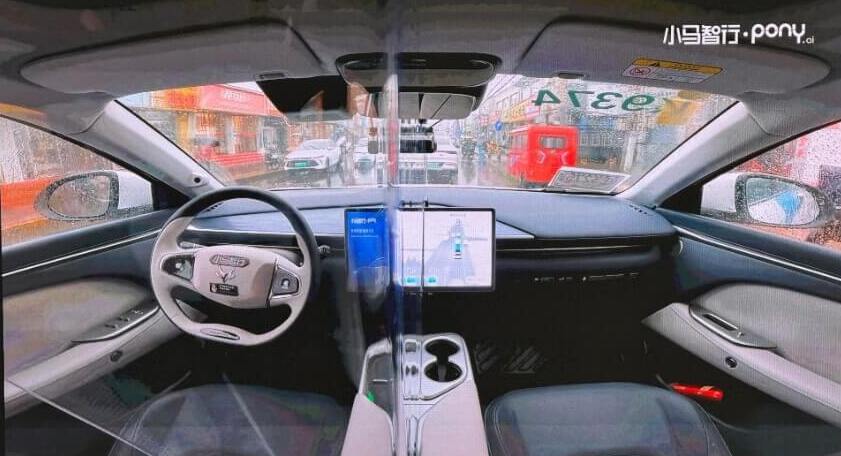
DVN-Dickmann: One important topic we discussed in the vehicle was radar resolution for Level 4 and higher. Could you explain why Pony.ai believes very high resolution, potentially in the sub-centimeter regime, is needed for normal Level 4 driving? What use cases drive this requirement?
Pony.ai: For Level 4, the objective is to operate as safely and reliably as possible within the defined operating area, without relying on a human driver as fallback. That changes the tolerance for uncertainty. The system needs strong perception and prediction capability, especially in complex urban environments, large intersections, unprotected turns, fast-moving vehicles, vulnerable road users and long-range interaction scenarios.
That said, I would be careful about reducing the discussion to one single radar parameter. Range resolution is one part of the overall sensor-performance picture, but detection probability, angular resolution, velocity estimation, update rate, robustness, dynamic range and fusion with cameras and LiDARs are also important. 4D radar can also bring unique advantages in challenging weather conditions, such as heavy fog or rain, where it can provide an important complement to cameras and LiDARs. Our general approach is to evaluate sensors based on the contribution they make to the full L4 system and safety case, rather than optimizing one specification in isolation.
DVN-Dickmann: That is clear. My question comes from the cost and integration logic. Even high-performance imaging radar can be relatively low-cost as a hardware box, and the vehicle-level infrastructure is comparatively simple. With LiDAR, even if the sensor itself becomes cheaper, the system may still need cleaning, scratch protection and line-of-sight assurance to guarantee quality of service. Doesn’t that create a cost floor, especially for privately owned vehicles?
Pony.ai: There is certainly a vehicle-integration and maintenance cost to consider, especially for privately owned vehicles where the operating model is different from a managed fleet. But in Robotaxi operations, we also learn from real-world deployment and can optimize the system based on actual maintenance data, not only theoretical design assumptions.
For our Gen-7 Robotaxi, one of the major achievements has been balancing safety, redundancy and cost efficiency. We reduced the autonomous driving kit BOM cost by 70% compared with the previous generation while maintaining a fully redundant L4 architecture. In a managed Robotaxi fleet, sensor cleaning, inspection, maintenance and service operations can also be standardized. For private passenger cars, the design constraints may be different, which is one reason we believe broad private-car L4 deployment will likely follow managed Robotaxi deployment.
DVN-Dickmann: As a former radar expert, I would like to better understand the specific driving use case behind the requirement for sub-centimeter or one centimeter-level radar range resolution in normal Level 4 driving. Even in dense urban traffic, pedestrian areas, large junctions or scenarios with many fast, low-RCS motorcycles, I would have expected other radar parameters, such as detection probability, angular resolution, dynamic range, update rate and robustness, to be more critical. In Germany, especially around Stuttgart, we have many non-perpendicular junctions and urban highway entries where vehicles or motorcycles approach from difficult angles. Radars that provide data that allows the discrimination of near bypass or potential pre-crash situation is enough. I can clearly see the value of 2 GHz or 4 GHz bandwidth for close-range automated parking, but I still struggle to see why normal Level 4 driving would require one-or even sub-centimeter-level range resolution. Especially for collision prevention and emergency braking functions Radar are heavily used which do not provide one- or even sub centimeter range resolution. Could you explain your logic?
Pony.ai: I think your point is valid. For normal Level 4 driving, we should not suggest that centimeter-level or sub-centimeter-level range resolution alone is the decisive requirement. In many real-world scenarios, detection probability, angular resolution, velocity accuracy, update rate, robustness in weather and lighting conditions, and the ability to support reliable sensor fusion may be equally or more important.
The use cases we care about include large intersections, unprotected turns, fast-approaching vehicles, motorcycles or e-bikes with difficult trajectories, and long-range interactions on curved roads or expressways. In these cases, the system needs enough perception confidence to support safe prediction and planning. Radar can play an important role, but it should be evaluated as part of a fused perception system, not as a standalone replacement for other sensors. So I would frame our position as: higher-performance radar is valuable for L4, but the exact specification requirements must be judged at the system level and validated through real deployment.
DVN-Dickmann: Let me frame the broader sensor question from a safety-case and cost-efficiency perspective. If imaging radar continues to improve and provides rich point clouds, one could imagine a front imaging radar and perhaps side radars as part of a LiDAR-reduction strategy. Lawyers often argue that product liability requires three orthogonal sensor types, but safety experts may say that the real requirement is statistically independent inputs and avoidance of common-cause faults. In a centralized AI architecture with raw or low-level sensor data, different sensor streams could be processed by independent algorithmic paths. From that logic, ASIL decomposition might be possible with camera and imaging radar alone, without LiDAR. Is there a flaw in this reasoning?
Pony.ai: Conceptually, the reasoning is understandable. The fundamental objective is not to use a specific sensor for its own sake, but to achieve sufficient safety, redundancy and independence while avoiding common-cause failures. In theory, if camera and imaging radar could provide enough independent and reliable information, and if the full system could be validated at L4 safety standards, such architecture could be considered.
Our answer depends on timing. For deployment today, we use what has been proven to work in real-world L4 operations. Camera, LiDAR and radar each bring different strengths, and the combination gives us a stronger safety foundation. For a future 2030 or 2035 architecture, the answer may evolve as imaging radar, AI models and validation methods improve. But for current large-scale L4 Robotaxi deployment, we prefer a mature, proven multi-sensor architecture.
DVN-Dickmann: Understood. So the answer depends strongly on whether we are talking about today’s deployment or a longer-term 2030/2035 perspective.
Pony.ai: Exactly. For today’s deployment, our priority is to use a sensor and compute architecture that has been validated through real-world operation, supports fail-operational capability and can be manufactured at scale. We do not want to rely on an unproven sensor concept simply because it may look attractive from a future cost perspective.
For a longer-term horizon, it is possible that sensor architecture will change. AI models may become stronger, imaging radar may improve, and vehicle integration may become cleaner. But L4 is ultimately judged by safety and real deployment performance. Until a LiDAR-free or reduced-LiDAR architecture is proven at L4 scale, we will continue to take a pragmatic, safety-first approach.
DVN-Dickmann: That is clear. My final check is simply on the logic: is there any fundamental mistake in that reasoning chain, or would you say it is logically consistent even if it has not yet been proven in practice?
Pony.ai: The logic is broadly consistent. The key distinction is between what may be possible in principle and what has been proven in real-world L4 deployment. From an engineering and safety-case perspective, we are open to future sensor-architecture evolution, but we need evidence from large-scale operation before adopting it for commercial driverless fleets.
DVN-Dickmann: Thank you for sharing these insights into Pony.ai’s strategy and philosophy. I am sure this will resonate with many of our readers, and I hope we will have the chance to continue the discussion.


