
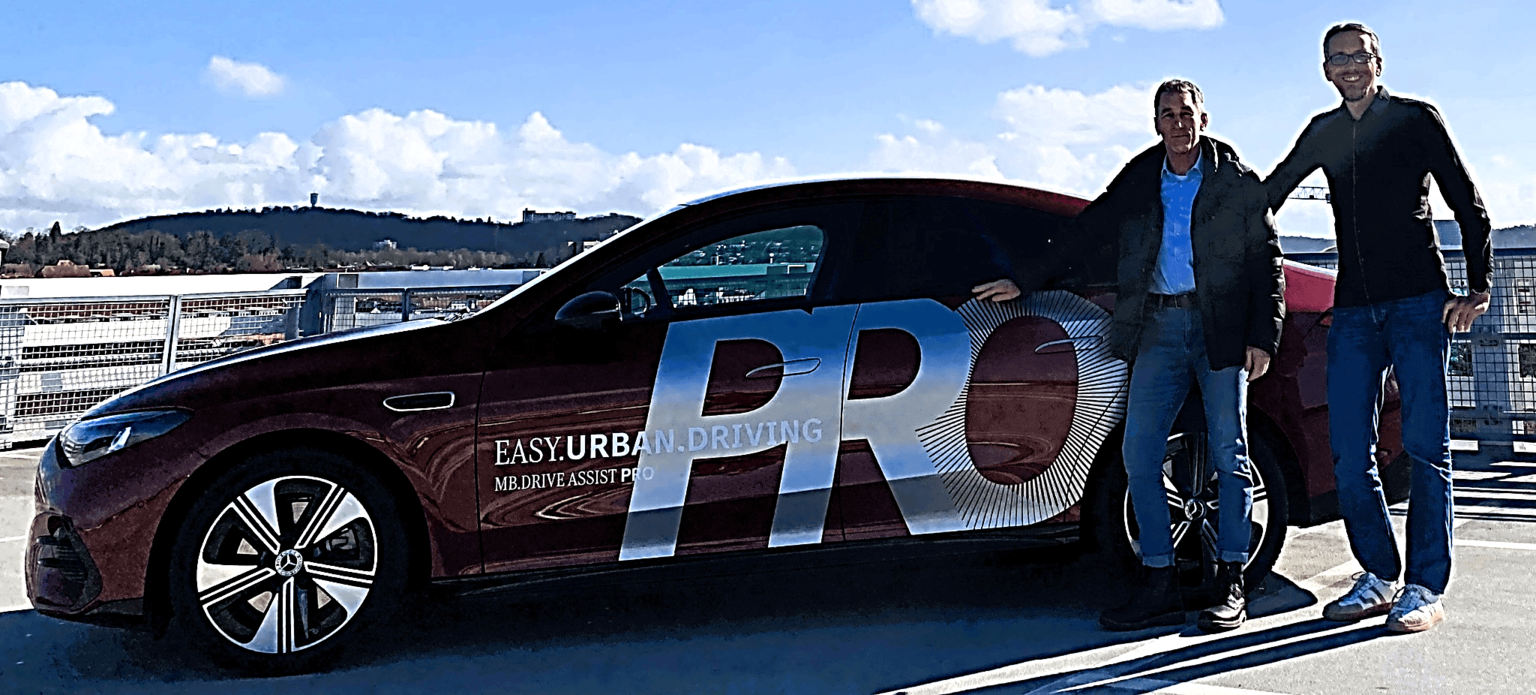
A one-hour demo in sunny, spring-like conditions suggested a supervised system that already feels strikingly natural – and surprisingly mature in urban use.
By J. Dickmann, DVN Senior Advisor and Independent ADAS/AD Engineering Consultant
When premium OEMs speak about point-to-point assisted driving from the driver’s home all the way to the destination, a degree of scepticism is healthy. Too many demonstrations in our industry still feel tightly managed or overly constrained. The one-hour Mercedes demo drive in Sindelfingen near Stuttgart, however, gave a different impression. In a red CLA development vehicle equipped with MB.Drive Assist Pro, I experienced a route that moved from urban streets around the factory gate 16 into the city and then out onto the Autobahn A81. MB.DRIVE ASSIST PRO is an advanced Level 2 system and complies with the updated DCAS, which will also take effect in the ECE region starting January 1, 2027. The system is already available in the CLA in China, will be introduced in the CLA in the U.S. this year, and will be available for sale in the ECE region starting in 2027. At that time, it will be available not only in the CLA but in nearly all new MB.OS-based model series from Mercedes-Benz.
The sensor-setup up is shown in the illustration and follows the general safety, using a multi-sensor configuration of Radar and Cameras as majority sensors. With appropriate C and Radar sensors, Lidar is not needed for L2 systems.

In bright sunshine, with spring-like temperatures, light traffic and relatively few pedestrians, the conditions were favourable – but the system still had to deal with the compressed distances, short reaction times and environmental variety that make city driving fundamentally harder than motorway assistance.
The strongest first impression was not raw capability but driving character. Like the better recent AI-based demonstrations, this Mercedes-Benz system did not behave like a machine nervously executing rules. It behaved in a calm, recognisably human way: smooth on steering, measured on braking, unhurried but not timid. For long stretches the ride felt comparable to the Wayve demo I recently experienced – not because the two systems share the same technical philosophy, but because both showed a welcome absence of robotic harshness. That matters. Customers will judge these systems not only by whether they complete a manoeuvre, but by whether their behaviour feels trustworthy and socially natural. I felt safe for the complete tour.
From Gate 16 to the city and out to the A81
The Sindelfingen route was well chosen because it compressed several use cases into a representative loop. It included urban traffic, denser inner-city stretches and highway driving, all connected by navigation-based guidance. Especially on A81 heavy road works take place and nothing seems like a normal pathway. Mercedes-Benz describes the function as point-to-point assisted driving: the user enters a destination, starts route guidance and activates the system; the car then steers, brakes, accelerates and turns where needed, while the driver remains responsible for supervision. In practical terms, the promise is clear: not a single isolated feature, but a continuous assisted journey.
Urban driving is where such claims become serious. The middle distances are much shorter than on the highway, reaction times are tighter, and the variety of surroundings is far greater. Lanes narrow unexpectedly, markings are inconsistent, parked vehicles reshape the road and the behaviour of other road users is less predictable. This is why progress in urban assisted driving is more meaningful than yet another incremental motorway function. It is also why any convincing demonstration in this domain deserves close attention.
A very human drive – even through complex roadworks
In the urban section, the Mercedes development car drove with maturity that was easy to appreciate from the passenger seat. The vehicle placed itself naturally in lane, braked early and comfortable enough to avoid drama and carried speed in a way that felt appropriate rather than algorithmic. There was no sense of the car dithering between options or waiting until the last moment to commit. That overall rhythm reminded me strongly of a competent human driver who is focused, cautious and experienced.
The most striking portion of the drive came later on the A81. Current roadworks there are intensive, and the temporary lane guidance is visually confusing even for a human driver. Original lane geometries are changed, temporary markings compete with the old layout, and the scene can look untidy and ambiguous. This is precisely the kind of situation in which a system can reveal whether it is merely functional or genuinely robust. Here, the Mercedes car remained composed. It followed the temporary path without visible uncertainty, did not hunt for the wrong centre line and handled the altered guidance with notable confidence. For a supervised Level 2 system, that kind of construction-zone stability is a strong result.
Hands on, eyes on – but the system carried the driving task
One point that merits careful explanation is supervision. Because the demo vehicle was a prototype (for EU) and because current regulation for this use case keeps the driver firmly in the loop, the test driver had to act in his “safety driver” role e.g. hold the steering wheel in the prescribed manner. That visual impression could easily mislead an observer into underestimating the system. The vehicle itself executed the driving task for most of the route. The role of the human was supervisory: monitor the environment, remain ready to intervene, and satisfy the legal requirements that still accompany an L2 function in urban traffic. Later, once this system is a regular series production system, drivers may hold the steering wheel in a natural and comfortable position.
Mercedes-Benz emphasized an interesting detail here: so-called cooperative steering. Unlike some conventional Level 2 systems, the driver can make steering inputs without necessarily deactivating the function, and even accelerator input does not automatically switch the system off. The logic is sensible. In dense city traffic, there are situations in which the driver may wish to slightly influence the motion while leaving the support structure intact. Combined with driver monitoring that checks the driver’s gaze direction, the overall concept feels more usable than the brittle on-off behaviour that still characterises many ADAS functions.
Mercedes-Benz internally describes the function as L2++, which is not an official regulatory category but a useful shorthand for the ambition: a supervised system that takes on a very large share of the dynamic driving task while remaining clearly within the Level 2 framework. In China and the US, Mercedes says versions of this capability are already being productised; in Europe the regulatory pathway now has opened as well. The important point for the drive itself was simpler: from behind the wheel, the driver was visibly present, but the system was doing the work.
Sensor philosophy: much broader than Wayve’s lean setup
Technically, Mercedes is pursuing a very different path from companies such as Wayve in their demo vehicles. The most obvious difference is the sensor set. Compared with Wayve’s relatively lean approach, the Mercedes vehicle uses a considerably expanded hardware package with multiple radars and cameras. That broader sensing envelope itself allows a more comprehensive environmental perception and hence better behavior, but in this demo, it likely contributed to the calm, well-grounded performance – particularly in construction zones and complex urban scenes where road geometry, lane interpretation and the behaviour of other vehicles can all change at short notice.
This richer sensor stack also makes sense from a product perspective. Mercedes is trying to industrialise a premium customer function, not just prove a research thesis. The engineering trade-off is therefore different: less emphasis on minimalism, more on robustness, redundancy and customer comfort over a broad range of scenarios. My impression from the drive was that this philosophy is already visible in the tuning. The car rarely felt like it was operating close to the edge of what it could understand.

China, the US and Europe – different stacks, similar behaviour
The software story behind the Mercedes system is also noteworthy. In China, Mercedes works with Momenta; outside China, including Europe and the US, the ADAS stack for this function is developed in a closed cooperation with Nvidia. According to Mercedes, the user story and the driving behaviour are intended to be identical even if the China version is naturally tuned to local signage, road markings and traffic conventions. If that holds true in broader testing, it would be an important achievement: a globally coherent function with regional adaptation, rather than entirely separate products that merely share a name.
For observers of the industry, this is strategically significant. It shows that Mercedes is not presenting a laboratory curiosity. The company is building towards product deployment with different regional technology pathways, while trying to preserve consistent customer experience. That combination of product discipline and technical ambition is exactly what has often been missing in European automated-driving narratives.
Why this matters
My main takeaway from Sindelfingen is that urban assisted driving has moved another step closer to everyday reality. The demo did not include dense pedestrian crowds, rain, darkness or the full catalogue of difficult edge cases. The light traffic and clear weather undoubtedly helped. But favourable conditions do not automatically create a good system; they merely remove excuses. Within that context, MB.Drive Assist Pro showed a level of composure and naturalness that deserves recognition.
The comparison with Wayve is instructive. Wayve impressed by showing how far an AI-centred approach with a leaner sensor suite can go. Mercedes, by contrast, demonstrated that a much more heavily instrumented premium-vehicle architecture can deliver a similar human driving feel while offering a clear near-term product path. Different philosophies, similar behavioural ambition. If the industry can bring this level of urban performance safely and scalably to customers, the centre of gravity in highly assisted driving will begin to shift from motorway convenience to genuine point-to-point usefulness. After this drive around Sindelfingen, that prospect no longer feels theoretical.
“The important shift is not that the car can assist on the motorway; it is that urban point-to-point support is beginning to feel technically credible and behaviourally natural.”
DVN note
Dr. Juergen Dickmann is an independent ADAS/AD engineering consultant and Senior Advisor at DVN with more than 20 years of experience in radar, radar perception, sensor fusion, perception architectures, sensor-set definition and automated-driving evaluation. For DVN, the Sindelfingen drive suggests that urban supervised automation is moving from technology demonstration toward real customer usefulness.
More detailed info can be found here:
Many thanks to my former Mercedes colleagues Jochen Haab and Alexandros Mitropoulos for making this demo drive possible.


