
I spent time last week at ISOL, the International Symposium on Lighting, held by ICAT in Delhi, just next to the Maruti plant in Manesar. ICAT, the International Centre for Automotive Technology – they handle vehicle certification in India, including their lamps – put on this event for the lighting community every two years, alternating with DVN, and I was pleased to talk and listen with participants including OEMs, tier-1 and -2 suppliers, and Indian authorities.
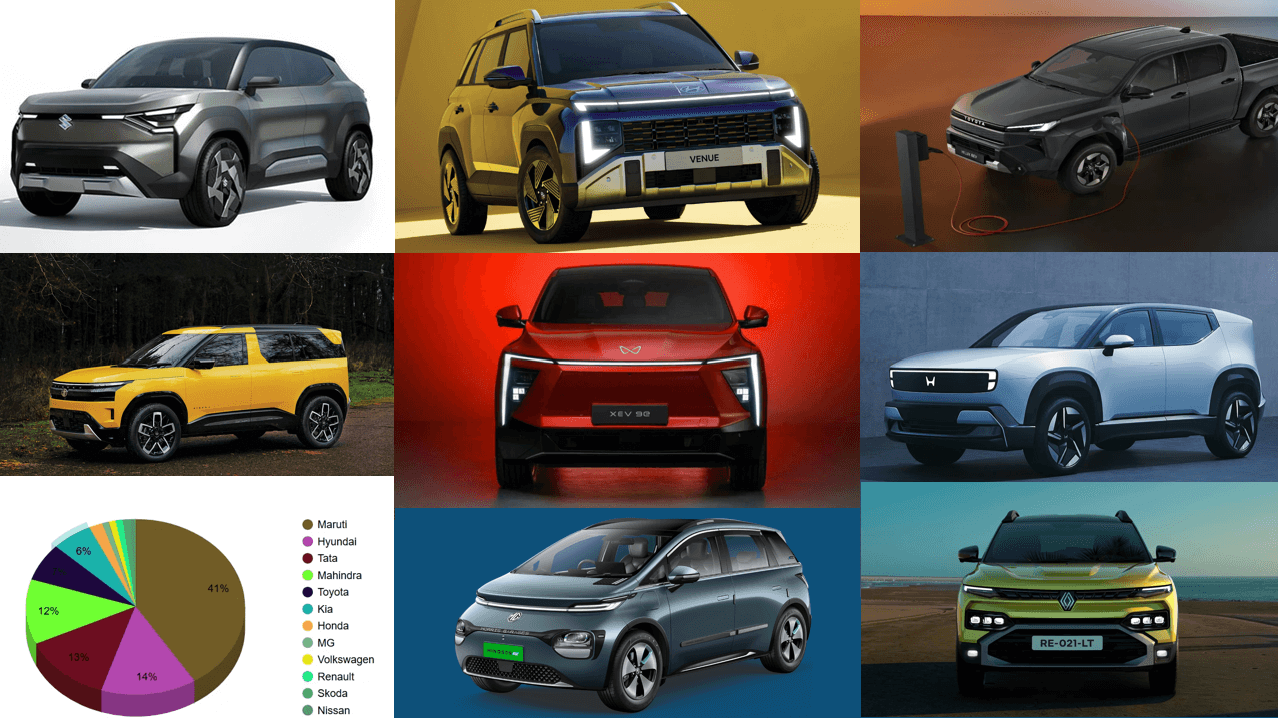
To illustrate what is happening in India, I chose images for this editorial pictures showing the latest models from the eight biggest OEMs in India. Everything has full LED lamps, and there’s even ADB on Maruti’s e-Vitara. Full-width light bars lit logos on Mahindra, Honda, and MG vehicles – vehicle lighting in India is evolving highly and fast. This year at DVN Munich, Mahindra’s welcome animation won the award for best lighting UX. It is interesting to see this fast evolution, with the Indian middle class’s revenue increasing the number of people able and ready to invest in a new vehicles with premium features for safety, style, and experience. Safety is the main key topic in India due to road infrastructure deficiencies and challenges, which drive high-performance lighting needs.
According to Fiem CEO Vineet Sahni, ballpark value for advanced vehicle lighting in India is increasing exponentially, from ₹50,000 to ₹75,000 for passenger cars (~€500 – €750), and ₹7,000 to ₹10,000 for 2-wheelers (~€70 – €100).
Uno Minda 4W CTO Todd Morgan mentioned global automotive market growth from 2019 to 2024 of 41.2 per cent in India (versus 4.1 per cent in China, 7.3 in South Korea…and declines of 6.4 per cent in USA, 13.9 in Japan, and 22.8% in France) with continuous growth in India by 2035 (forecast at 7.7 per cent).
India is not only catching the train, they are also innovating. Fiem mentioned how they use AI to successfully run thermal simulations, and Maruti presented interesting results about LED thermal dissipation improvement with paraffin wax usage (Tcase reduction of 30 Kelvins versus classical thermal paste).
In today’s newsletter, I bring you some examples of the latest Indian innovations to give you a sense of the directions and scope of this fascinating evolution.
Sincerely yours,