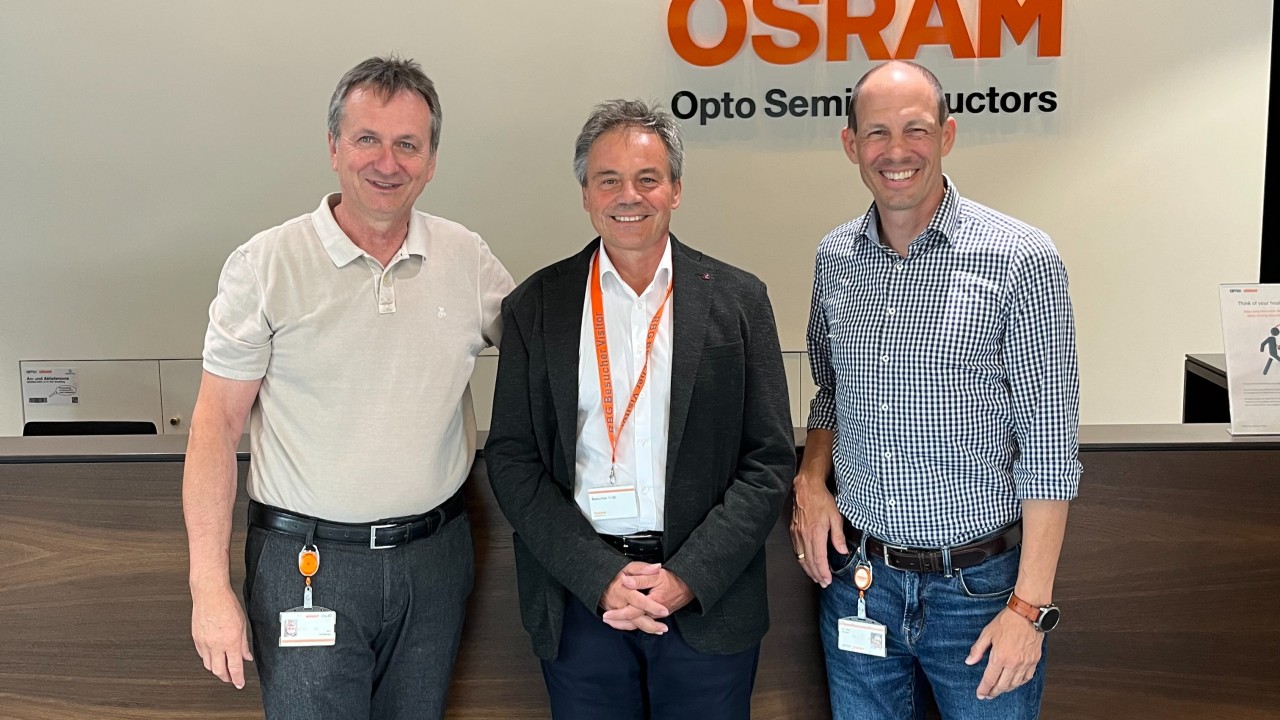
For the 100th anniversary of ams Osram’s vehicle lighting activities – their first headlight bulb, the Bilux AS, was introduced in 1925 – DVN’s Hans Joachim Schwabe talked about the challenges of the field a legend in automotive semiconductor lighting, Wolfgang Lex, and his successor Joerg Strauss.
DVN: Wolfgang Lex, can you talk about yourself and your milestones with ams Osram, and your career path to legendary status in the industry?
W.L.: Sure! My journey began during my university days, where I focused on the characterization of discrete semiconductors for my diploma thesis. That early exposure led me to Siemens Semiconductor, where I started as a quality engineer. I was deeply involved in verification and reliability testing, which gave me a solid foundation in efficiency, process optimization, and Moore’s Law.
In 1995, light became a central theme in my work. We began developing orange LEDs for interior lighting in collaboration with BMW. This was made possible by AlInGaP chip technology and the transition from radial LED to SMDs.
One of the biggest achievements was converting blue LED light into white using yellow phosphor converters. Audi’s introduction of homogenous white interior lighting behind plastic surfaces marked a true milestone. I was still heavily involved in product qualification, including PPAP and reliability testing, which laid the groundwork for the race among OEMs to define their brand-specific lighting colours.
In 1998, I moved from quality and reliability to a newly formed business line at Osram Opto Semiconductors, the ICC group (Industry, Consumer, Computer). Our mission was to intensify the spread of new LED technologies into consumer and industrial applications, like keypad illumination and LED flash for mobile phones.
By 2001, ICC merged with the Automotive division, and I took on the role of VP for Marketing and Application for the LED business. From 2006 to 2016, we saw rapid LED adoption across automotive applications – replacing halogen and incandescent bulbs in rear lights, Daytime running Lights and headlamps. I also had the opportunity to lead OSRAM’s sales operations, particularly in China.
From 2016 onwards, LED technology continued to evolve, with newer generations offering higher efficiency, lower costs, and smarter applications. While Innovation remained strong, especially in South Germany (OEM), the industry increasingly felt the pressure of cost optimization.
DVN: Joerg Strauss, will you introduce yourself as a relative newcomer and Wolfgang’s successor?
J.S.: Certainly. I studied chemistry and first encountered lighting during my PhD thesis research on OLED-like materials. In 2002, I joined Osram Opto Semiconductors in Backend Development R&D, where I worked on packaging and chip conversion technologies. My first touchpoint with Automotive was with Audi, developing new DRLs for the R8 and A4 using Dragon and APT LEDs.
From 2008 to 2011, I lead R&D for phosphors, supporting both LED and fluorescent lamps. Then, I moved to the U.S. to head Osram’s Research Centre in Cherry Hill, MA, from 2011 to 2016.
After returning to Germany, I rejoined the automotive business, focusing together with my team on laser technology for headlights (additional high beam), including a novel security switch-off mechanism. In late 2017, I became business line Head for IR Emitters and Lasers, working extensively on automotive sensing.
Most recently, from 2023 until 1st of April 2025, I served as Head of Corporate R&D and Quality at ams Osram. It’s been an exciting journey so far, and I’m honoured to continue building on Wolfgang’s legacy.
DVN: What have been the biggest highlights of your career, and which honours you are proud of?
W.L.: One of the early highlights was working with Nokia Mobile to revolutionize keypad backlighting – moving from basic green illumination to innovative white, followed by high power LED flash in mobile. This trend of pure white lighting later influenced both interior and exterior automotive applications.
But perhaps the most significant innovation was the development of our 25-kilopxl chip. It began over a decade ago as a research activity with Daimler, Hella and Infineon. Despite several technological and business hurdles, we brought it into mass-production two years ago. Convincing OEMs, management, and our own team was a rewarding journey and a major step forward.

DVN: What do you see as the biggest challenges for LED makers?
J.S.: The market dynamics has changed rapidly over the last decade, largely due to the entrance of Chinese automotive OEMs and suppliers in the e-car sector. This has created new ways and rules within the entire automotive supply chain.
Meanwhile, LED technology is maturing and, in many areas, soon reaching its physical limit e.g. in terms of efficacy. As commoditization sets in, cost becomes an even more critical factor. The challenge is to manage this while staying true to our innovative DNA, pushing forward with smarter driving modes, new materials, and intelligent solutions.
DVN: Do you see a maximum threshold for lm/W efficiency?
W.L.: In the end it is more a theoretical discussion as 220 lm/W already have been proven. A multiplication of Photons is limited, but destruction is multiple on the way to the final optical system solution. From a tier-2 perspective, system optimization – rather than chasing peak performance – offers the greatest benefits in efficiency and cost.
DVN: How do you forecast the automotive lighting market?
J.S.: Currently we are foreseeing a stable market in terms of vehicle production with around 90 million units per year. Despite intense price pressure, innovations like our Eviyos HD matrix chip with 25-kilopixel are increasing lighting content per vehicle, which should lead to a single-digit percentage market growth per year.
Design wise, we’re seeing a strong trend towards narrow slit-like lighting designs with 30mm height or even below. We’ll need to work on minimizing light loss as long as it’s possible within the constraints of physics.
DVN: What do you see as the biggest breakthrough innovation within last 20 years?
W.L.: Without a doubt, the 25-kilopixel chip stands out; it enables intelligent, flexible HD lighting for a wide range of more use cases in other application areas. But as former ‘Q-Engineer’, I’d also highlight the breakthroughs in material combinations and the integration of opto chip technology with silicon. The entire manufacturing process, backed up by strong IP and qualified for harsh automotive environment conditions, represents a major achievement.
DVN: Do you see future trends/developments or other applications driving change in the industry?
J.S.: Definitely. While regional differences exist, we’re seeing matrix lighting and intelligent light controls gaining traction globally. The next step in this journey is HD adaptive driving beam functionality, powered by our 25-kilopixel Eviyos technology. It enhances safety, comfort and light functionality.
Also, the interior of cars is further developing with innovations like panoramic head-up displays or RGBi ambient illumination which turn the car into the next living room. Innovations like Eviyos, iRGB, pHUD etc. are not just premium features anymore; they’re increasingly being adopted even in the compact car class segment.
DVN: Being involved in multiple functions, including non-automotive lighting and electronics, do you see beneficial cross-learnings and synergies?
W.L.: Absolutely. White LEDs were initially developed for a single application, but they used the same EPI reactors and material combinations across industries. This shared foundation allowed innovations to spread beyond their original domains.
In fact, the push for white LEDs in automotive lighting significantly accelerated their adoption in general lighting. Without that momentum, mainstream use might have taken much longer, Cross-industry synergy has been a key driver of our success.
DVN: Anything upcoming to challenge LED?
J.S.: For sure lasers have been discussed and are implemented in some applications. However, when it comes to the mass automotive market, the price-performance ratio of LEDs remains unbeatable. At this point, I don’t see other real challengers for LED around the corner right now.
DVN: Being involved with OLED also, what do you think about technology also with regard to Displays?
W.L.: OLED has been started as a singular application for non-functional 3D displays – mostly single-colour. The challenge of going into a huge investment for product and process running at least for a 20-year cycle overshadowed by market weakness and competitive technologies for limited use cases has been a blocking point.
Scale and value forming was critical, and functionality could many times not replace LCD and LED technology due to simple cost reason. Maybe time can change since LED is now widely used as TV and handheld technology which can provide now scale for lower cost.
DVN: Being actively involved in lasers how do you see challenges for LED?
J.S.: Indeed, lasers have certain technical advantages, particularly in terms of luminance, which can be leveraged for both lighting and projection functions in automotive applications. However, it’s always a balancing act between luminance, power-consumption, and cost. Many of these applications can still be effectively realized by LEDs. The challenge for laser remains scaling – achieving a cost-effective price-performance ratio is still difficult. That said, I believe that implementation of laser projectors inside or even outside the car could be an interesting application going forward.
DVN: Capacity of LED has been again and again a kind of bottleneck; is lead time so critical for expansions?
W.L.: The LED business is highly scale-dependant. Take TV backlighting, for example: some models use 500 to1.000 LEDs, which significantly impacts cost. LED capacities follow standard semiconductor behaviour; there are times with overcapacity and times with shortages. It is all about speed in reaction accordingly.
With new technologies like Eviyos 25k, we’re entering a new level of complexity in our industry. We’re merging two different manufacturing supply chain with different lead times into one product category.
DVN: How do you cover major risks out of geopolitical or nature disasters?
J.S.: Our automotive supply chain is robust, with front-and backend production sites in Germany (FE), Malaysia (FE & BE), and China (BE). Still, we’re not immune to global influences, much depends on the further development of US tariffs, and on the question of how these will affect global automobile production. We’re actively managing those influences and feel well-prepared overall.
DVN: Are you partnering with others for industrialization purpose?
W.L.: We generally prefer in-house development, but we’re evaluating core and non-core strategies. In automotive, dual source compliance is a must for materials and critical processes. That’s why we have dual-site production for key operations.
DVN: For a couple of years, you have been involved in sensing and IR technology especially for autonomous driving. How do you see further progress there?
J.S.: Over the last years there has been a noticeable shift in focus toward electrification at OEMs, which has slowed the scaling of sensing applications compared to expectations from 5 to 10 years ago. Still, sensing technologies – enabled by IR emitters like IRED, VCSELs, and edge-emitting lasers – have advanced significantly, both for exterior applications like lidar and in-cabin sensing. However, fully autonomous driving is a different level of complexity. It requires enormous sensing effort including redundant systems. There is impressive work done by players like Waymo, but it’s still ways to go for many companies until autonomous driving application in the mass market can happen.
DVN: Having been a key person in developing the next generation of HD Multi-pixel chip from 1,024 pixels to 25 kilopixels, how do you see this discussion on more and more pixels to reach highest resolution?
W.L.: Scaling to 100 kilopixels or more can’t be justified by automotive applications alone. Developing such high-resolution ICs and opto-chips can easily breach 3-digit millions of Euros (more than €100million). At that point, we’re talking about RGB projectors on a chip – a multi-dimensional platform that would need to be driven by a high-volume industry beyond automotive.
DVN: Currently you are developing high-brightness products for automotive displays (eg Aliyos) Can you elaborate on some activities?
J.S.: Light-out-of-nowhere is a fascinating enabler for new functionalities supporting trends like smart surfaces. In principle, any area inside and outside the car can light up in future without recognizing it in the off-state. We’re also enabling free forming, which gives designers more freedom.
Right now, we’re focusing on 2.5D curving and freezing the carrier material. Our first technology has already been automotive-qualified. These applications will use miniLEDs initially, followed by microLEDs. We’re committed to pushing this technology further to unlock even more possibilities.

DVN: What is your view on current and future competition? Is China with their capabilities your biggest threat? How do you differentiate?
W.L.: With over 50 years of LED experience, our strength has never been about volume alone. It’s always been delivering innovative products for new applications, paired with structured volume growth.
Even today, we serve high-volume markets like general lighting, but we focus on segments where performance and high quality are critical. This differentiation has helped us remain a valued partner for our customers – even in highly competitive environments like China.
DVN: With regard to significant changes ahead with electric, shared, and autonomous driving, how do you evaluate opportunities vs challenges?
J.S.: Despite the general challenges in the market and changing dynamics, I still see tremendous opportunities. Technologies like ADAS and E-cars are increasing the demand for sophisticated optoelectronic solutions. The content per car is rising, both in lighting and sensing, which bodes well for our industry.
DVN: The Chinese display industry claims superior cost benefits with chip-on-board technology: Do you share that view with regard to automotive displays?
J.S. & W.L.: It’s true that chip-on-board supply chains are currently centred in China. However, we believe that broader display solutions – including HuDs and pHuds – will continue to demand innovative solutions. This creates a competitive space where western players can still thrive.
DVN: What will you focus on after retirement?
W.L.: After a career filled with global travel and professional commitments, my family often had to take second place. So, my retirement focus will be on them – especially watching my grandchildren grow, which I’m really looking forward to.
Beyond that, I am very excited to explore woodworking and hardware creation through wood carving. It’s a new challenge and a chance to keep learning. I believe in never stop thinking and learning.
And for sure, I will be watching my colleagues in Opto Semiconductor from my retirement beach as they continue to change the world. Cheers!
DVN: Any expectations and wishes with regard to Automotive industry?
J.S.: My hope is that the automotive industry is not only trending towards a pure and narrow component cost focus. While cost is undeniably important, we must also prioritize innovation – solutions that enhance total cost of ownership, deliver stellar performance and quality, and improve higher safety and comfort. A stable and secure supply chain as well as a strong IP protection are equally vital.
DVN: ams Osram is a long-term player and exhibitor at the next ISAL conference in Darmstadt. Can you highlight shortly what you will present during the conference?
J.S.: We’re very much looking forward to ISAL – it is a fantastic venue to connect with leaders and experts in automotive lighting. This year, we’ll be showcasing improvements to our Eviyos technology, including the new 4k-pixel version with flexible resolution, known as Eviyos Flex. We’ll also present new demos of Aliyos, which highlights its unique value proposition: ‘Light out of nowhere’. It’s a powerful product that continues to inspire new applications.


