
Once a purely functional tool for cutting through darkness, vehicle lighting is now a design signature — a way for brands to stand apart and drivers to connect with their vehicles on a more personal level. Last year, the global market for vehicle lighting was expected to reach about $35bn, with analysts projecting it will grow to more than $48bn by 2029.
That growth reflects a shift in purpose. As the industry moves toward the era of connected, autonomous vehicles, lighting is evolving into an intelligent interface — capable of offering clear, trustworthy signals in increasingly complex driving conditions. Nowhere is the change more evident than in the luxury segment, where automakers use light to refine the contours of a car, reinforce brand identity, and turn every approach or departure into a small performance.
LG Innotek’s latest lighting innovation, the Nexlide (for ‘Next Lighting Device’) is built on a proprietary microöptical technology. It blends high-performance, reliable optical films with flexible resin materials, giving automakers more freedom in design while improving energy efficiency. The system adapts easily to a range of applications, from daytime running lights to rear combination lamps that demand both form and function.
Since its introduction in 2014, Nexlide has been on a steep trajectory, posting an average annual growth rate of 47 per cent and surpassing $110m in total revenue by 2024. Today, it serves more than 170 programs to tier-1 customers worldwide, backed by a portfolio of over 200 patents.


There’s the NexlideA series, built with ultraviolet curing, and the Nexlide M series, which uses heat curing. Each is engineered with a different set of strengths. The A series emphasized homogeneity in tight spaces. Its slim modules and UV curing process improve manufacturing efficiency and ensure an even glow in the most confined lamp housings. From this core, the lineup branches into specialized versions. There’s Nexlide A+ for front lighting, Nexlide C+ for 3D effects, Nexlide E for seamless illumination, Nexlide L for sharp linear designs, and logo lighting for distinctive branding. By reducing the number of LEDs required, the A series lowers power consumption while maximizing energy efficiency.
The M series is for tougher environments. Using heat-resistant resin, it is built for applications where reliability under high temperatures is required. With higher optical efficiency than conventional systems, the M series boosts light output and energy performance. Applications include DRLs and front and rear signal lighting. The lineup is expanding; recent additions include Nexlide Edge, Nexlide Vision, and Nexlide Air.


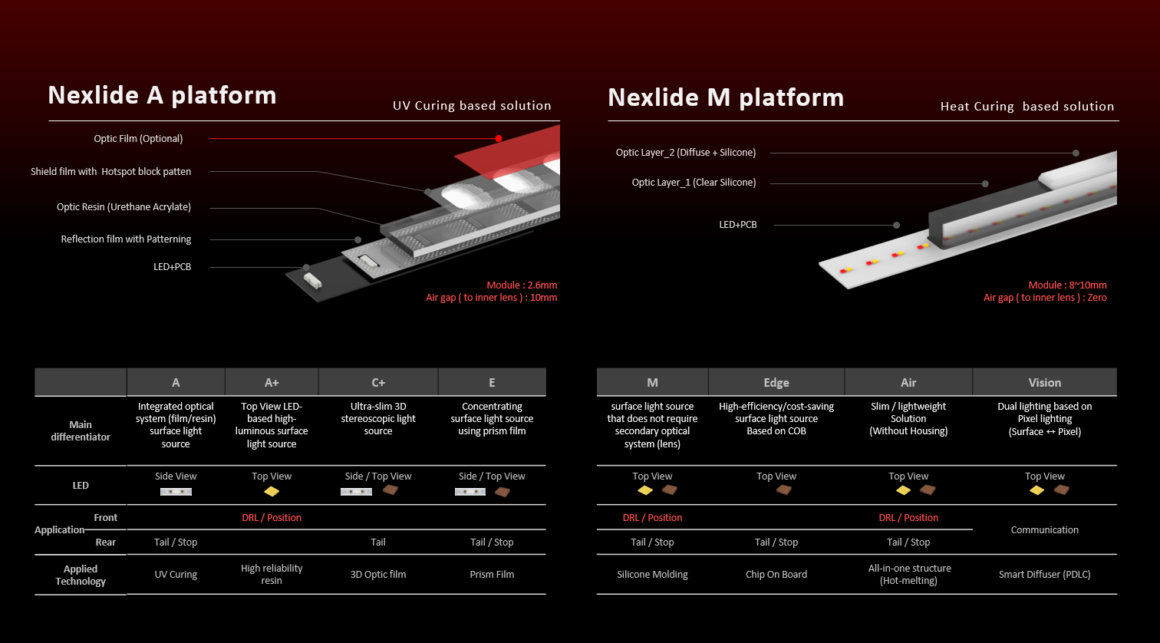
In the Nexlide Edge lighting module, LEDs are often among the costliest items on the bill of materials. Hence the desire to cut costs by spacing LEDs farther apart and reducing the total count without sacrificing performance. The Nexlide Edge replaces conventional LED packages with bare LED chips, to create slimmer modules that run cooler, shine brighter, and consume less energy. The result is a uniform, high-quality lit appearance.


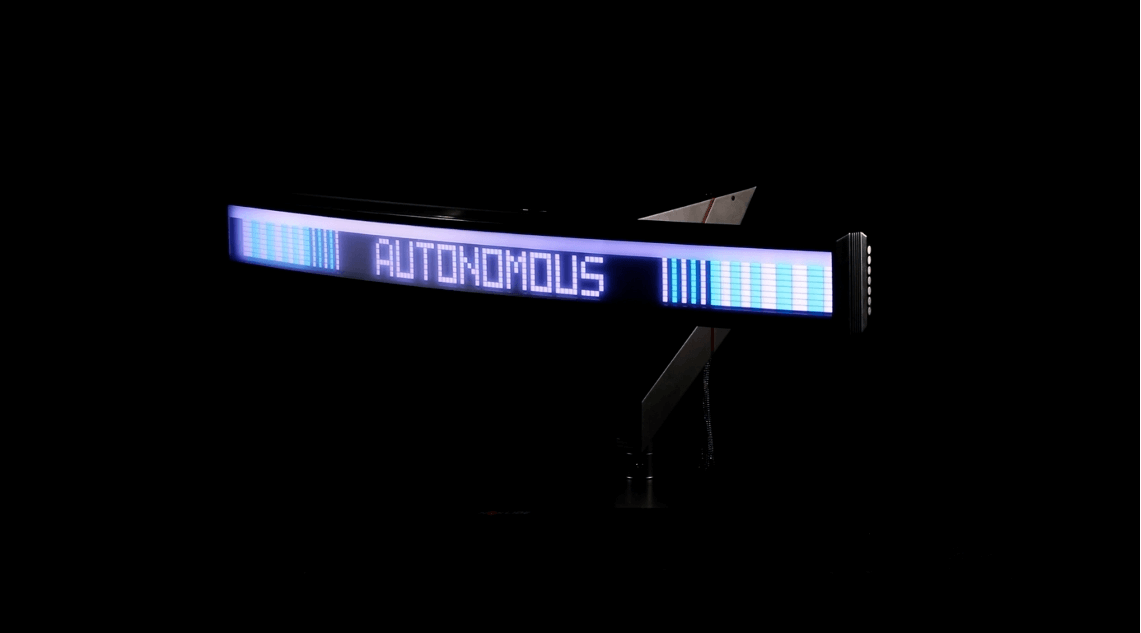
As for Nexlide Vision: automakers are toying with full-colour Interactive Social Displays (ISDs) for branding and messaging. Using sources like mini- and microLEDs, these systems give designers the freedom to blend function with spectacle. By varying the diffuser density depending on whether it’s powered on or off, the Nexlide Vision module can shift between pinpoint pixels and broad, seamless lighting. With an integrated driver IC capable of complex pixel animations, it facilitates lighting effects that can signal, entertain, or impress: a flexible tool for the next wave of automotive design.


Automakers are increasingly putting light into new places — the curve of a bumper, the mesh of a grille. These parts of the car entail safety considerations and structural limits, making it hard to deliver a distinctive yet practical solution. LG Innotek’s Nexlide Air is a waterproof module which mounts directly to the back of the vehicle’s exterior lens, freeing designers from many old structural compromises. A hot-melt process secures the silicone back cover, creating a fully integrated unit that eliminates the need for a separate lamp housing. The result is a versatile platform that works well in a front position lamp or decorative accent or in tail and stop lamps.


About fixation into lamps, there are multiple ways to mount Nexlide onto brackets, but the most widely adopted method is the push-pin type. This push-pin is a rivet-style pin made of slightly flexible material, and it is pre-assembled onto the Nexlide board. Installation is simple: the customer’s worker only needs to press the pin into the bracket, and the module locks into place. Its shape — reminiscent of a Christmas tree — ensures a secure fit that resists pull-out, even under vibration or stress. The color and position of the push-pin are also carefully designed to preserve the homogenous lit image, ensuring it does not interfere with the lit appearance quality.
For customers seeking alternative solutions, LG Innotek also offers an SMT clip type, featuring a stainless-steel clip mounted on the back of the Nexlide board. By placing the clip on the rear side, there is no mechanical structure on the light-emitting surface, which helps maintain a more uniform lit appearance. This method is commonly used with Nexlide M-type modules.
Lastly, for maximum convenience, LG Innotek can supply Nexlide as a sub-assembly module — pre-mounted on the bracket and ready for immediate integration into the customer’s housing.”
As electrification and hyper-personalization reshape the auto industry, light is turning into a language. In the mobility era ahead, vehicles will use lighting to communicate with pedestrians, signal to other cars, and express a brand’s character as well as the driver’s moods.
LG Innotek will reveal Nexlide Edge, Vision, and Air later this year during an upcoming Lighting Solutions Webinar.


