
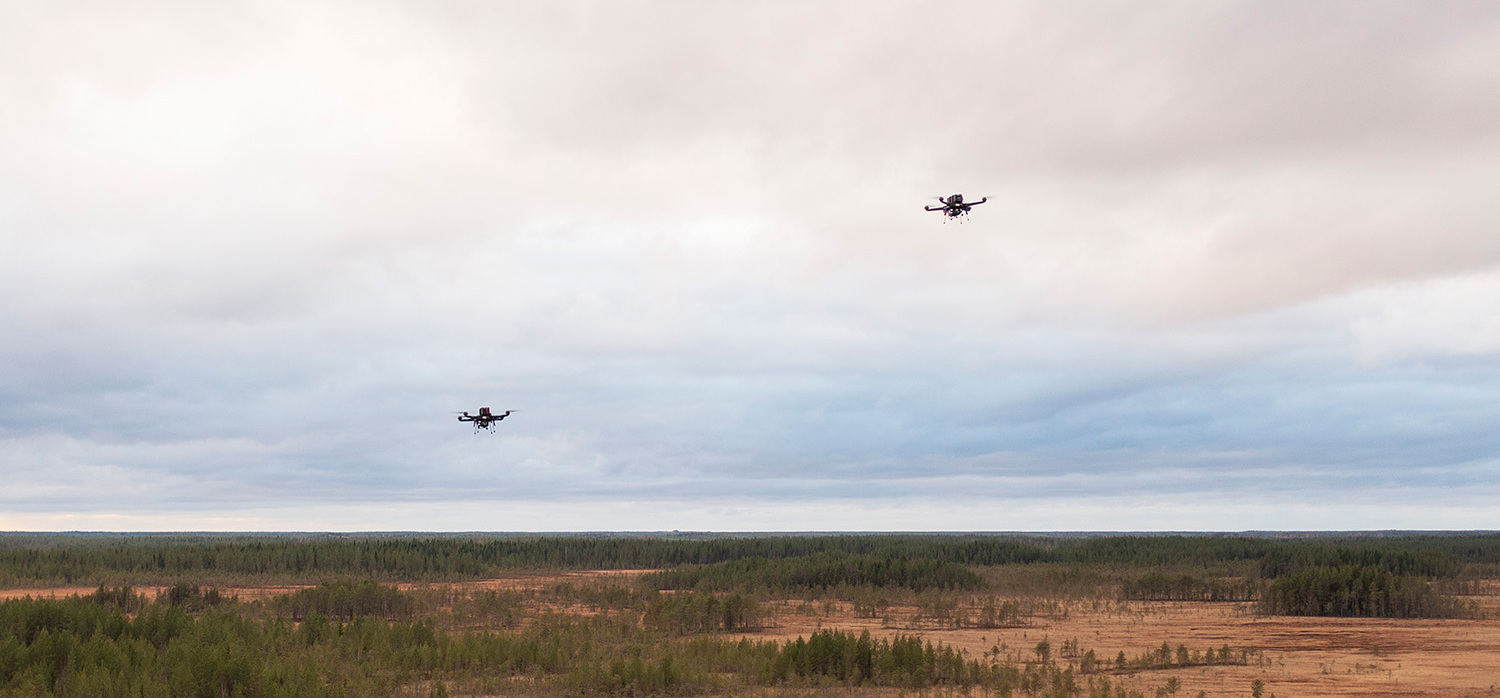
Unikie and Bittium demonstrate autonomy over tactical radio
Unikie and Bittium announced a demonstration of autonomous drones using a tactical communications network at the NATO Innovation Range event in Oulu in October. NATO is the North Atlantic Treaty Organization. The demonstration brings drone coordination together with communications and shared situational awareness.
Bittium supplies tactical networking and radios, including a module intended for unmanned systems. Unikie brings work on autonomous systems, sensor fusion and drone coordination. Other partners contribute aircraft, embedded software and voice technology. The integration is therefore wider than a standalone aircraft or radio demonstration.
Unikie’s automotive activities provide a relevant adjacent application. Its AutoLog programme combines vehicle coordination, perception and communications in port logistics. Both programs concern autonomous machines connected to infrastructure, although their operating conditions and safety requirements differ.
The common supplier does not establish that identical software or an automotive safety case transferred to the drone programme. The event is an integration demonstration. Measured range, latency and performance under disrupted communications have not been disclosed.
The concrete cross-sector development is work on connecting autonomous platforms with an operating network and human command. It creates an engineering comparison with vehicle applications while leaving the robustness and readiness of the tactical system to be demonstrated within its own conditions.
Applied Intuition takes commercial autonomy infrastructure to the Navy

Applied Intuition announced a United States Navy production contract in October for data infrastructure and onboard perception. Its Intelligent Perception System is planned to begin with five Arleigh Burke-class destroyers, building on an earlier data-collection prototype programme.
The company’s Data Engine connects collection, processing and use of operational data. Its Acuity perception platform uses shipboard camera and infrared inputs for detection, tracking and classification, with visual overlays and alerts for operators. The system is also intended to keep collecting material that can support model improvement.
Applied Intuition explicitly describes adapting commercial production autonomy technology to naval requirements. The transferable elements include sensor integration, data pipelines, onboard computing and the mechanisms for updating deployed models. They are development and deployment capabilities that also matter in automotive autonomy.
The application is not a road-driving system transplanted unchanged to a ship. Maritime perception, communications and operating procedures create a different integration and validation task. The contract also does not mean every planned installation is already complete.
The significance is a move from data collection towards a production deployment programme using the same wider commercial-autonomy infrastructure business. Its progress should be measured through installed capability and operational evidence within the naval application, rather than inferred from automotive experience alone.
Forterra’s field report highlights cross-sector lidar integration

Ouster reported that Forterra’s Lancer ground vehicles in Ukraine had completed 1,426 missions, including 88 casualty-evacuation operations. These are company-supplied aggregate figures. They do not identify every mission’s operating mode or establish that each was completed autonomously.
The Lancer platform uses Ouster’s OS1 light detection and ranging sensors, or lidar, to supply three-dimensional information about its surroundings. The announcement concerns deployed Rev 7 sensors and plans for the newer Rev 8 generation. Earlier missions should not be attributed to hardware planned for a later configuration.
The application connects vehicle sensing and autonomy integration with difficult off-road conditions. It is a concrete reuse of a sensing product family across commercial and defense-related markets, rather than a general claim that all autonomous technology has military relevance.
Operational experience can help a developer identify integration and maintenance issues. Its meaning still depends on terrain, mission, supervision and the rest of the vehicle system. A mission count is not equivalent to a road-driving safety measure or a validation result for a passenger car.
For automotive suppliers, the useful comparison concerns how a sensor is integrated, supported and evaluated in another demanding environment. The field figures describe Forterra’s reported activity, with their original scope retained.
Ouster and Seneca adapt lidar sensing for wildfire drones

Ouster and Seneca announced in October a partnership to integrate Ouster’s Rev 8 OS1 Max light detection and ranging sensor, or lidar, into Seneca’s autonomous drone platform. The programme targets wildfire-response tasks including carrying cargo, terrain-following mapping and inspection of structures and utility infrastructure.
Seneca previously used infrared sensors and cameras for collision avoidance, mapping and object detection. Adding lidar supplies three-dimensional distance information to the perception system. The companies highlight range and detail as relevant to obstacle detection while an aircraft moves through difficult terrain.
The proposed operating environment includes smoke, dust and changing visibility. Sensor durability and perception integration matter in those conditions, but an environmental rating is not a guarantee that a complete aircraft can operate safely in every fire scenario. The partnership describes an integration programme rather than an independently assessed mission-success rate.
The cross-sector connection is the reuse of a sensing product family across vehicles, robotics and emergency-response aviation. It is not a military deployment claim. The experience is relevant to suppliers working on perception in demanding environments, with validation still specific to the aircraft and its task.
The next evidence is the integrated platform’s operating performance within those defined missions. Sensor specifications are one input to that assessment rather than the outcome itself.


