

The 2026 Paris Motor Show has surely surprised and impressed many visitors with its wide variety of concept cars, special versions of production models, and creative, colorful interiors. We are pleased to have the opportunity to speak with Cedric Caravano, a highly renowned specialist in automotive seat design, about the latest trends in his field and his experience with European, North American, and Chinese markets.
DVN: What’s your impression of this year’s Mondial de l’Auto?
Cedric Caravano: I went to the show to get a sense of the latest production-seat designs and emerging trends in automotive seating, as I’m currently working on an ambitious new seating project for a sports car. There were some interesting concepts, of course, but production-ready solutions were my main focus.
One thing you couldn’t miss when entering the show was the strong presence of Chinese brands, with a remarkably high level of execution and a broad product range.
Two groups stood out to me: premium European brands, and the many Chinese brands that, judging by conversations I overheard on the public day, were still relatively unfamiliar to visitors.
I was also genuinely impressed by the diversity, relevance and quality of the CMF (Color, Material and Finish) solutions on display throughout the show. There were so many strong examples that it was hard to narrow them down here to a short selection.
DVN: The upper backrest is one of the most complex and visually exposed areas of an automotive seat. It brings together structural, functional and decorative elements, while offering designers an important opportunity to express a brand’s identity. What caught your attention in Paris?
C.C.: The upper backrest has traditionally been an area where designers can add visible value. It is the only part of the seat that can be seen from outside the car. And in vehicles and markets where the second row is frequently occupied, it is also what passengers look at during the journey.
Large decorative bezels beneath or behind the headrest were a recurring feature. In many cases, they created an open, see-through effect where the backrest extended around them.
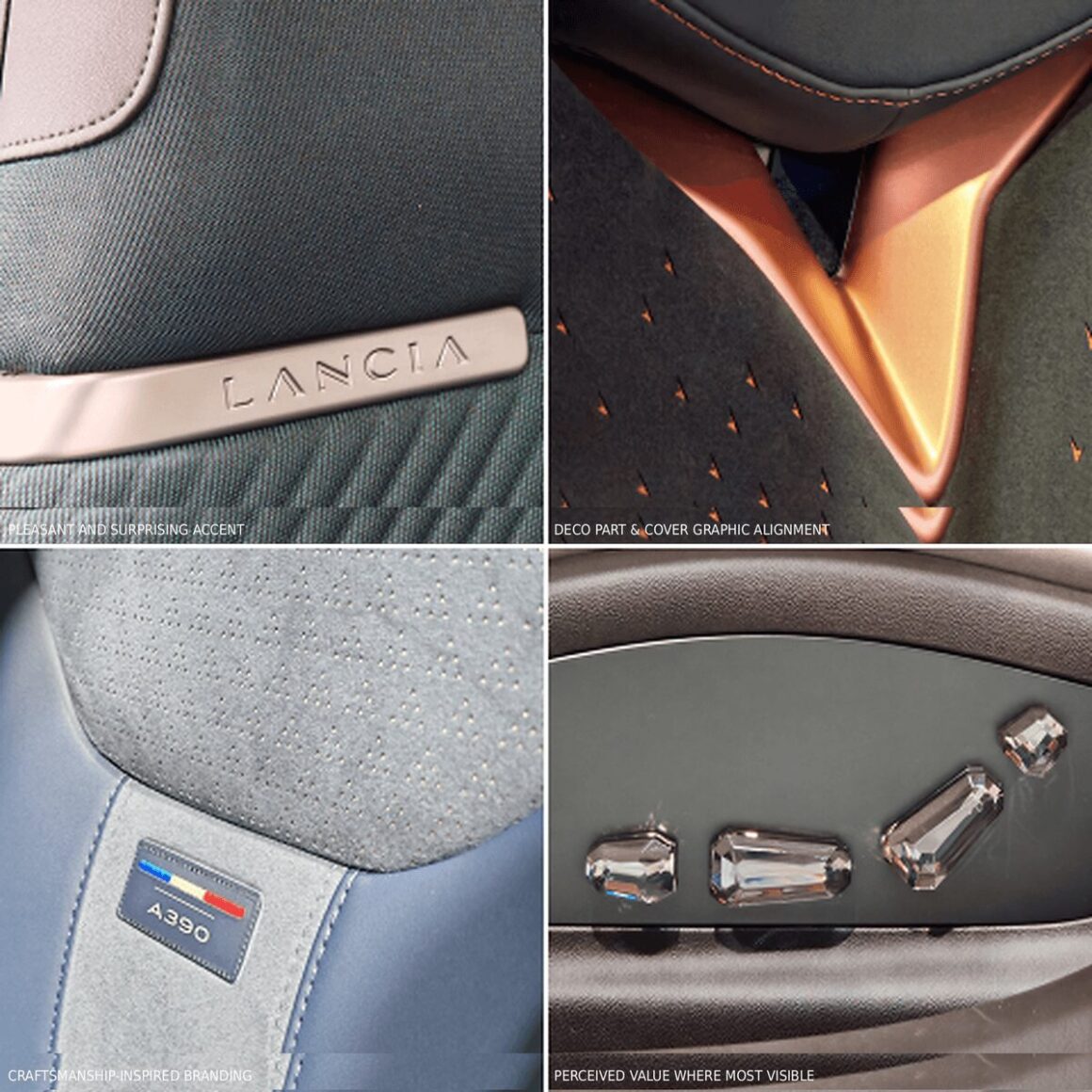
I also noticed a few examples where a similar decorative element appeared on both the rear panel and the front trim cover, creating a strong sense of design continuity.
Several cars featured another related idea: a stripe or band running across the seat at its centerline. In most cases, it was integrated into the trim; in a few, such as the Kia, it continued over a rigid decorative element.
These examples show how carefully designed details can help turn a technically complex area into a distinctive part of the vehicle’s interior identity.


DVN: The largest playground for CMF specialists is the upholstered contact surfaces of the seat cushion and backrest. Why do the world’s different markets have such different preferences for leather versus fabrics? What opportunities are there to expand the range of seating materials and visual experiences?
C.C.: Yes, that matches my experience. I moved back to France from Shanghai a few months ago for personal reasons, and I can’t wait to return. I was impressed by the dynamism of the automotive industry there. There’s a real sense of ambition and hard work, and I felt as though I saw a new car model on the road every day. China has a very large number of automotive manufacturers – around 115 brands often cited.
From my experience there, I got the impression that Chinese consumers still associate a premium look with traditional materials such as leather. At the same time, the cost of genuine leather encourages manufacturers to use synthetic alternatives such as vinyl and PU on more than 90 per cent of vehicles.
I didn’t own a car in Shanghai, so I used Dīdi, the Chinese ride-hailing service, every day. That gave me the chance to ride in many local cars, from Chinese, European, Korean and American brands. In my experience, synthetic-leather upholstery, including wrapped rear panels, was the norm in the vehicles I travelled in. Genuine leather was still available in higher-end models, and I expect this premium material to be offered more widely in Europe, but at a significant price premium.
One insight though: automotive leathers feature a protective polyurethane-based surface finish – so ‘plastic’ is in contact with your skin, mainly to improve durability. That doesn’t make the material synthetic, though; the underlying material is still genuine leather.
I also saw a few attempts in China to use technical or premium-looking fabrics on small trim-cover areas. They were rare, but I know CMF teams are exploring these options to broaden the possibilities for seat-cover design.
I think there’s still considerable scope for innovation in this area, not only through the choice of materials, but also through texture, surface treatment and the way different materials are combined to create a distinctive brand identity.


DVN: The cherry on top of the seat-design cake is the headrest. The version integrated into the seatback seems to have won out in terms of design, don’t you think?
C.C.: Well, I’d almost go so far as to say that the headrest is often the rotten cherry on the seat-design cake. Cost constraints, standardization and packaging limitations leave designers with little room to play. The exposed metal adjustment rods have also long been a weak point in perceived quality.
Foam-in-place technology made it possible to create concave surfaces shaped around the occupant’s head, and crisper edges. However, it can present recycling challenges, may result in higher scrap rates, and is not always well suited to leather upholstery. These factors may help explain why it seems less common than it once was.
For some time now, we’ve been seeing integrated yet adjustable headrests on cars around the world. The Paris Motor Show offered a good snapshot of this trend.
Many cars had an extended upper backrest that concealed the rear of the headrest. Unlike the fixed headrests once found on some entry-level cars, these were usually still adjustable, either vertically or fore and aft. I also noticed headrests with carefully positioned perforations and graphic details on the sides, often to accommodate speakers.
These extended upper backrests appeared on many Chinese vehicles. I believe some of these were the same versions sold in China, which makes the trend particularly interesting. In China, the ability to create a continuous sleeping surface by aligning the front and second-row seats can be an important consideration for some users – nap time isn’t just urban legend! This creates an interesting design challenge when it comes to balancing visual integration, adjustability, and different expectations of comfort.

DVN: The back of the front seat is an increasingly important part of the rear-seat experience, particularly in premium SUVs and vans. Beyond adding decorative elements and features, how can designers correctly balance perceived quality, functionality, cost, and the actual needs of rear passengers?
C.C.: I saw a wide range of proposals including decorative films, metallic accents in different sizes and shapes, UX features, and even LED light strips. These features have traditionally fallen outside the seat’s scope – partly, I imagine, because of how costs are allocated.
Chinese SUVs and vans showed a clear ambition to make the back of the front seat more attractive, both in finish and in function. It becomes an extension of the premium second-row experience, which often includes a relaxed seating position, an integrated leg rest and touchscreen controls.
Yet the vast majority of seats still have a soft-trimmed rear panel, primarily for cost reasons. From a perceived-quality standpoint, these surfaces can be challenging to execute well.
The right approach depends on the vehicle’s positioning and intended use. In a premium vehicle designed around the rear passenger experience, the back of the front seat can become a genuine design opportunity. In other segments, the challenge is to identify where carefully chosen materials, finishes or functional details can add value without unnecessary cost.
For me, the key is not simply to add more features, but to understand how design can improve the passenger experience while remaining consistent with the vehicle’s overall positioning.

DVN: Perfect. To wrap things up, let’s take a look at some of the smaller CMF details – decorative elements or carefully-placed branding. What did you see in Paris?
C.C.: Yes, details shouldn’t be underestimated. They can help a brand stand out, and they’re often the things consumers notice and remember.
The range of solutions is wide, from sewn-in labels to large decorative elements, with a similarly wide range of cost implications.
Some of the strongest examples at the show, in my view, were the result of close collaboration between CMF and interior designer. That collaboration brought refined finishes to well-designed three-dimensional parts, as I saw on models from Cupra and DS.
I also noticed attempts to bring more design value to the seat-control switches, with several drawing inspiration from product design.
These examples highlight how CMF, detailing and the design of functional components can work together to create a more coherent and distinctive seating identity.
DVN: Thank you, Cedric, for sharing your interesting informative, and informed perspective. I look forward to continuing our conversation soon, perhaps at our DVN Interior Event in Munich in 2027 – ideally with you as one of our speakers!
C.C.: I’d be delighted to join the DVN event in Munich next year as a speaker and represent the automotive seating design community.
It would be a great opportunity to share my perspective on how seating design could evolve over the next three to five years, both creatively and strategically.
I’d like to explore how OEM design studios can better integrate the complex technical requirements of seating into their creative process, rather than having to accommodate them only after key design decisions have been made. I’d also like to discuss how closer collaboration between OEMs and suppliers, guided by a clear innovation roadmap, could unlock new creative opportunities and accelerate the development of innovative seating solutions.
Ultimately, the goal is to turn the growing complexity of automotive seating into an opportunity for greater design freedom, stronger brand identity and meaningful innovation.
Thank you for giving me a voice in the DVN newsletter.


