
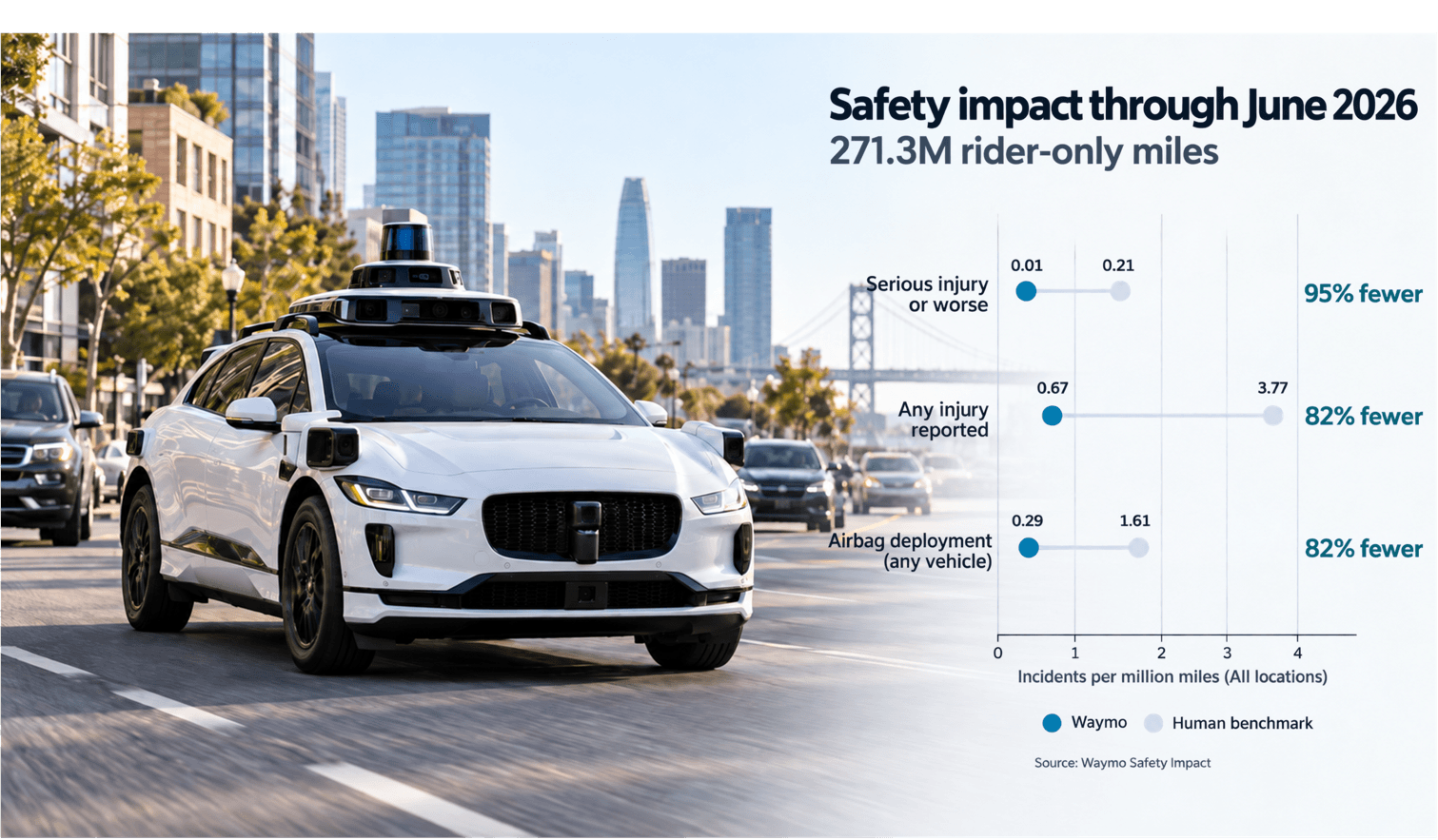
Autonomous driving has entered a more demanding phase. Companies can still win attention with a launch date, a new city or a large vehicle target. They now face a harder question. What is operating today, under which conditions, and with what evidence?
The October source set shows this shift clearly. Waymo is adding markets and vehicles while publishing safety results from a rapidly growing mileage base. Tesla is seeking wider European access for FSD Supervised while regulators and safety groups examine how the system handles speed limits and local traffic rules. In freight, Einride and Lidl have placed a cab-less truck into regular logistics work in Germany. Other companies are still preparing driver-out pilots, commercial launches or future fleets.
The opening interview and test drive bring the same issue down to street level. i4Research repeatedly tests production vehicles after software updates and separates safety-critical interventions from inefficiency and rule violations. During a Huawei-equipped AITO drive in Shanghai, the system was smooth in structured traffic but still needed a human when scooters, narrow gaps and assertive drivers turned the road into a negotiation. The lesson is not that one impressive drive proves or disproves a system. It is that comparable routes, repeatable scenarios and software-version tracking are becoming part of the product evidence.
These examples should not be placed on one scale without qualification. A paid driverless ride is different from a supervised demonstration. Regular operation on a defined logistics route is different from unrestricted public-road deployment. Company-reported crash reductions are useful, but they are not the same as an independent safety verdict.
The commercial contest is becoming a contest over proof. New technical work proposes twelve criteria for deciding whether an automated-driving release presents an absence of unreasonable risk. The list spans system safety, cybersecurity, verification, collision avoidance, road-rule compliance, vulnerable road users, risk management and field monitoring. No single mileage figure or test can carry that case alone.
The strongest companies will be those that can define their operating boundary, show repeatable service and explain their safety evidence in terms that regulators, customers and insurers can test.

Dr. Markus Hahn
Senior Advisor, DVN


