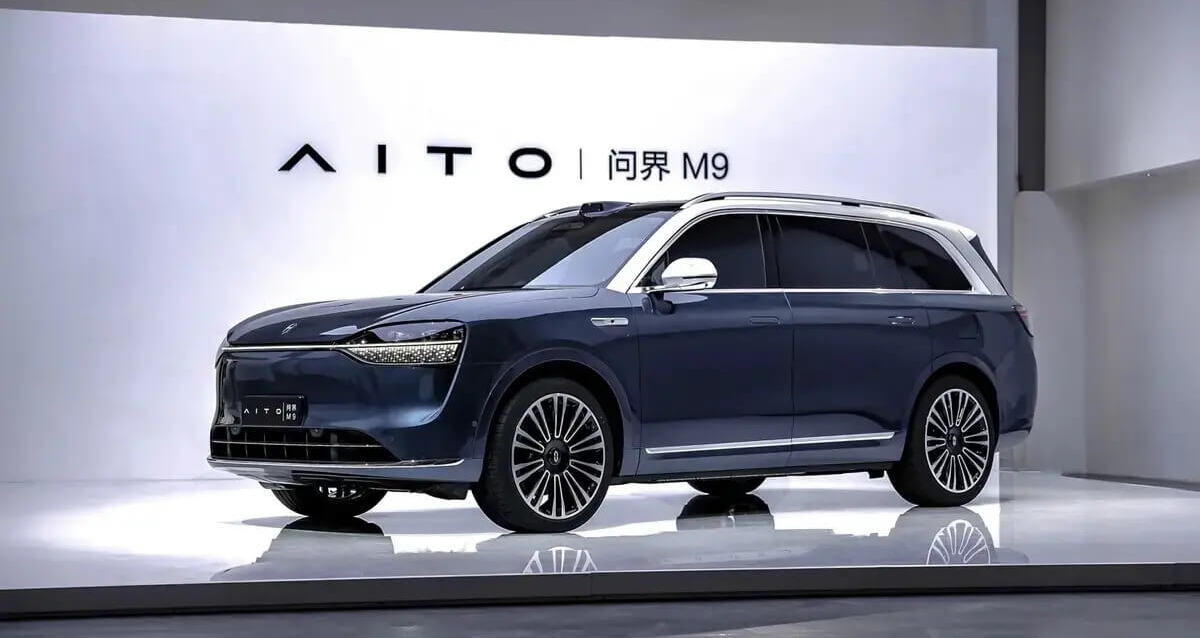
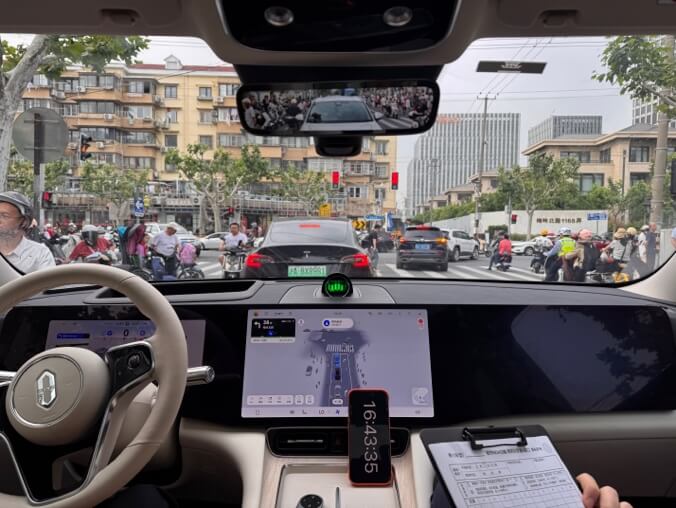
During my recent visit to Shanghai, I had the opportunity to experience an i4Research demo drive from the company’s headquarters at 10A Building, Tiandi SW Park, Putuo District, Shanghai. In contrast to my Pony.ai Robotaxi demo drive in Beijing, this was not an L4 robotaxi ride. It was a production AITO vehicle equipped with Huawei’s software stack, operating as an L2++ ADAS / urban NOA function with a human test driver remaining responsible at all times. This vehicle represents the type of high-level driver-assistance functionality that Chinese customers can buy in mass-produced vehicles.
The context matters. i4Research positions itself as an ADS data and benchmarking platform for advanced driver assistance in China. Public i4Research material describes a Shanghai-based start-up focused on ADS/ADAS user-experience benchmarking and testing, including road and track tests for adaptive cruise, lane keeping, parking, OTA behavior, traffic-jam assist and city/road NOA.
The same public material refers to a database of more than 40,000 km in real-world driving on Chinese open roads and proving grounds, more than 70 cars tested, and a broad range of typical road-traffic environments from urban roads and expressways to tunnels and automatic parking. This makes i4Research an interesting reference point for DVN readers, because the company observes the practical boundary between impressive demo performance and repeatable, benchmarked system behavior in real traffic.
In a public joint DVN / i4Research presentation on AEB and L2+ systems, i4Research data was also used to show that L2+ is becoming standard for top Chinese brands, but that urban NOA risk MPI values can still be low. The presentation refers to tests over 620 km in seven urban regions plus 820 km on highways, covering systems from suppliers including Huawei, Horizon Robotics, Momenta/Bosch and Deeproute. This is a useful background for the Shanghai demo drive: the question is not whether L2++ can look impressive in selected moments. It can. The more relevant question is where and why interventions still occur in dense, non-cooperative city traffic.
The vehicle context is equally important. AITO, a Huawei-backed brand owned by Seres, has become one of the most visible routes for Huawei’s intelligent-driving technology into premium mass-market vehicles. Huawei’s Qiankun ADS family has expanded into multiple versions and vehicle classes, from basic assisted driving to urban navigation assistance and higher-end functions. Depending on model and software version, AITO vehicles have been associated with Huawei ADS generations ranging from ADS 2.0 and map-free NCA to newer Qiankun ADS versions. For publication, the exact vehicle variant and ADS software release of the Shanghai demo car should be confirmed with i4Research. For the passenger-level assessment, however, the key fact is clear: this was a purchasable production vehicle using an L2++ ADAS function, not a driverless robotaxi.
The drive started under what first sounded like excellent test conditions: sunny weather, dry roads, no rain and good visibility. From a sensing perspective, these were good conditions for camera, and LiDAR perception. In this car, no Radar was equipped. But from a traffic-scenario perspective, it was almost the opposite of an easy demo. The route around the i4Research headquarters in Putuo District took place during rush hour, on tight roads, with many pedestrians, scooters and motorcycles. Other drivers behaved aggressively in bottlenecks because traffic was dense. Several scooters did not follow traffic rules. Some two-wheelers changed lanes spontaneously and created situations that were difficult to predict. Realistically, the test conditions could only have been more difficult with bad weather. Otherwise, nearly everything that makes urban L2++ difficult was present.
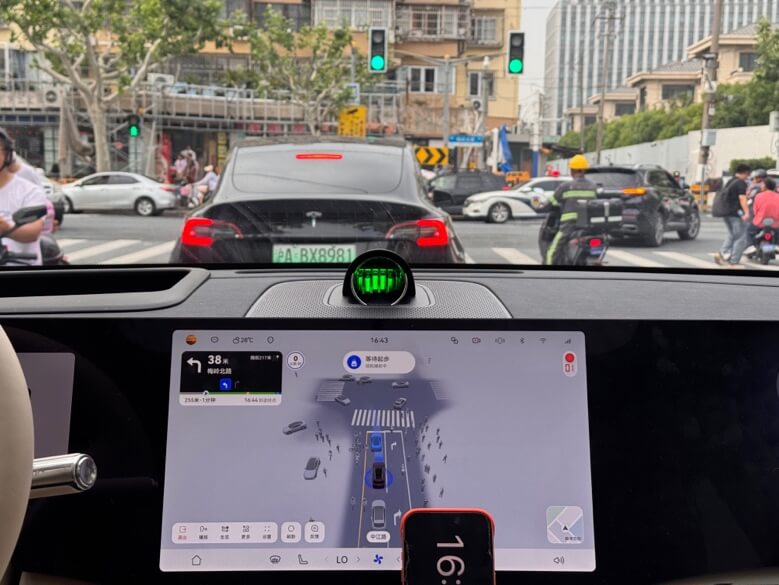
In the traffic situations that were still structured enough for the system, the AITO drove smoothly and the vehicle behavior felt clean. Acceleration and deceleration were comfortable, lane keeping was stable, and in flowing traffic the system gave the impression of a mature production ADAS rather than an experimental prototype. These moments are important, because they show why Chinese L2++ systems are attractive to customers. In normal or moderately complex traffic, the function can reduce workload and make the vehicle feel technologically advanced and well integrated.
The demanding moments told the other side of the story. In narrow sections, in situations with non-compliant traffic participants, and especially when scooters or other vehicles made sudden movements, the test driver had to intervene repeatedly. From my point of view, these interventions were understandable. The vehicle was not failing in a dramatic way; rather, it reached the practical boundary where an L2++ system still depends on human judgment. The most critical situations were not necessarily pure perception problems. They were often social and tactical traffic problems: Who insists first? Who yields? How much lateral distance is still acceptable in a bottleneck? When does a cautious vehicle become blocked by more aggressive human drivers?
In some of these “battle scenes” for access through a narrow section, the vehicle appeared lost. It needed the skill of the test driver, who understood not only the road geometry but also the informal negotiation style of dense Shanghai traffic. The colleague who was noting the manual interventions and the resulting MPI values had a lot to do during the ride. The low kilometer-per-intervention number was therefore understandable to me, but it must be interpreted in the right context: these were very difficult traffic conditions, not a calm boulevard demo.
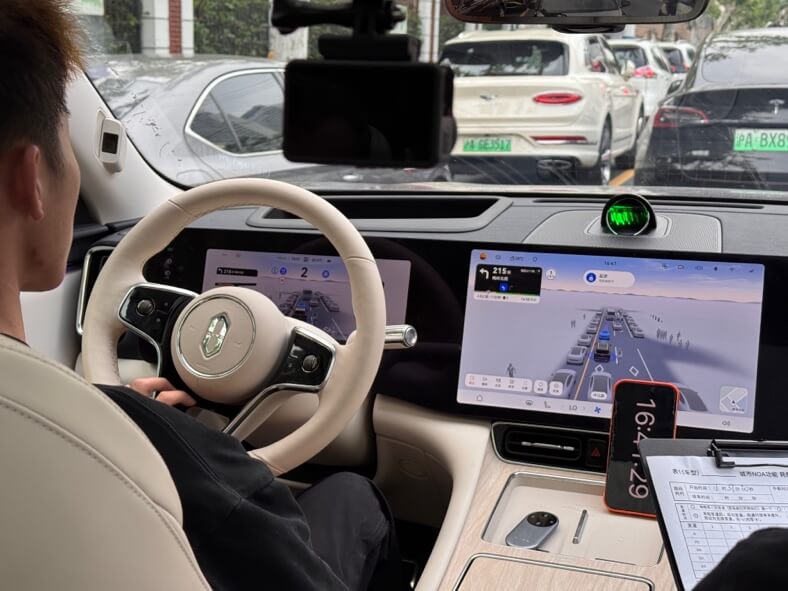
This made the drive especially valuable. I would have liked to experience a true robotaxi on the same route and under the same conditions, simply to compare its behavior. Would an L4 vehicle remain passive and wait? Would it manage to negotiate the bottlenecks more assertively? Would it request remote assistance? Or would its ODD avoid exactly this type of environment? The i4Research drive made clear that a fair comparison between L2++ and L4 requires comparable traffic difficulty, not only comparable technology names.
Compared with the Pony.ai demo drive in Beijing, the difference in operating environment was striking. The Pony.ai ride took place in excellent weather, on large and wide roads, with many cars but relatively few pedestrians and critical two-wheelers, and outside rush hour. The i4Research / AITO drive in Shanghai also had good weather, but traffic itself created a much harder test. In Beijing, a conservative driving philosophy could still work because surrounding traffic remained orderly. In Shanghai rush-hour bottlenecks, pure conservatism quickly becomes impractical. The vehicle must either negotiate like a human or rely on the human driver.
For DVN readers, the most relevant conclusion is not that the Huawei-equipped AITO was weak. On the contrary, it was impressive to see this level of urban assistance in a mass-produced vehicle. The system drove smoothly whenever the traffic situation remained within a sufficiently structured envelope. But the drive also showed why L2++ and L4 must not be mixed in public communication. L2++ can be a powerful driver-assistance feature, but the human driver is still part of the safety concept. In dense urban traffic with aggressive behavior, rule-breaking scooters and narrow-road negotiations, that human role remains visible and necessary.
This is exactly why i4Research is relevant. The Chinese market is moving quickly from showroom claims to real-world benchmarking. Smoothness, comfort, customer acceptance, MPI, risk-MPI and scenario-level analysis are becoming more important than simple feature lists. A system that performs impressively on a wide, structured road may still be challenged by an unstructured bottleneck with scooters, pedestrians and assertive local drivers. The value of a company like i4Research lies in documenting these differences systematically and making them comparable across vehicles, software versions and suppliers.
The strongest signal from the Shanghai demo drive was therefore different from the Pony.ai Robotaxi experience. Pony.ai in Beijing showed how calm and normal an L4 robotaxi can feel inside a favorable operating domain. i4Research in Shanghai showed the frontier of production L2++ under real stress. The AITO with Huawei ADS drove well whenever the world behaved sufficiently like a lane-based traffic problem. It needed the human driver whenever Shanghai became a human negotiation problem. And that boundary is precisely where the next years of ADAS and autonomous-driving development will be decided.