
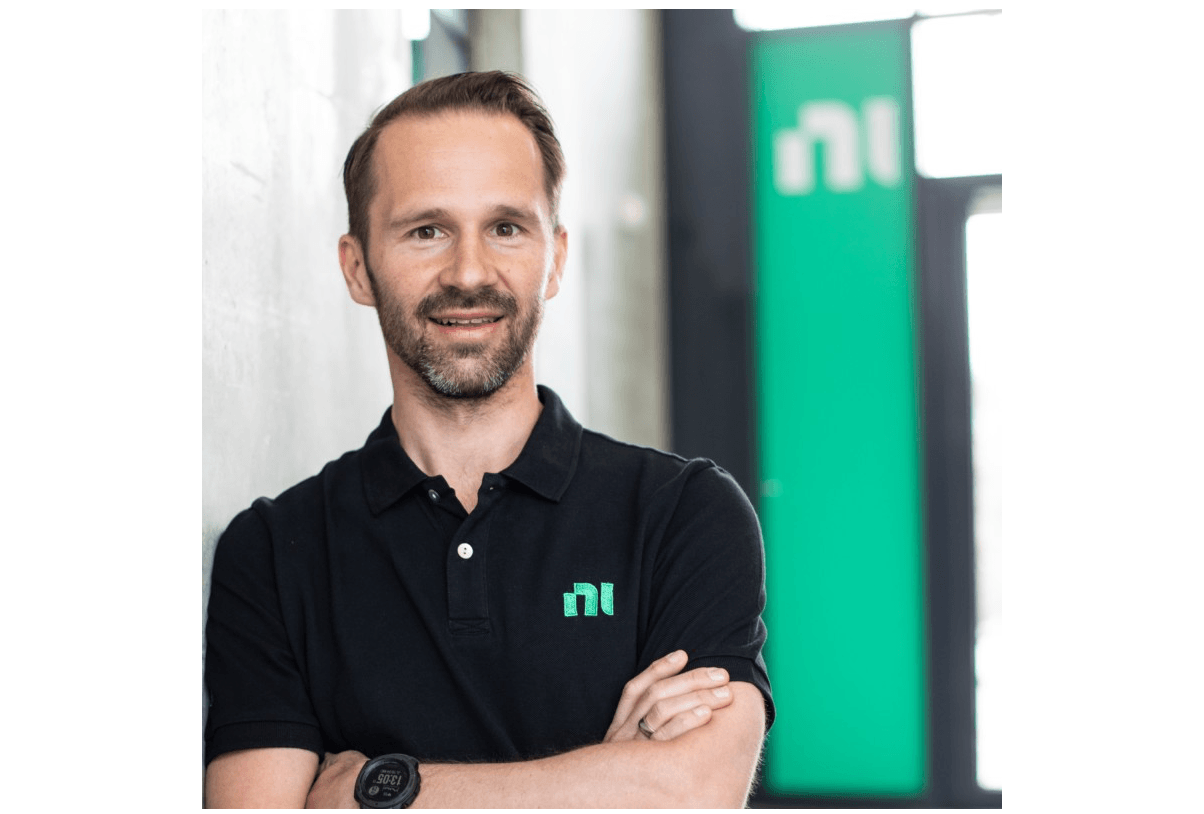
Daniel Riedelbauch is Chief Technical Marketing Manager of NI Transportation Validation, Test & Measurement. He is responsible for overseeing software and hardware validation to bring NI’s solutions to market globally.
Riedelbauch has worked at NI, Emerson’s Test & Measurement business, for two decades. He has held positions in technical support and regional product marketing, focusing on the automotive and transport industries across central and eastern Europe.
Riedelbauch earned his diploma degree in electronics and information technology from the Technical University of Applied Science in Rosenheim, Germany, and can be reached at
[email protected] or +49 160 74 34 885.
DVN: Can you tell us about your organization and its activities?
D.R.: NI is part of Emerson’s Test & Measurement business and is therefore not reported as a standalone company. We develop modular hardware and software platforms for automated test and measurement, helping engineers validate increasingly complex systems from R&D through validation and production test. In automotive applications, this includes ADAS, vehicle networking, radar, wireless communication and software-defined vehicle development.
Emerson employed approximately 71,000 people worldwide in fiscal 2025, operated around 120 manufacturing locations, and generated $18bn in net sales. Emerson does not separately disclose revenue for its Test & Measurement business.
Our focus is helping engineers address system complexity through software-connected test, modular instrumentation and data-driven workflows that improve efficiency, interoperability and insight from validation data.

DVN: How does NI position itself in transport?
Daniel Riedelbauch: We see transport as an important growth sector. Electrification, ADAS, automated driving, connectivity, and software-defined vehicle architectures are increasing system complexity. At the same time, OEMs and suppliers face greater pressure around safety, quality, efficiency and development speed.
These trends require more engineering, test and measurement before increasingly complex systems can be safely deployed. NI addresses this through an open and modular test platform that helps teams standardize approaches, automate workflows and reuse test assets across the development lifecycle. Transport extends beyond passenger and commercial vehicles to off-highway equipment, railway, marine and emerging robotics. Our strategy is to integrate into customers’ existing ecosystems and allow their test infrastructure to evolve as requirements change.
DVN: Are you present in the whole validation chain from development to serial production?
D.R.: Yes. NI supports testing across the ADAS and automated-driving lifecycle, from early R&D through validation and into production test of ECUs, sensors and actuators. The challenge is not simply collecting more measurements. Engineering teams must also maintain measurement fidelity, test coverage, traceability and reuse as the device under test moves through development.
NI provides a modular platform that scales across this lifecycle and enables test assets to be reused. This supports a continuous validation strategy in which test intent, data and assets can be carried from development toward serial production.
DVN: Can you support virtual validations? How does NI support creation, management, and reuse of test scenarios?
D.R.: Absolutely. Virtual validation is becoming critical as the number and complexity of required driving scenarios increase. NI has a particularly strong role in HIL and in connecting MIL and SIL environments with real-time testing, measurement and data analysis. NI VeriStand provides HIL capabilities, test automation, virtual ECU integration and connectivity to third-party simulation, modeling and scenario-generation environments. This enables test cases, scenarios, data and validation intent to be reused as testing moves from virtual environments to HIL and vehicle testing, rather than being recreated at every stage.
DVN: How do you manage standardization, modularity and customization?
D.R.: Standardization is essential as ADAS validation becomes more complex and test systems must support multiple programs over many years. Our approach is to standardize interfaces, architecture and common building blocks while keeping implementations modular. In a HIL environment, real-time execution, automation, measurement, synchronization and interfaces can be reused across vehicle programs, while application-specific capabilities such as radar simulation, camera simulation or additional I/O can be added as required.
The same applies to software. Customers can integrate their preferred simulation, scenario-generation and analytics tools within a consistent automation framework. NI also supports standards and formats such as ASAM XIL, FMI, FMU and ARXML. Our principle is simple: standardize the foundation, modularize what may change and customize where the application requires it.

DVN: How does your toolchain apply to validation of a fusion system?
D.R.: Radar and camera fusion illustrates the complexity of ADAS validation because engineers must evaluate not only each sensor, but also the interaction, timing and correlation between sensor streams and the fusion algorithm. A typical workflow moves from scenario generation and SIL testing to HIL validation and correlation with vehicle data. The objective is to maintain the same validation intent while progressively increasing physical realism and reusing scenarios across the process.
NI’s differentiation is the ability to combine deterministic real-time execution, high-performance measurement and I/O, synchronized sensor streams, automation and open software integration within one validation architecture. NI does not provide every specialized element of the toolchain. We provide the infrastructure that connects them. The value is not any single component, but the ability to connect simulation, measurement, automation and HIL validation into a continuous workflow. For sensor fusion, synchronization is critical. Realistic radar and camera streams are insufficient if the ECU does not receive them with the correct timing, latency and correlation.
DVN: As raw-data/spectrum interfaces gain traction, what throughput and latency levels can your software stacks handle?
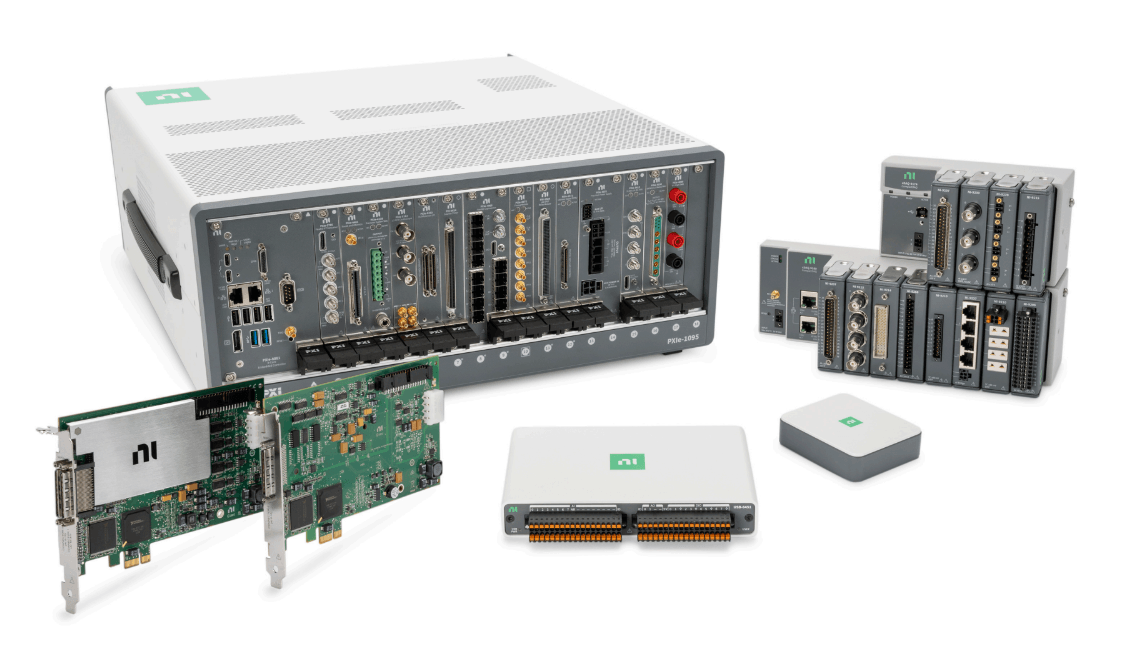
D.R.: The shift toward raw sensor data creates greater demands for throughput, deterministic latency, synchronization and scalability. NI combines high-performance data streaming, deterministic real-time execution and hardware-accelerated processing using technologies such as FPGAs. Processing can be distributed across real-time CPUs, FPGAs, GPUs and high-speed interfaces while maintaining timing and synchronization integrity.
There is no single throughput or latency figure for every application. Performance depends on factors including sensor type, resolution, channel count, required processing, network architecture and system configuration. Our focus is providing a scalable architecture for demanding multi-sensor HIL applications.
DVN: Can you support customers with heterogenous ecosystems, adding NI equipment to third-party hardware?
D.R.: Absolutely. Heterogeneous environments are common in ADAS development, and customers often have substantial investments in hardware and software from multiple vendors. NI is designed to operate within these environments rather than require customers to replace existing infrastructure. NI hardware can be combined with third-party equipment, while NI software can provide or connect to orchestration, automation, measurement, analysis and data-management capabilities.
Our philosophy is: integrate, don’t replace. Customers can introduce NI capabilities where they provide value while protecting existing investments and maintaining flexibility in their technology choices.
DVN: Does NI support cybersecurity testing as part of your automotive validation offer?
D.R.: We address cybersecurity in two ways: by securing NI products and development processes, and by providing test infrastructure for broader vehicle cybersecurity validation workflows. Our software-engineering processes include secure-by-design practices, secure coding standards, independent code reviews and Software Bills of Materials. We are also working to address relevant regulatory requirements, including the Cyber Resilience Act.
For vehicle validation, NI infrastructure can be used to exercise ECUs or networks under controlled security test conditions while system behavior is measured and analyzed. Customers can also integrate specialist cybersecurity tools into the broader validation workflow through NI’s open architecture.
DVN: What role do cloud-based test architectures play in NI’s roadmap for automotive validation?
D.R.: Cloud-based architectures are becoming increasingly important as engineering teams manage larger data volumes, more complex software and globally distributed workflows. We see the cloud not as a replacement for physical test systems, but as a complementary layer for connecting test data, automating workflows and improving collaboration. Cloud-connected approaches can centralize results, support data management at scale and improve access for distributed teams. Our focus is connecting laboratory, HIL, production and real-world test data while enabling more consistent and reusable validation workflows across locations.
DVN: How does your ‘Nigel’ AI contribute to the performance of your testing equipment and measurements?
D.R.: AI is important to NI in two dimensions. First, customers are developing AI-enabled products that require new approaches to validation. Second, AI can improve testing itself. Nigel AI is part of our vision for AI-assisted and agentic engineering. It helps engineers configure tests, automate workflows, analyze measurement data, identify anomalies and reach insights faster. As test systems generate more data, Nigel can reduce repetitive work while the engineer remains responsible for critical decisions and validation. The opportunity extends beyond transportation: Nigel is becoming a foundational element of the NI platform across industries. Our objective is to make test and measurement more intelligent without making engineering less human.

DVN: How do you prevent LLM hallucinations and other failure mechanisms in mission-critical tests, and guarantee functional safety?
D.R.: Our philosophy is: AI accelerated, human led. Nigel AI can help generate or modify test code, explain code, suggest test strategies and automate repetitive tasks. However, generated output must be treated as untrusted until it has been reviewed and validated by an engineer. We address potential failure mechanisms through grounding in engineering context and NI APIs, automated validation, established software-engineering controls, and human review and approval. The engineer remains responsible for confirming that the test implements the intended requirement and behaves correctly. We do not claim that AI itself guarantees functional safety. Existing requirements, traceability, verification, validation and safety processes remain in place.
DVN: How effectively can Nigel AI interface with third-party instruments without enforcing an NI vendor lock-in?
D.R.: Nigel is designed to support engineers working in heterogeneous environments rather than steer them toward a single-vendor ecosystem. While it provides its deepest assistance within the NI ecosystem, Nigel can use available drivers, documentation, instrument specifications and reusable code to assist engineers working with third-party equipment.
This builds on NI’s long history of instrument integration through LabVIEW, IVI drivers and the Instrument Driver Network, and supports real-world test systems in which NI and non-NI instruments coexist.
DVN: But Nigel AI must possess less specialized knowledge of third-party hardware than of NI’s native stack. Does the manual engineering effort to integrate and validate third-party devices offset the ROI and AI efficiency gains in test operations?
D.R.: We would argue that Nigel helps reduce, rather than increase, the effort required to integrate instruments into complex test systems. Nigel has the deepest knowledge of the NI ecosystem, but it can also use available third-party drivers and instrument specifications to assist with instrument selection, configuration, code generation, troubleshooting and documentation.
Engineering judgement and validation remain essential. However, Nigel can accelerate repetitive integration and discovery work, allowing teams to reuse existing drivers, code and integration knowledge across mixed-vendor environments. That is where we see meaningful productivity gains.
DVN: How seamlessly does NI integrate your tools – like TestStand and VeriStand – into modern OEM DevOps pipelines without requiring extensive custom adaptation?
D.R.: Software-defined vehicles are making validation a continuous part of software development rather than an activity performed only at the end. NI TestStand and VeriStand can connect with existing CI/CD environments through APIs and standard automation mechanisms. TestStand orchestrates automated test execution, while VeriStand provides real-time testing, simulation integration and HIL capabilities. Tests can be triggered through existing CI/CD infrastructure, with results returned to the development workflow. The level of adaptation depends on the customer’s pipeline, security model and infrastructure. Our objective is to minimize bespoke integration and enable automated test and HIL environments to operate as scalable services within the development ecosystem.
DVN: Does Nigel AI directly generate code compliant with standards such as MISRA C, allowing test-bench software to be handed over ready for certification?
D.R.: Nigel AI helps engineers create and work with test software more efficiently, but it does not replace established verification, validation or certification processes. In safety- or compliance-critical environments, engineers remain responsible for reviewing, validating and approving generated content. Nigel-generated output should not be considered ready for certification solely because it was produced by AI. It is also important to distinguish between embedded automotive software and test-system software. NI solutions are primarily used to develop and operate test and validation systems rather than software that runs in production vehicles. Applicable requirements therefore depend on the specific application, process and customer environment. Our approach is to accelerate test development while maintaining engineering oversight, traceability and required validation practices.


