
Multi IR’s New Narrowband IR Camera Filter
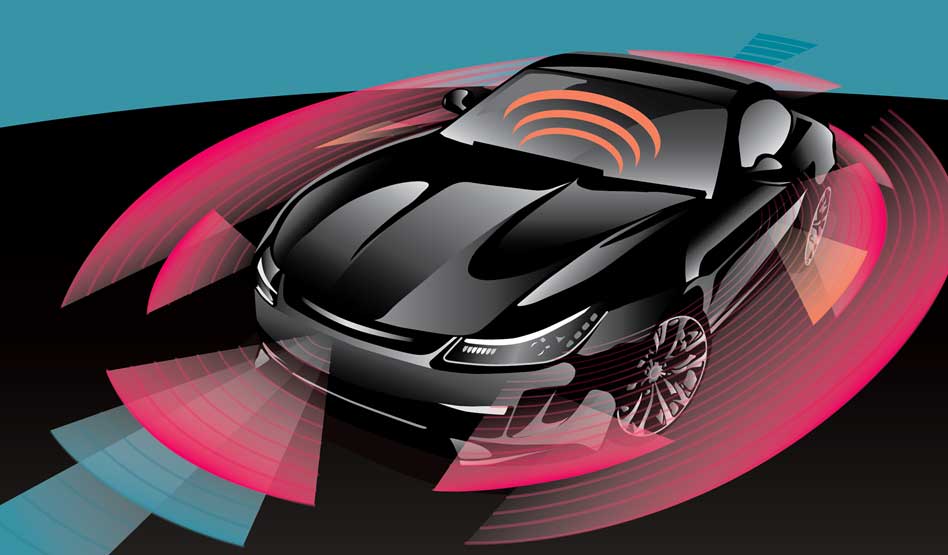
China’s automotive infrared sensor market is projected to grow by over 30 per cent per year from 2026 to 2030, potentially reaching tens of billions of yuan as the technology moves from premium option to mainstream feature.
Three main factors are accelerating adoption. Regulation – Euro NCAP added DMS to its 2025 safety ratings, the U.S. NHTSA now requires driver-state sensing for L2 ADAS, and China will mandate factory-installed DMS on new L2+ passenger cars and trucks from 2027, so infrared sensing is becoming essential. Costs are also falling.
Once priced above C¥10,000 and limited to luxury models, infrared night-vision systems are becoming viable for vehicles around C¥200,000 thanks to localized detector chips, mass-produced near-infrared illuminators, and higher optical-component yields. And competition among smart-vehicle brands is intensifying. For Chinese NEV makers, infrared night vision offers a visible safety advantage by detecting pedestrians and obstacles 200 – 300 meters ahead in darkness, glare, and poor weather.
Automotive infrared systems currently follow two main technology paths: far-infrared thermal imaging and near-infrared structured light or ToF. Far-infrared thermal imaging relies on either uncooled microbolometers or cooled detectors. Microbolometers are lower-cost and require no cooling but offer more limited sensitivity and resolution. Cooled detectors provide very high sensitivity, with NETD (noise equivalent temperature difference) below 20 mK, but need a Stirling cooler to maintain cryogenic temperatures of around 77 K. Both solutions image thermal radiation: people and animals appear as bright silhouettes, vehicle hoods are also bright, and the background remains comparatively dark. Their main benefit is all-weather operation, while the limitations are the absence of colour information and the need for algorithms trained to interpret thermal scenes.
Near-infrared systems use InGaAs detector arrays operating in the 0.9 to 1.7 µm range, combined with 850- or 940-nm IR illuminators. They provide near-visible image quality, including depth and texture information, with very fast response times suited to dynamic tracking. The main drawbacks are cost, since InGaAs chips are much more expensive than microbolometers, and typically smaller pixel sizes.
Regardless of the chosen architecture, one shared component often sets the system’s performance ceiling: the narrowband filter. In automotive infrared systems, the filter blocks stray environmental light while letting only the target wavelength band reach the detector. In vehicles, however, this task is far more demanding than in standard industrial applications.
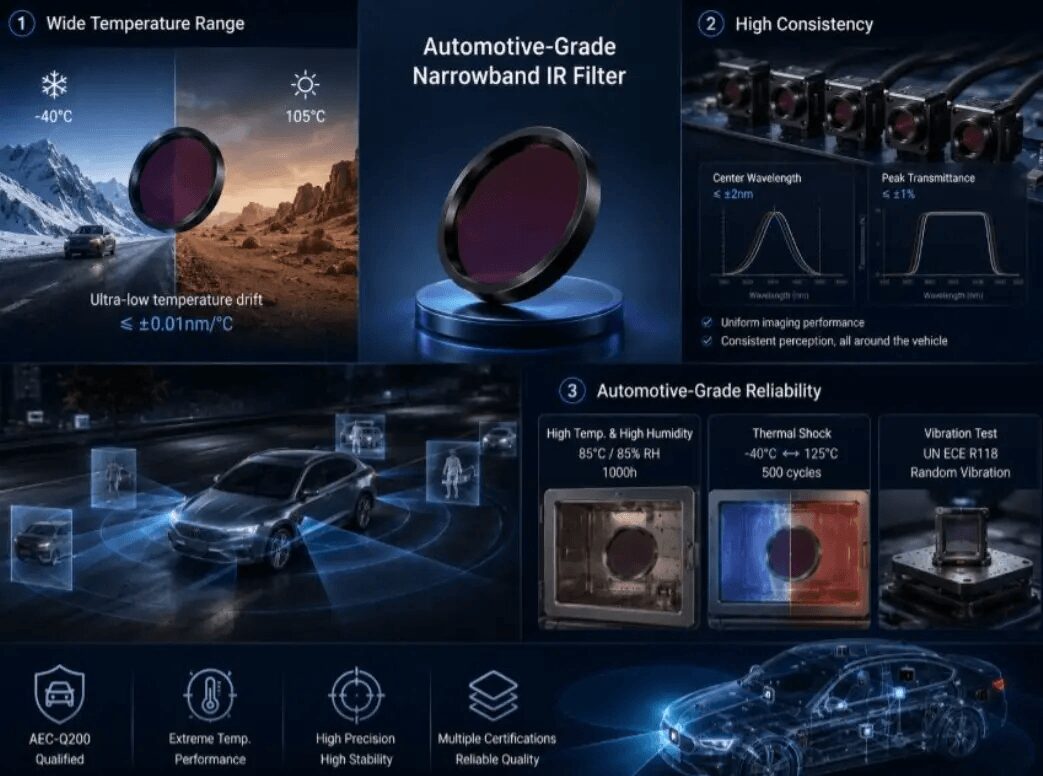
Temperature is the first challenge. Automotive infrared systems must operate from -40 to +105 °C and beyond. Standard optical components can drift significantly across this range, as center wavelengths shift and transmittance curves change. Automotive-grade filters therefore need thermal drift below ±0.01 nm/°C to remain stable. Multi IR’s automotive filters use dedicated temperature-compensation designs to keep spectral performance consistent under extreme temperature variations.
The second challenge is consistency. A vehicle may integrate a dozen or more infrared sensing modules, each requiring filters with the same specifications. If centre-wavelength variation between batches is too large, image quality can vary from one module to another, creating uneven performance across viewing angles. Automotive requirements are therefore much stricter than in consumer electronics: within a batch, centre-wavelength deviation typically must stay below ±2 nm, while peak-transmittance variation must remain below ±1%.
The third challenge is automotive qualification. AEC-Q200 is the baseline requirement for passive automotive components, but infrared optics must withstand more demanding reliability tests, including 1,000 hours at 85 °C and 85% RH, 500 thermal-shock cycles from -40 to +125 °C, and random vibration profiles defined by UNECE Regulation № 118. Suppliers able to meet the full automotive qualification package will be well positioned in the automotive supply chain.
The market window for automotive infrared night vision is likely to last three to five years. During this phase, hardware will lead adoption, with software and algorithms adding value later. As with GPS navigation, once the hardware is installed, map updates and ADAS upgrades become the next source of differentiation.
Filter suppliers must act quickly to secure their place in the supply chain; once an OEM or tier-1 has fixed their optical architecture and completed automotive validation, changing supplier becomes costly – requalification typically takes 18 to 24 months, from sample and DV/PV testing to production ramp-up. Early entrants can therefore secure orders for the next five to ten years.
The automotive infrared supply base remains fragmented. Established optical suppliers hold part of the high-end market, while emerging Chinese suppliers are closing the gap. However, few can simultaneously meet requirements for precision, consistency and qualification, leaving room for new leaders to emerge.
Multi IR, with their deep expertise in infrared filters, has automotive-grade product lines covering the 850- and 940-nm bands used in DMS, and are expanding into longwave infrared bands for thermal imaging. This combination of broad multi-band coverage and deep vertical specialization fits the fast-changing needs of automotive infrared systems.
Automotive infrared night vision is not new; Mercedes-Benz and GM (Cadillac) introduced it many years ago. What is different now is its move toward mainstream adoption, driven by regulation, falling costs, and competition among NEV manufacturers.
Founded in 2007, Hangzhou Multi IR Technology Co is an optoelectronic technology enterprise integrating R&D, production, and sales. Their products are widely applied in aerospace, medical care, AR/VR, display imaging, photography, and other fields, steadily holding the position of the world’s largest spot supplier of optical components. Multi IR stocks more than 10,000 types of infrared-sensitive components, ranks among the global top three in overall strength, and offers infrared filters, optical coatings, infrared sensors and other core products. The company is also the lead drafter of the infrared filter industry standard.
DVN comments
IR filters are a critical but often underestimated element in automotive camera performance. By only selecting the useful infrared wavelength and rejecting unwanted ambient light, they improve image contrast, reduce glare and help the sensor deliver stable information in night-time, backlit or rapidly changing lighting conditions. This is especially important for DMS, night vision and near-infrared ADAS cameras, where small spectral shifts can directly affect detection reliability. As IR-based sensing moves toward higher vehicle volumes, filter quality, temperature stability, batch consistency and automotive qualification will become as important as the camera sensor itself. In that sense, narrowband IR filters are not just optical accessories; they are enabling components for robust, repeatable and scalable automotive vision systems.
Ghost Braking: When Electronic Aids Create Nightmares

Autonomous emergency braking is supposed to prevent accidents by stopping a vehicle in time to avoid a forward collision. But sometimes AEB systems slam on the brakes for no reason. Here we take a look back at a technical failure that worries users.
For a growing number of motorists, the scenario is now a recurring nightmare: driving serenely at 120 km/h on the motorway under cruise control, a driver begins to overtake a heavy goods vehicle. Suddenly, the vehicle slams on the brakes, brutally reducing the speed to 70 km/h. Not in response to any physical obstacle or imminent danger, but a totally erroneous reading of the onboard camera. The sign recognition system misinterprets a self-adhesive speed limit placard (70 or 90 km/h, for example) affixed to the back of the trailer, reacting as if it were a roadside speed limit sign.
This is not an isolated case; misinterpretations by on-board sensors are increasingly common. A simple plastic wrapper flying in the wind, a reflection of the setting sun on the asphalt, a shadow cast under a bridge, or a mistakenly analyzed road sign are enough to fool the camera or the radar. These driving assistant systems then order the computer to hit the brakes, risking a catastrophic chain-reaction rear-end accident.
Such incidents have been happening in vehicles made by a long list of automakers, and not just once in awhile; user anger has been growing. In France, the ‘Freinages Fantômes’ collective (“phantom braking”), born on social networks in the spring of 2025 following an accident on the A40 autoroute, has several thousand members. This gathering of victims has initiated a class action before the judicial court of Aix-en-Provence. The objective is to demand transparency and to call on the Vehicle Market Surveillance Service (SSMVM) attached to the Ministry of Transport to do something about the problem.
For victims of spurious braking, the battle continues in the garage. Once the vehicle has been brought to the dealership, the technicians’ response is always the same: the electronic diagnostic kit does not return any error codes. From the point of view of the on-board computer, the system worked exactly as it was programmed: it perceived a threat and ordered a response.
This lack of a computer trail puts drivers in a terrible pickle. Faced with their insurors’ refusals and post-accident forensic analysis, they come up against a technical opacity where the word of the user carries very little weight in the face of the presumed infallibility of the computers. To counter this inertia, consumer associations are demanding access to raw data from on-board black boxes, in order to prove the failure of detection algorithms.
Phantom braking has caused vast waves of recalls internationally. In the United States and Canada, authorities have forced manufacturers to carry out emergency campaigns. More than 420,000 Hyundai Tucson and Santa Cruz SUVs were recalled in North America, for example, after a software bug in the front camera was identified, which ordered unjustified emergency braking at high speeds.
In Europe, the problem is taking on an eminently paradoxical dimension. Since the entry into force of the last phases of the GSR2 (General Safety Regulation), the European Union has imposed the mandatory presence and systematic reset of automatic emergency braking (AEB) on all new vehicles, extended to the detection of pedestrians and cyclists. By forcing engineers to multiply the sensitivity of sensors to meet institutional crash tests, the legislators have inadvertently increased the frequency of false positives.
DVN comments
False or ghost braking is becoming a critical ADAS acceptance issue because it sits at the intersection of safety, user trust and validation limits. AEB systems must be sensitive enough to protect pedestrians, cyclists and vulnerable road users, yet robust enough to avoid unnecessary braking in real traffic. Many false-positive events are not component failures in the traditional diagnostic sense; they are perception and decision errors caused by ambiguous scenes, sensor artefacts, or edge cases that may leave no diagnosable trace. This makes post-event analysis difficult for drivers, insurers, OEMs and regulators. The next step for the industry should therefore be stronger scenario-based validation, better event data recording, and clearer rules on how false positives are measured and reported. AEB remains essential, but its credibility will depend on proving not only that it can brake when needed, but also that it does not intervene dangerously when no threat exists. A third sensing technology like lidar could also complete the system for a safer braking/no braking decision.
New Mazda CX-6e Has Lidar NOA

Mazda has updated the CX-6e with a roof-mounted lidar sensor, enabling Navigation-on-Autopilot (NOA) functions for both highway and urban driving. lidar-equipped versions are expected to start at around C¥160,000 – around USD $23,800.
Orders have opened in China, where the model is also sold as the EZ-60. It’s Mazda’s second NEV offering in China, following the 6e sedan, known locally as the EZ-6. Unveiled at the 2026 Chengdu Auto Show, the new CX-6e can be had as a BEV or as a range-extended EV. Developed by the Changan-Mazda joint venture, it uses Changan’s EPA1 platform and is closely related to the Deepal S07. EV trims use a 77.94 kWh LFP battery from CALB, delivering a CLTC range of 585 to 600 km. Power comes from a 190 kW, or 255 hp, rear motor, with a top speed of 185 km/h. The 3C fast-charging system enables a 30- to 80-per-cent charge in 15 minutes.
EREV versions combine the same 190 kW rear motor with a front-mounted 1.5-litre naturally aspirated range extender producing 72 kW, or 97 hp. They use a 31.73 kWh LFP battery from CATL-Changan, providing 200 km of CLTC electric range.
The main upgrade is the roof-mounted lidar, which Mazda says enables advanced L2 assisted driving across more than 200 scenarios. Mazda says the lidar-supported system operates from 0 to 130 km/h on highways and from 0 to 80 km/h in cities. It also supports remote, automated and path-following parking functions. The system also uses three mm-wave radars, 12 ultrasonic radars, and 11 cameras.
On highways, Mazda says the CX-6e can perform more automated maeuvers, manage ramps and service-area access with limited driver input, and overtake slower vehicles through autonomous lane changes. In urban use, the system is said to handle intersections, roundabouts and U-turns without driver input. It can also move between parallel main and side roads, and execute emergency lane changes to avoid obstacles.
Mazda has not named the suppliers behind the new lidar system. The related Deepal S07 offers Huawei’s lidar-based Qiankun ADS system on higher trims.
China EV DataTracker reports that Mazda delivered 2,929 CX-6e / EZ-60 units in China in July 2026. Together with the 6e / EZ-6, NEV models now account for more than half of Mazda’s China sales, making Mazda one of the few joint ventures in the market to sell more NEVs than ICE vehicles.
DVN comments
The Mazda CX-6e update is a good illustration of how quickly lidar-supported assisted driving is moving from premium flagships into more affordable Chinese-market vehicles. Even for a traditional global brand, local competitiveness in China now requires a visible intelligent-driving offer, especially in the C¥160,000 range where consumers increasingly compare ADAS capability as part of the value proposition. The key question is not only the presence of a roof-mounted lidar, but the maturity of the full system: sensor fusion, scenario coverage, driver monitoring, fallback behaviour and validation in dense urban traffic. For joint ventures such as Changan-Mazda, lidar can help close the perception gap with leading Chinese NEV brands, but it also raises expectations. Once marketed as enabling urban and highway NOA, the system must deliver consistent, transparent and safe performance in real use, otherwise the technology risks becoming more of a branding feature than a genuine safety and convenience benefit.


