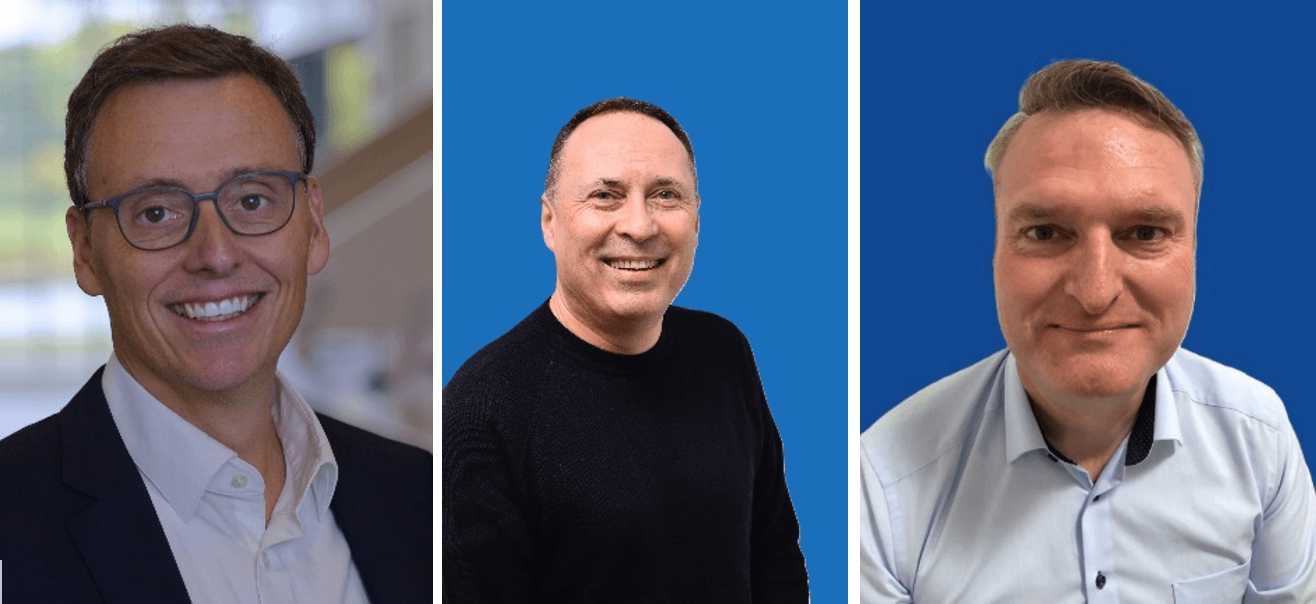
- Ralf Schmidt, Senior Vice President and Head of Automotive Systems
- Jürgen Minichshofer, Senior Director, Global Application Marketing Automotive Radar
- Udo Dannebaum, Senior Principal Engineer Automotive
Interview by Dr. Jürgen Dickmann, Senior Advisor, DVN
Note: On 17 – 18 November, our DVN conference will take place in Stuttgart and for the first time, host special sessions on dual use and on “The Road to Type Approval: Mastering End-to-End AI Systems”.
In the runup to the DVN conference, we are presenting Key ADAS/AV players , and sharing their results, perspectives in this field. The first in this series was our report on a preview drive with Wayve’s latest vehicle; now comes the INFINEON interview, and further instalments will follow every fortnight until the conference begins
DVN-Dickmann
NVIDIA is advancing centralized compute architectures with Thor and the announced Rubin platform. End-to-end models and AI-intensive software stacks also seem to support this trend. At the same time, robotaxi and fleet operators represent only one part of the overall market; many OEMs must balance cost, packaging, platform strategy, and differentiation. Which architecture path does Infineon consider sustainable for ADAS and the software-defined vehicle? Do you expect a clear movement toward centralized architectures, or rather a fragmented landscape with different OEM strategies?
Infineon-Ralf Schmidt
The software-defined vehicle is the overarching driver of new E/E architectures. OEMs want to update vehicles more flexibly, enable new business models, and accelerate development cycles. This requires architectures that support secured software updates, scalability, and functional safety. As a global automotive partner, we do not see one single architecture path across all manufacturers but very different approaches among our customers. However, the common denominator is stronger centralization. How far this centralization goes depends on the OEM, the platform strategy, cost and differentiation targets, and the specific market. We also observe that areas such as cockpit, infotainment, and ADAS continue to evolve and may partly converge. However, we currently don’t see a complete fusion of all domains as a market standard. Flexibility and scalability are therefore decisive: Infineon supports different architecture paths with microcontrollers for real-time control and safety functions, power supplies, memories, MOSFETs, and increasingly Ethernet capabilities. This allows us to address the different transformation speeds of our customers.
DVN-Dickmann
Follow-up to question: Looking at radar within the ADAS domain: Will radar sensors remain relatively intelligent “black boxes” with their own computing power, which are then integrated into a centralized architecture? Or does Infineon expect sensors to become leaner, with more and more signal processing moving to a central compute unit?
Infineon-Juergen Minichshofer
We expect radar to follow a development path similar to camera systems. With cameras, we have seen that raw data can be processed centrally once the corresponding interfaces, cables, and peripherals are available. We see a comparable tendency in radar. If raw ADC-data is transferred, costs, packaging space, and thermal requirements in the radar module can be reduced. This is especially relevant because sensors are often located in thermally unfavorable positions in the vehicle. If computing power is moved into a central unit, there are also fewer limitations in terms of memory and performance. We currently see the first implementations of such centralized concepts in China.
DVN-Dickmann
Question 2: For OEMs, however, such centralization requires significant investment: architecture, data paths, SoC integration, responsibilities, and quality assurance change fundamentally. Do you see enough economic and technological pressure for such raw-data or streaming concepts to become part of the ADAS mainstream?
Infineon-Ralf Schmidt
OEM decisions move within a triangle of cost, differentiation, and speed. The weighting differs depending on the market, vehicle segment, and internal capabilities. For the end customer and for the OEM, the decisive factor will be where the greatest benefit arises: lower system costs, faster time to market, or stronger functional differentiation.
Infineon-Juergen Minichshofer
For end-to-end AI approaches, it is particularly attractive to bring sensor data into the central AI engine with no compression and in best quality. This preserves more degrees of freedom for training, algorithms, and future function development. This is an important driver for raw-data or streaming concepts. At the same time, the supply chain will not change completely overnight. Tier-1 suppliers still have a great deal of radar and software know-how and will continue to play an important role. However, we expect more flexible models: Some OEMs are building up their own capabilities, while others are selectively buying software or stack expertise. The market will therefore see several models in parallel over an extended period.
DVN-Dickmann
If radar data is processed more centrally in the future, who will take over the signal processing that today is often handled by Tier-1s? Will software-stack providers, OEMs, or semiconductor companies take on this role, or will several models emerge in parallel?
Infineon-Juergen Minichshofer
We expect several models to co-exist near to medium-term. Tier-1 suppliers will continue to play an important role because they currently have a great deal of signal-processing and integration know-how. At the same time, individual OEMs will build up more capabilities internally or work with software-stack providers. Combinations of these models are also conceivable. It will probably take longer for the supply chain to settle into a few dominant patterns. It may well be that several concepts continue to exist side by side on a lasting basis.
Infineon-Ralf Schmidt
Infineon’s core business is semiconductors. We provide technological building blocks that enable such architectures. Of course, we also have software elements, for example in AUTOSAR, e.g. for edge-based sensors, drivers, and ecosystem integration. These are important to remain connected to the market and support customers holistically. However, the focus of our value creation clearly remains on semiconductors. We currently don’t see a complete ADAS software stack as a core business model for Infineon.
DVN-Dickmann
Do you see centralized radar as a clear trend outside China as well, or will the rest of the world remain more fragmented because OEMs define their platforms and system boundaries differently?
Infineon-Juergen Minichshofer
We see OEMs preparing for centralized radar concepts globally, although with different levels of intensity and speed. In the Western world, architecture decisions usually include more thorough concept, proof-of-concept, and validation phases and therefore take longer. We see this pattern also with centralized radar. In China, the speed of implementation is faster. Promising new concept are brought to the road very quickly.
DVN-Dickmann
If we put this trend on a timeline: from your perspective, will centralized radar already be a global standard by 2030, or will it be a path that has been defined by then but not yet implemented across the board?
Infineon-Juergen Minichshofer
We don’t expect it to be a global standard by 2030 but we do expect significantly more implementations to be visible by then. The direction of the market will be largely clarified a few years from now and most OEMs will have defined which architecture path to follow and by when. The actual implementation will then take place according to the respective platform and model cycles.
DVN-Dickmann
Another perspective is the future distribution of value creation. At many Western OEMs, traditional development departments for radar, camera, or lidar are becoming smaller, while end-to-end software providers, SoC manufacturers, and platform companies are gaining influence. At the same time, these players often work with reference sensor sets that remain fixed over long periods, because every change would have to be validated and trained again. For Infineon, will OEMs remain the key contacts in the future, or will software-tech companies and platform providers increasingly become decisive counterparts? And how does this change the role of Tier-1s in ADAS value creation?
Infineon-Juergen Minichshofer
That depends on the specific OEM. Some do indeed shift capabilities outside the company, decreasing their in-house development teams. Others follow the opposite path and build up additional capabilities. As a result, very different models are emerging. For example, an OEM without in-house know-how can buy in ADAS capabilities and work quickly with specialized partners, for example for a local market such as China. At the same time, there are still some OEMs that develop their own SoCs or deliberately pursue hybrid approaches, using both internal expertise and external platforms. From our perspective, there is currently no single dominant path. Rather, different models are being tested in parallel. For Infineon, this means working closely with OEMs, Tier-1s, SoC providers, and software companies.
DVN-Dickmann
If both, the architecture paths and the value chain in the market are so diverse, how does Infineon decide which product concepts and manufacturing capacities to prioritize? Where do you see the largest business potential? Is the path more about customer-specific designs, high-performance radars, or scalable platform products that become economical through global volumes?
Infineon-Juergen Minichshofer
We are clearly aligning our radar portfolio with the trend toward centralized architectures. As with any product development, it is about finding the right balance: We have to enable platform capability and high volumes while also considering the requirements of different customers and architectures. The radar market continues to grow, so volume is available. At the same time, competition remains intense. The decisive factor is who recognizes the right requirements early, develops quickly enough, and offers a product that fits the next vehicle generation both technically and economically.
Infineon-Udo Dannebaum
Today, we talk to significantly more stakeholders than we did a few years ago. OEMs, Tier-1s, SoC manufacturers, and other system partners all want to help shape the architecture. Out of these conversations, we identify the common requirements, for example for microcontrollers, switches, power supplies, and the components needed to reliably support a central SoC environment. In this way, we derive global product concepts that are viable at high volumes.
Infineon-Ralf Schmidt
Our global presence is a major advantage in this respect. We can bring together requirements from different regions and customer groups and derive the intersection that addresses the largest market. These are exactly the products we then consistently drive forward to make them available at scale in future architectures.
DVN-Dickmann
Strong local competitors for MMICs are emerging in China, including Calterah in the radar chip market. At the same time, price pressure is increasing as technical solutions for classical radar applications become more similar. How does Infineon assess this dynamic over the long term, and which competitive advantages remain decisive versus new local providers?
Infineon-Juergen Minichshofer
Competitive pressure should not be viewed only through the lens of unit price. Infineon has been active in the radar market for many years and has brought large volumes onto the road in a very reliable manner. This experience is an important differentiator compared with new market entrants. In the automotive industry, it is not enough to quickly show a prototype. What matters is being able to deliver a product at a high volume, with stability, qualification, and reliability throughout the entire ramp-up. This is where challenges often arise in practice. At the same time, we want to become even faster than today and speed up development. Those who can provide early samples, identify new architecture trends in time, and consistently align products with them will continue to differentiate. Experience, quality, supply capability, and speed remain strong competitive factors.
Infineon-Ralf Schmidt
From my experience in the OEM and Tier-1 world, reliability is a very important factor. In sourcing decisions, price and technical evaluation matter, of course. But the development side also plays a major role, especially when problems must be solved together. Infineon has always been perceived as a particularly reliable partner in that regard. This reliability can be decisive when a customer chooses between technically comparable solutions.
DVN-Dickmann
Follow-up: Mr. Schmidt, you view ADAS and SDV from a system perspective. Does this overall system view also help in subareas such as radar, allowing better solutions to be developed because requirements from architecture, cost, function, and integration are evaluated together?
Infineon-Ralf Schmidt
Yes, the system view is a clear advantage. The Infineon automotive system group does not only look at individual products, but at complete applications, their roadmaps, and system interdependencies. This ranges from inverter and onboard charger applications to ADAS and SDV architectures, for example. Our task is to identify the best possible overall solution: to bring products together, understand technical dependencies, and recognize early on when individual building blocks do not yet work together optimally. These insights then flow back into the business units and influence future product generations. For us, innovation means either more functionality, lower costs, or ideally both. This is exactly why the system perspective is decisive.
Infineon-Udo Dannebaum
We also understand this role as trend scouting. We want to identify the requirements of next-generation vehicles early on to incorporate the relevant product requirements into our development roadmap. The goal is to have solutions available when the customer needs them.
DVN-Dickmann
That brings us to the question of localization and resilience: Infineon continues to emphasize the importance of production in Europe and Germany rather than relying exclusively on individual regions. Is this global production and supply footprint a genuine competitive advantage, especially regarding reliability, availability, and supply security?
Infineon-Ralf Schmidt
Yes. Our global production and supply footprint is strategically important and a clear asset. It provides Infineon with great resilience and translates into reliable supply to our customers worldwide.
DVN-Dickmann
How strongly is Infineon following the local-for-local trend in China, and where is the balance between local adaptation, global scalability, and technological differentiation?
Infineon-Ralf Schmidt
We localize strategically to increase our supply chain resilience, to diversify our market presence, and to balance risks and opportunities in developing our markets globally. This also includes China in certain product categories. At the same time, technological differentiation and global scalability remain important. In areas such as power semiconductors, we build on our technological lead over local competitors. That is why we need to understand local requirements, continue to expand our technological strength and pick up speed at the same time.
DVN-Dickmann
Which three milestones, from your point of view, should show between 2026 and 2035 how Infineon’s market position in ADAS/AV is developing? What can the industry specifically use to measure whether Infineon is making progress in radar, centralized architectures, and SDV system understanding?
Infineon-Juergen Minichshofer
From a radar perspective, one central milestone will be the first series introduction of centralized radar concepts leveraging our components.
Infineon-Udo Dannebaum
E/E architectures will continue to change significantly. We will see far more zone architectures, domain architectures, and hybrid forms of the two. This will also change the endpoints in the vehicle: from complex endpoints to smart endpoints and very simple, largely softwareless endpoints. We therefore see a great deal of movement in zone controllers and the associated components. We are already well prepared to address this, and we will continue to enhance our portfolio in close exchange with our customers. You can expect to see Infineon play an important role in coming implementations.
Infineon-Ralf Schmidt
System understanding will become even more important for Infineon in the coming years. Because of verticalization at OEMs, we need to understand the customer’s architecture to have the right discussions and develop suitable products in the first place. That is why we continue to invest strongly in system and application expertise.
Dickmann-DVN:
Dear Mr. Schmidt, Mr. Dannebaum, and Mr. Minichshofer, thank you very much for this multi-partner interview, which provided insights from different angles and complemented the first insights shared in the AGM report.
Mr. Minichshofer, I hope we will be able to welcome you as a keynote speaker at our 9th DVN Conference on November 17-18 to continue the discussion.