
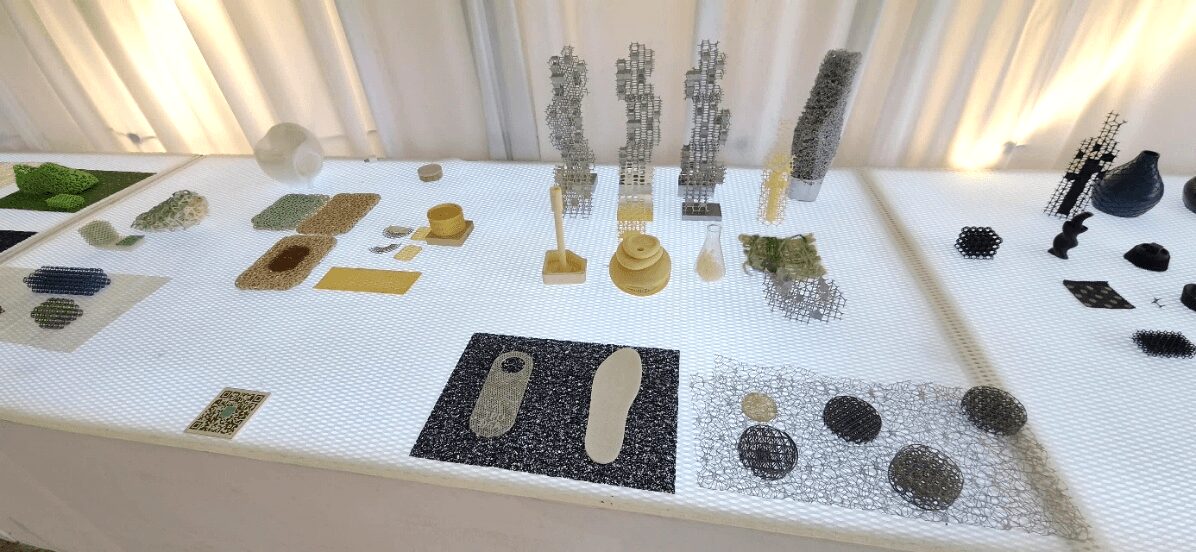
What probably impressed me most during my visit to Yang Design was not one particular color or trend, nor their remarkable library of some 30,000 physical samples. No, it was the way the studio considers material itself: not as just a decorative choice, but as the starting point of an experience.
Every material can be connected to a process, a supplier, a technology, a sensation, a function. A fiber can carry light. A 3D-printed structure can locally adjust its flexibility. A mineral-looking surface can become semi-transparent. A decorative film can progressively reveal information. Even recycled materials can derive their identity from their imperfections instead of attempting to hide them. Experience and light are integrated to expand the traditional scope of CMF.
This approach changes the logic of automotive CMF.

Light penetrates the material itself, so CMF is no mere skin, but integral to the interface. User interface is not confined to a display or control panel – it’s where the hand meets a surface, light reveals depth, or the cabin subtly changes its atmosphere.
This evolution is particularly interesting in China. Yang Design demonstrates how cultural references, natural materials, technology, and the supply chain can be combined to create a contemporary identity outside the established European luxury codes.

Designing tomorrow’s interior experience will require CMF designers, material specialists, lighting experts, electronics engineers, UX designers, and process suppliers to work together much earlier in the development process. It is fascinating to watch how it all evolves and converges!
Enjoy the newsletter,



