
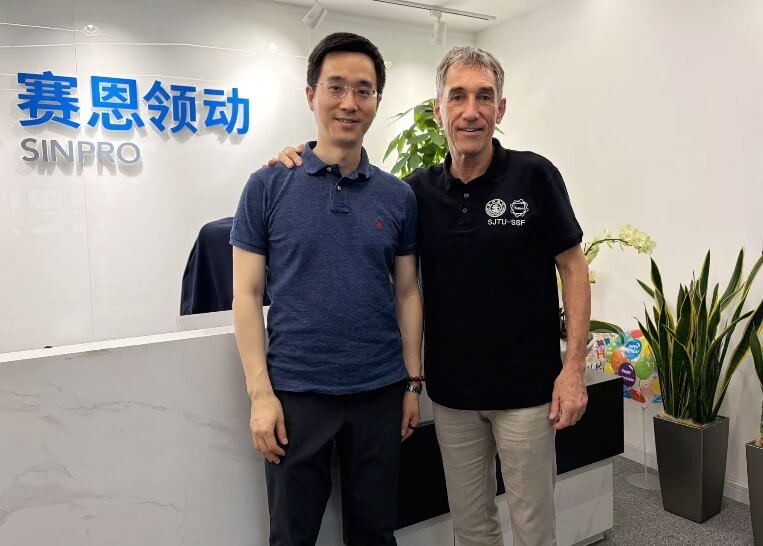
Here we introduce an important hub in the transition state between startup and successful supplier in China: Sinpro Intelligent Technology (Shanghai), in the person of CEO and founder Dr.-Ing. Xuyang Li.
Second Interview: Sinpro, Chinese radar supplier
Interview by DVN’s Dr Jürgen Dickmann
DVN: You have many trophies and awards on your bookshelf. Which are most important?
Dr.-Ing. Xuyang Li: The most important awards are Tech AD first prize and the KPMG recognition as an advanced automotive technology company. Together, they show that Sinpro is not only innovative, but also moving successfully toward industrialization, reliable production, and customer delivery. In the meantime, we have produced more than 500,000 radars in China, for China OEMs. So, our Radars are on Chinese roads.
DVN: Since our last discussion in November 2025, what has changed at Sinpro? Where do you position the company today within the ADAS and AV radar sector?
Dr.-Ing. Xuyang Li: At Sinpro, we focus on radar and, in particular, imaging radar. Our goal is to move from being only a radar sensor supplier toward becoming a system partner for ADAS and automated driving systems, including L2+ navigation pilot functions and L3 use cases. On the hardware side, we deliver the radar sensors that tier-1s and OEMs need. On the software side, we provide the modules required to connect the radar to central ECUs and to deliver the necessary performance, including point cloud and perception outputs, functional safety, diagnostics, and system-level integration. Within radar, we have deliberately chosen the high-performance segment. Instead of staying with traditional 3×4 or 4×4 radars, we focus on 6×8, 8×8, 16×16, and now 24×24 architectures.
DVN: Do you also see a need to go beyond 24×24?
Dr.-Ing. Xuyang Li: Our current development focus is 24×24. Going beyond 24×24 is still under discussion. For the Chinese market, even 24×24 is still expensive for many OEMs today. For global OEMs, however, we already see requirements moving in that direction.
DVN: So your radar portfolio can support both L2 / L2+ and L4 applications?
Dr.-Ing. Xuyang Li: Yes.
DVN: Will you explain the two main application areas you serve today?
Dr.-Ing. Xuyang Li: Today, part of our customer base is focused on L2 and L2+ applications. One of our first customers was Nio. They use our 6×8 radar together with lidar and cameras to build their navigation pilot system, which is an L2+ function. This type of functionality is currently very dominant in the Chinese market.
DVN: In China, do you expect L4 systems to enter the privately owned vehicle market at scale, beyond robotaxis?
Dr.-Ing. Xuyang Li: You mean the consumer market?
DVN: The large OEM consumer market, yes; privately-owned passenger vehicles.
Dr.-Ing. Xuyang Li: That is a good question. Not at the beginning, in my view. Some of our customers are already focused on L4 robotaxi applications. Multiple leading L4 autonomous driving companies in China trust our solutions.We already deliver imaging radars to these robotaxi companies, and they operate L4 vehicles with multiple imaging radars around the car.
DVN: For privately-owned cars, do you expect China to move beyond L2++ toward L3 or even L4?
Dr.-Ing. Xuyang Li: For privately-owned vehicles, I currently see end customers buying L2 and, in some cases, L3 functionality. I do not yet see a real need for L4 in privately-owned cars.
DVN: So the key difference is the customer use case?
Dr.-Ing. Xuyang Li: The main reason is that L4 vehicles are much more expensive than typical L2 or L3 vehicles. They require much more redundancy in the system design. Also, the customer use case is not yet clear. For example, if a private owner could send the car out like a robotaxi to earn money, that would be a different discussion. But today, most end customers are not yet familiar with that robotaxi model.
DVN: Are robotaxi applications still a smaller-volume market compared with your L2+ and L2++ business?
Dr.-Ing. Xuyang Li: In the beginning, yes. Today, our robotaxi customers produce maybe 1,000 to 5,000 vehicles per year. But I believe that by 2028 or 2029, the volumes could increase significantly, potentially to 100,000 or even 500,000 vehicles.
DVN: You mean specifically for robotaxis?
Dr.-Ing. Xuyang Li: Yes, that is the scaling they are planning for. Didi is a good example because they already operate a large ride-hailing fleet. They can gradually switch from manually driven vehicles to robotaxis. If the system recognizes that a route in a defined city area is already familiar to the robotaxi fleet, it can assign a robotaxi. If not, it can still send a vehicle with a driver. This allows a very smooth transition over one or two years. After that, robotaxi scaling could become very fast, reaching 100,000, 200,000, or even 500,000 vehicles in China.
DVN: If L4 is a realistic end point, since hardly anyone is seriously targeting L5, and if 24×24 radar is sufficient for leading Chinese robotaxi companies such as Didi or Pony, does that mean the radar roadmap is almost complete?
Dr.-Ing. Xuyang Li: For current robotaxi scenarios in China, companies are not yet asking for 24×24 radars. Many of them are still discussing 8×8 or 16×16. In general, they are not yet very familiar with high-performance radar. Many engineers in robotaxi companies originally came from L4, or similar environments where lidar was the dominant sensor. As a result, their overall system design is still strongly dependent on lidar today.
This is starting to change because robotaxis also need to operate in bad weather. That is why these companies are now paying more attention to radar. The first step is usually 4×4, then 8×8. But many of them do not yet have a clear understanding of how a 24×24 radar performs, why it would be needed, or which scenarios it can address. That still needs to be studied and demonstrated.
DVN: Robotaxi companies are in a race. Their USP is not only the ODD, but also cost per vehicle. This makes sensor-set optimization a key differentiator. Could high-performance radar help them reduce overall sensor cost and improve the setup compared with lidar-heavy architectures?
Dr.-Ing. Xuyang Li: Yes, you are right. They need to see the sensors and experience the performance difference between 8×8 and 24×24 radar. That is how they will change their view. It was similar with lidar in the beginning, from the early Velodyne systems onward: companies had to drive, collect data, and see the value. We now need to do the same for radar. Today, there are still very few, if any, truly well-performing 24×24 radars available in China.
DVN: Are you waiting for robotaxi companies to change their mindset, or are you actively pushing this discussion by demonstrating what high-performance radar can do?
Dr.-Ing. Xuyang Li: We are actively stimulating this change. We visit our customers, demonstrate our radar performance, and work with the engineering teams of the leading robotaxi companies. I also have strong contacts with their senior management. We have to proceed step by step, but we must be proactive and not simply wait for the market to change by itself.
DVN: In the 4×4, 6×8, and 8×8 radar segments, you face global competitors. What is Sinpro’s unique selling proposition versus the likes of Bosch, Aptiv, or other established suppliers?
Dr.-Ing. Xuyang Li: Two or three years ago, we saw a very strong opportunity. Chinese OEMs needed imaging radar, but they were not yet asking for 16×16 or 24×24. They wanted to move from 4×4 to 6×8 or 8×8. We therefore made a clear decision to develop a 6×8 radar based on the NXP solution, including Barracuda and the R41 radar processor. R41 is a very powerful radar hardware accelerator SoC.
With this platform, we achieved a very high point-cloud performance, around 2,000 points perframe, compared with roughly 500 points for a traditional 4×4 radar. We also achieved around one-degree angular capability, compared with two to three degrees for traditional 4×4 radars. So the performance improvement from 4×4 to 6×8 is roughly three to four times. At that time, we were among the first companies in China able to bring this level of performance toward serial production. Many startups tried to develop 6×8 radars, but most remained at demonstrator level and could not move into production. Global tier-1s did not put much focus on this segment at that time because the volumes were still small. So in 2022 and 2023, this segment was still in an early stage of competition.
DVN: But now the market opportunity has become visible to everyone.
Dr.-Ing. Xuyang Li: Now everyone has recognized the opportunity. Global tier-1s are starting to develop 8×8 products, but their mature products may only arrive on a different timeline. This gives us an important scaling advantage today. Our unique selling point is not only performance, but also timing. A second point is that we understand what is really important for imaging radar. It is not just a point cloud. We also provide advanced perception features, such as extended object tracking with length, width, and height, instead of a traditional single-point radar object. We also support static object detection by clustering radar points and building polygons with quality information that can be provided to the fusion system together with camera data.
This means we do not only provide hardware and point clouds; we also provide advanced perception value. Third, we have built an AI team. Because imaging radar provides a certain point-cloud density, traditional radar algorithms alone have performance limits. We therefore work with neural networks and transformer-based approaches to create more advanced perception, including end-to-end processing from raw data to perception output. We can also explore raw-data fusion of camera and radar. In my view, AI radar is the next major technology trend. A radar company that can combine strong radar expertise with strong AI capability has the potential to become a leading player globally.
DVN: Many AI-driven software stacks, for L2++ and higher automation levels, are moving toward interfaces where raw sensor data is fed directly into the AI stack, with less need for advanced edge processing. Do software companies still value sensor-specific signal processing and perception outputs?
Dr.-Ing. Xuyang Li: For L2+ systems, Chinese OEMs are currently very focused on cost optimization. But as the systems move forward, they will need redundancy. Robotaxi companies are already thinking in this direction. Even if they have a main software stack for robotaxi driving, they still need a fallback system. This fallback system is focused on safety functions, such as emergency braking in critical scenarios. For this, the system needs clear and robust decision-making. I believe this requires traditional classifiers and traditional algorithms, not only for vision but also for radar. It is a low-level, bottom-up safety layer.
DVN: Is this already state of the art among robotaxi companies? And is Sinpro prepared for this fallback-system architecture?
Dr.-Ing. Xuyang Li: Yes. I know several robotaxi companies that already have additional fallback systems today. And for these fallback systems, traditional radar signal processing is still needed.
DVN: For L2+ and L2++ passenger car programs, which are the high-volume business for you, do you see the same architecture? Or will these customers mainly use raw radar data for end-to-end processing?
Dr.-Ing. Xuyang Li: If we look at the current state, whether for L2 or L4, OEMs today still mainly use traditional radar software. Most of them use the perception outputs we provide. Some are starting to use point clouds and fuse them with camera systems.
DVN: Chinese L2++ programs still use traditional radar outputs, such as object-level or perception-level outputs?
Dr.-Ing. Xuyang Li: For radar, yes, currently, but these systems were developed over the last year. The next step is moving toward end-to-end architectures. The first step will be to feed point clouds into the system and fuse them with camera data. True end-to-end processing, where ADC data is used for very low-level fusion, is more likely a future step, maybe two years from now.
DVN: Since 2024, we have seen trade-war tensions, export-control concerns, and stronger local-for-local requirements. At the same time, global OEMs are building major R&D and engineering capabilities in China. Is this an advantage for Sinpro? How do you see this market situation?
Dr.-Ing. Xuyang Li: I see this as a major opportunity for Chinese local tier-1s. Because of local-for-local strategies, even global OEMs in China increasingly want to find strong cooperation partners among local suppliers. At the same time, cooperation between startups and gobal premium OEM is not easy because these OEMs are naturally conservative in their decision-making. But for imaging radar, we may have a good opportunity because there are not many large local tier-1s that can deliver production-ready, high-performance imaging radars. Local teams often have advantages in service response efficiency due to geographical proximity and local market focus. Chinese OEMs have been dissatisfied with this for several years.
DVN: So Sinpro, as a Chinese radar provider, can offer Chinese OEMs and joint ventures the local development speed they need, then?
Dr.-Ing. Xuyang Li: Exactly. This is why many Chinese OEMs are looking for cooperation with local Chinese tier-1s. For vehicles exported to Europe or North America, cooperation with global tier-1s may still be needed. But for the Chinese market, and especially for joint ventures such as Toyota or BMW in China, there is a strong need for local tier-1s and local system providers to increase ADAS development speed. In China, the overall speed of ADAS technology development is veryfast, and even top management from global OEMs has recognized that.
DVN: The Chinese market is clearly large enough to keep Sinpro busy. Nevertheless, do you also plan to expand into Europe or the United States?
Dr.-Ing. Xuyang Li: Yes, of course. International expansion is a logical next step, but it will not be easy. The Chinese market is very competitive, especially on price. First, Sinpro needs to build several strong cooperations with Chinese OEMs and achieve a basic level of scale. Second, we need cooperation with joint ventures to reach even higher standards in hardware design, system design, and processes. Once those fundamentals are in place, the third step is to expand internationally through cooperation with global tier-1s.
DVN: In context of trade wars and local-content requirements, how can Sinpro make itself attractive and lower the perceived risk for customers outside China?
Dr.-Ing. Xuyang Li: There are two main solutions. The first is cooperation with global tier-1s. We have already had deep discussions with several global tier-1s about potential cooperation. However, this is also difficult because within global tier-1 companies there are often different internal views.
That can make the process slow. The second step is to establish a local presence, for example with an office in Stuttgart, to support local OEMs. The platform development can remain in Shanghai, while technical sales and engineering support can be located in Germany.
DVN: But export restrictions and compliance assessments often depend on where a regulated item was developed; if the core development remains in Shanghai, it is still considered Chinese technology. How could you make such products exportable and acceptable outside China?
Dr.-Ing. Xuyang Li: Another solution is to start certain developments outside Shanghai from the beginning. We are evaluating a global R&D footprint to better serve local customer needs and comply with regional regulatory requirements.
DVN: That would require a significant international setup.
Dr.-Ing. Xuyang Li: Yes. You have to plan this before the project starts, maybe two or three years in advance. Manufacturing also has to be considered. For some markets, localized supply chain and production capabilities may be required. This is something that can be solved, but it has to be planned.
DVN: China’s advantages include strong engineering capacity, speed, and a highly competitive supplier base. Some observers say safety, FMEA, and validation requirements are less strict in China than in Europe or the United States. Would meeting stricter legal and OEM requirements abroad affect your cost and speed advantage?
Dr.-Ing. Xuyang Li: First of all, Sinpro’s core team comes from global tier-1 backgrounds. Our first product, SFR 2K, was already designed according to very high standards. Our first customer, Nio, also had very high requirements for hardware design, functional safety, validation testing, and FMEA. Nio is well known for high vehicle quality compared. This was good for us because it forced our team to develop according to a high standard from the beginning. Sinpro is therefore not a startup unfamiliar with global OEM requirements. Of course, there are still differences between Chinese OEM standards and the highest standards of companies such as Mercedes or GM. We are currently discussing an international top-tier OEM, so we are actively working on briding these differences.
It has very strict standards, for example regarding EMC. I believe we can close these remaining gaps within the next two years and reach the highest standard in the automotive market. The key question is then: if we fulfill these standards, what cost advantage remains? In my view, the standard itself is not the main issue. Higher standards do increase cost, but not by 20 or 30 per cent; maybe closer to 10 per cent. The real advantage of Chinese local tier-1s is speed and efficiency across the entire development chain, from partners to customers. Even while fulfilling high standards, we can reduce development time significantly, potentially to around one and a half years. That reduces R&D cost. In addition, the local supply chain for mechanical parts, electronic parts, PCBs, and manufacturing lines is very strong in China. In almost every field, you can find high-quality suppliers that are also cost-effective. This supply chain enables faster development, lower R&D cost, and competitive product cost.
This is a clear trend.
DVN: Companies such as BYD are discussing streaming radar, where low-level radar data is sent into a modern E/E architecture with central processing. I understood that many interfaces today are still object-level or point-cloud based. Is streaming radar the next step in China, and how quickly do you expect this shift to happen?
Dr.-Ing. Xuyang Li: There is a clear trend toward streaming radar among some Chinese OEMs.
Probably within the next few months, we will see streaming radar included in more new development projects. However, broad adoption as a standard architecture may still take two to five years, depending on cost, computing power, and E/E architecture. It is becoming part of new projects. I think most new projects are now targeting streaming radar.
We have also been developing streaming radar for about two years. We have built competence in the hardware, in streaming ADC data, and in processing ADC data in central ECUs. These central ECUs can be based on NVIDIA platforms and etc. We have already completed algorithms for radar signal processing on several central ECU platforms. This is valuable because the data is available in the central ECU and can be fused directly with camera data. Some OEMs still want to do the signal processing themselves, and they are trying to do that. But radar is different from camera data.
Radar data is not easy to process. Therefore, I believe that even with streaming radar, OEMs will still need tier-1s to perform the radar signal processing for them. This includes point-cloud processing and perception in the central ECU. We will therefore deliver SDKs that run on the central ECU. In that sense, the role of the tier-1 does not disappear; it shifts from processing inside the radar sensor to providing radar-processing software and SDKs for the central ECU. The radar sensor itself becomes cheaper, and the interface may change from Ethernet to a serializer. But there are also challenges. Many people assume that central ECUs have enough computing power, but in practice the computing power available for radar processing is limited. If the allocated computing power is too low, radar performance has to be reduced. Dedicated radar hardware accelerators, such as those used in radar SoCs, are still more efficient for certain tasks. For this reason, edge radar will continue to have a market, especially in lower-level systems that need a radar to deliver point-cloud or object outputs for fusion with cameras.
DVN: About three years ago there was strong enthusiasm in the radar community around streaming radar. Today, some OEMs say the benefits are less clear than expected when looking at the full development chain. Do you see streaming radar as temporarily slowed down before it becomes a standard? Or will the market continue to use a mix of streaming radar, point-cloud interfaces, and object-level radar outputs depending on the OEM and application?
Dr.-Ing. Xuyang Li: I still see streaming radar as a trend, but the timing may be two years or five years depending on cost and architecture. Streaming radar requires serializers, high-speed links, and additional cable cost. The benefit is that the radar SoC can be removed from the sensor, which reduces sensor cost. The final decision depends on whether the added cost for serializer, cable, and central ECU computing power is lower than the cost of keeping the SoC in the radar. If that balance is positive, streaming radar will become a major trend. At the same time, fallback systems still need standalone radar functionality. For those radars, an edge processor is needed because the algorithms and decisions must be calculated locally. Therefore, I believe streaming radar and edge radar will coexist in the future.
DVN: Removing lidar is not only about the sensor price; it also affects packaging, infrastructure, design, and system complexity. If central processing can handle low-level data from different sensors and radar modes with separate algorithmic paths, this could support statistically independent inputs into a safety-relevant perception system. If radar can provide the required data density and quality, do you see a real opportunity for radar and software-stack providers such as Pony to reduce or eliminate lidar?
Dr.-Ing. Xuyang Li: I think the trend is there. lidar created significant value, including emotional value for end users, and OEMs used it as a marketing feature during the last three years. Today, however, both OEMs and end users better understand what lidar can do, but also its cost and its limitations. The market is moving toward a more balanced evaluation of sensor configurations. Lidar companies have done a very good job reducing cost, but bad weather remains an important topic. Cameras and lidar alone cannot solve all bad-weather scenarios. I strongly agree with the idea of having a standalone radar-based system in addition to the camera system. For the front area, multiple sensors may still be needed, potentially including lidar, because critical obstacles must be detected very reliably. Around the vehicle, however, radar is low-cost and can provide 360-degree coverage. You can fuse radars together to create a standalone radar functionality and combine that with a standalone camera functionality.
These two systems provide redundancy, which I consider more reasonable. Some OEMs in China are following a vision-only strategy, similar to Tesla. I believe that multi-sensor fusion is a more robust path for L4 and higher-level systems under current technical conditions.. For us, radar will therefore play a larger role in future L3 and L4 systems. Next month, we will announce a next-generation L3 system that will be equipped with many of our radars.
Those OEMs believe that if they want to deliver a strong L3 function, they have to use radar very carefully and use more radars. In some ways, how they use radar becomes even more important than how they use cameras, because camera algorithms are becoming less differentiated between OEMs.
DVN: Where do you see Sinpro in five years?
Dr.-Ing. Xuyang Li: We started as an imaging radar company, and that will remain an important part of our business. But we do not want to stay only in automotive. Radar can be applied in many different areas, including robotics and industrial applications. In parallel, we are also considering what second sensor technology we may develop to enter new markets, because a company needs multiple products to survive and grow. Internally, we have discussed this a lot. Sinpro aims to be a technology-driven company. We maintain tier-1 competence and manufacturing capability, while focusing on technological collaboration and strategic partnerships rather than building a fully self-contained global manufacturing footprint. Instead, we want to work through cooperation and focus on technology: hardware design, software design, AI, data streaming, radar performance, different sensors, services, and functions.
DVN: So you do not see Sinpro as a huge global tier-1, but rather as a strong tier-1 in China and a technology company internationally?
Dr.-Ing. Xuyang Li: We will be a tier-1, but we do not want to become a huge tier-1. That is why we are very open to cooperation with other huge tier-1s.
DVN: Xuyang, thank you very much for this fascinating interview with insides in your impressive development and your future plans! I hope we will see you and your colleagues at our DVN Conference on 17 – 18 November and continue the discussion.
Disclaimer
The content of this interview is for industry communication and reference purposes only, and does not constitute any guarantee, promise, or confirmation regarding any technical performance, business cooperation, production data, or future business plans. For specific products and business cooperation information, please refer to the company’s official disclosures.